
What Happened to Miami's Jewish Deli Row
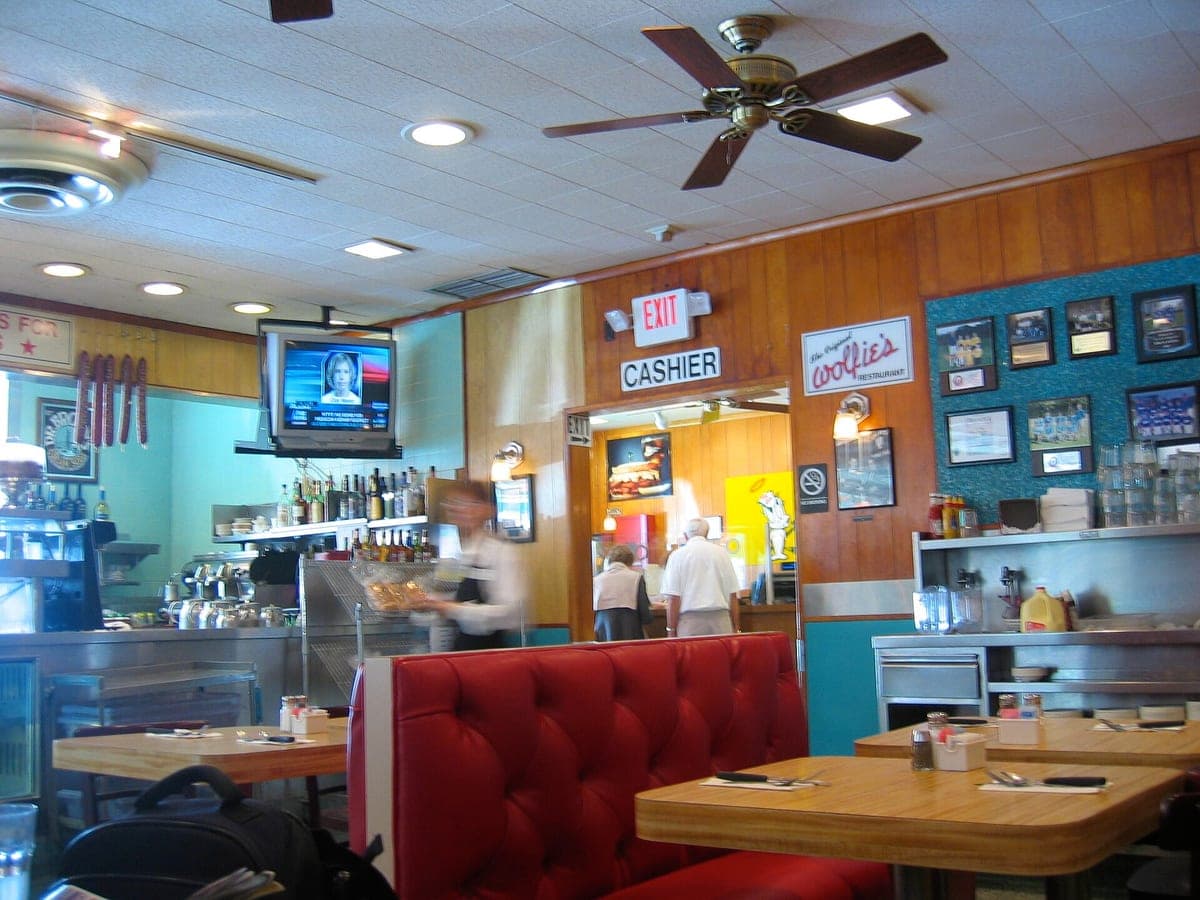
Wolfie Cohen's Rascal House served its last plate of stuffed cabbage on March 30, 2008, after fifty four years at the corner of 172nd Street and Collins Avenue in Sunny Isles Beach. There was no dramatic announcement, no farewell tour, just a closed sign on a building that had spent half a century handing out free rye bread and half sour pickles to a clientele that arrived by the busload from New York, then slowly, quietly, stopped arriving at all. If you want to understand what happened to an entire chapter of American Jewish life, the story of Miami's deli row is as clear an answer as you'll find, and almost nobody outside Florida knows it happened.
The Migration That Built It
Miami Beach's Jewish deli boom didn't happen by accident, and it didn't happen early. Through the first half of the twentieth century, much of Miami Beach actively restricted Jewish visitors, with some hotels posting signs reading "No Jews, No Dogs." That began breaking down after World War II, when Jewish veterans who had trained at bases across South Florida returned as civilians and liked what they'd seen: warm winters, cheap land, a beach. Behind them came a much larger wave, mostly from New York and the Northeast, as Jewish retirees and snowbirds discovered that a Miami Beach condo cost a fraction of staying in Brooklyn through another winter.
By the 1950s and 1960s, Miami Beach had become something close to a satellite of the Lower East Side and Brooklyn, transplanted onto sand. And a satellite of that scale needed the same institutions the old neighborhood ran on. Delis followed the population the way delis always have, not because someone planned it, but because homesick New Yorkers wanted a decent piece of brisket and a bowl of matzah ball soup that tasted like their mother's.
Wolfie's, Pumpernik's, and the Rascal House
Wilfred "Wolfie" Cohen opened his first restaurant, simply called Wolfie's, at the corner of Lincoln Road and Collins Avenue in the 1940s, with a second location a few blocks north at 21st Street. The food was straightforward deli fare, but the real draw was volume and personality: towering sandwiches, bottomless bread baskets, and a running gag on the menu boasting that "the only thing that needs to come dressed is our chickens." Cohen expanded from there, opening Pumpernik's at 67th Street, and then in 1954, the crown jewel, Wolfie Cohen's Rascal House, further north in Sunny Isles Beach.
The Rascal House became the template for the whole genre: a boisterous, brightly lit room that could seat hundreds, waitresses who called every customer "hon," and those stainless steel buckets of pickles and coleslaw dropped on the table before anyone had ordered a thing. It was loud, it was fast, and it never once tried to be elegant. That was the point. A deli like the Rascal House was built to feel like an extension of somebody's kitchen, not a restaurant you dressed up for. At its peak, it was turning tables from breakfast through the small hours of the morning, a required stop for entertainers playing the Beach's hotel showrooms and for anyone else who wanted proof that Jewish Miami had arrived.
The Room Where Everybody Ended Up
Part of what made the Rascal House more than just a good sandwich was who else was in the room. Frank Sinatra dropped in after his shows at Miami Beach hotels. Jackie Gleason, who filmed his variety show from Miami Beach for years and became so associated with the city that a local theater still bears his name, was a regular, as were Jack Benny and Milton Berle. The comedian Jackie Mason worked the Rascal House into his own stand up routines while he was playing the hotel showrooms next door, which tells you how thoroughly the deli had become part of the area's cultural furniture rather than just a place to eat before or after the show. Even Meyer Lansky, the mob financier who spent much of his later life in Miami Beach, was a known regular, a reminder that deli row welcomed everybody who showed up hungry, glamorous or not, legitimate or not. The restaurant's glowing sign was famous enough in its own right to open the music video for the Bee Gees' "Night Fever," a strange and fitting bit of proof that a Jewish deli in Sunny Isles Beach had, for a few decades, become a genuine American pop culture landmark rather than just a neighborhood favorite.
Why It Emptied Out
The forces that built Miami's deli row eventually dismantled it, and they were almost exactly the forces you'd guess. The generation that moved to Miami Beach after World War II aged, and by the 1990s and 2000s, that generation was passing away in large numbers. Their children, meanwhile, had mostly grown up somewhere else, in the suburbs those same grandparents had helped populate up north, and many of them had no particular pull toward a Sunny Isles Beach institution their grandparents loved. A newer generation of Jewish retirees kept moving to Florida, but they increasingly skipped Miami Beach itself for Boca Raton, Fort Lauderdale, and other communities further north, chasing newer housing stock and different amenities. Miami Beach's Jewish population didn't vanish. It redistributed, and deli row didn't follow it.
At the same time, Miami Beach itself was transforming into something with almost no connection to the deli crowd's tastes. South Beach's Art Deco district, once run down enough that developers considered bulldozing it in the 1970s and 80s, was rediscovered, restored, and rebranded into an international nightlife and fashion destination through the 1990s. The neighborhood that had quietly sheltered Jewish retirees was suddenly hosting European fashion shoots and velvet rope clubs. Real estate values climbed accordingly, rents for old fashioned, low margin restaurants climbed with them, and a restaurant built around a two dollar bowl of soup and unlimited free bread stopped making financial sense on some of the most expensive oceanfront land in the country.
Wolfie's original Lincoln Road location closed in the 1980s. Pumpernik's followed. The Rascal House held on longest, propped up by loyalty and its status as a genuine landmark, before closing in 2008. Within a few years the building itself was demolished, and today a bank branch and a strip of retail sit where the 400 seat dining room and its 60 foot counter once ran nonstop from breakfast through the small hours.
None of this happened overnight, and none of it happened out of malice or neglect. It's simply what happens to any institution built for a specific generation's habits once that generation moves on. The same math that filled the Rascal House in 1965, cheap real estate plus a concentrated population that wanted a taste of home, worked in reverse forty years later, when the real estate stopped being cheap and the population stopped being concentrated.
What's Left, and What Replaced It
Miami's Jewish deli culture didn't disappear entirely, it just changed shape and shrunk considerably. A handful of newer, smaller operations have tried to carry pieces of the tradition forward, among them Bagel Cove in Aventura, operating on a fraction of the old scale, serving a Jewish community that is smaller, more scattered, and considerably younger in its tastes than the one that filled the Rascal House on a Sunday morning. Zak the Baker, a kosher certified artisan bakery and restaurant that opened in Wynwood in 2013, represents almost the opposite model: slow fermented sourdough and a farm to table sensibility aimed at a younger, design conscious crowd, proof that Jewish food culture in Miami survived by adapting rather than by staying the same.
What's genuinely gone is the scale and the specific social function the old delis served: a place where an entire displaced community, thousands of miles from where it had built its life, could sit down together at three in the morning and feel completely at home. That kind of institution isn't really about the menu. It's about density, a critical mass of people who all grew up eating the same food in the same borough and now needed somewhere to eat it together in a new one. Once that density thinned out, no amount of good pastrami could bring the room back.
Kosher Couture's own reason for existing runs on a similar instinct: dress up Jewish pride, put it somewhere visible, and refuse to let it fade quietly into background noise the way an entire deli row eventually did.
A Familiar Story, Told in Pickles
Miami's deli row is, in miniature, the story of American Jewish geography over the last seventy five years: a community moves toward warmth and opportunity, builds an entire infrastructure of institutions to make the new place feel like home, ages in place, and then watches its children scatter to yet another set of suburbs the grandparents never anticipated. It happened on the Lower East Side. It happened on Maxwell Street in Chicago. It happened, on a smaller and sunnier scale, on Collins Avenue.
Miami's version is worth remembering because the story keeps repeating, not because a free pickle bucket makes for satisfying nostalgia. Each time a deli row empties out, it takes with it a very specific, very local flavor of American Jewish life that nobody thought to record while it was still ordinary. Kosher Couture exists partly to keep those flavors from disappearing entirely, one story, one T-shirt, one half sour pickle at a time. If Miami Beach's deli scene taught its regulars anything, it's that the things you assume will always be there rarely are, so it's worth writing them down while somebody still remembers exactly how they tasted.
For more on how Jewish communities have reshaped American neighborhoods, read our piece on Miami Beach's Art Deco history, and for the Chicago version of the same story, see our walk through Maxwell Street's lost Jewish market.
Cover image: Jeremy, Wikimedia Commons (CC BY 2.0)


