
Walking Maxwell Street, Chicago's Lost Jewish Market
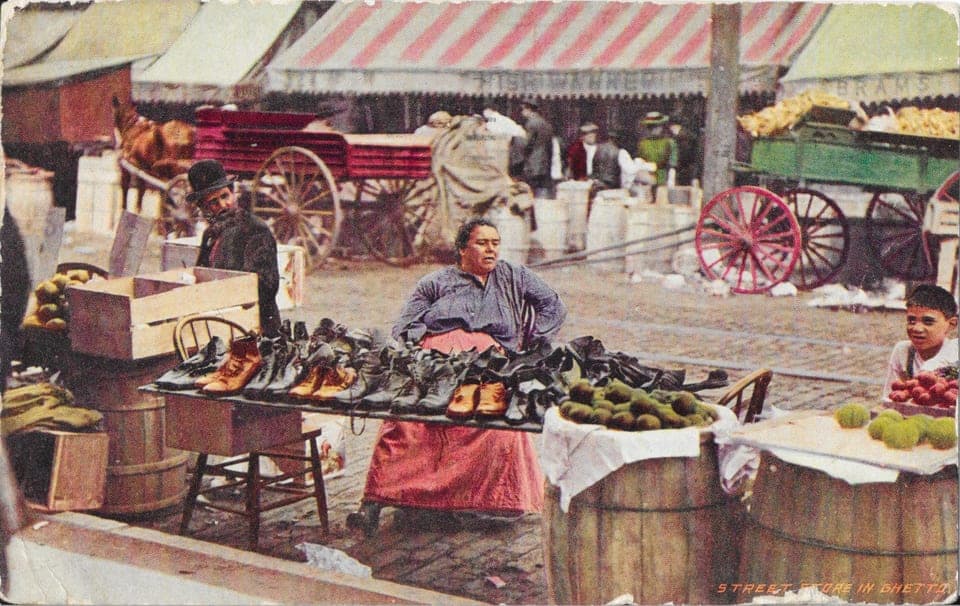
Sunday morning, before most of Chicago is awake, and Halsted Street is already a wall of noise. Wagon wheels clatter over cobblestones. A woman in a shawl is shouting the price of a herring in Yiddish over the head of a man haggling for a pair of boots. Somewhere behind a stack of orange crates, a fiddler is tuning up, hoping the crowd throws a few coins his way before the police make him move along. This is Maxwell Street, sometime around 1910, and if you wanted to understand Jewish Chicago, this nine-block tangle of pushcarts on the Near West Side was the place to start.
Walk it with us. The Maxwell Street Market's Jewish history isn't a museum plaque; it's a route you can still trace on a map, corner by corner, even though almost none of the old buildings are left standing.
Stepping Off the Train Near Halsted
The story starts, as so many American Jewish stories do, at the docks and the depots. Beginning around 1880, Eastern European Jews fleeing pogroms and poverty in the Russian Empire, Poland, and Romania got off the train in Chicago and kept walking until the rent got cheap. That put them on the Near West Side, in the blocks around Maxwell and Halsted Streets, a short walk from the freight yards, the stockyards, and the garment lofts where a newcomer with no English could still find piecework.
By the market's peak, roughly 50,000 Jews, nearly all of them from Eastern Europe, lived in the several square blocks around Maxwell Street. Peddling was the fastest way in: no license required for a pushcart in the early years, no capital beyond a crate and a scale. Sunday, the one day devout Jews wouldn't lose to the Christian Sunday-closing laws that shut down downtown commerce anyway, became market day almost by accident. An unofficial peddlers' bazaar had been running since the 1880s before the City of Chicago finally recognized it as an official public market in October 1912.
The Jefferson Street Pushcarts
The earliest version of the market didn't even start on Maxwell Street proper. It began a block over on Jefferson Street, where Polish and Russian Jewish immigrants set up barrels of produce, secondhand clothes, shoes, and housewares, then simply spread outward until Jefferson and Maxwell merged into one continuous open-air bazaar. Before 1920, this scrappy strip of pushcarts was, by some estimates, the third-largest grossing retail district in the entire city, bigger than that sounds for a market built on penny profit margins and a folding table.
Between the stalls sat the neighborhood's actual infrastructure: kosher butcher shops with chickens hanging in the window, matzah bakeries running at full tilt before Pesach, tailor and seamstress shops, and the sweatshops where the same immigrants who peddled by day sewed piecework by lamplight. More than forty synagogues eventually served the neighborhood, along with the Chicago Hebrew Institute and a scatter of Hebrew schools and Yiddish theaters: this was a fully built Jewish world, not a strip of stalls. Contemporaries called it "the Ellis Island of the Midwest," and it earned the name: for tens of thousands of families, Maxwell Street was literally the first American address.
That instinct, building something out of nothing on your own terms because nobody was going to hand it to you, is the same one we try to bottle at Kosher Couture. Chutzpah is in our DNA, and it didn't start with us.
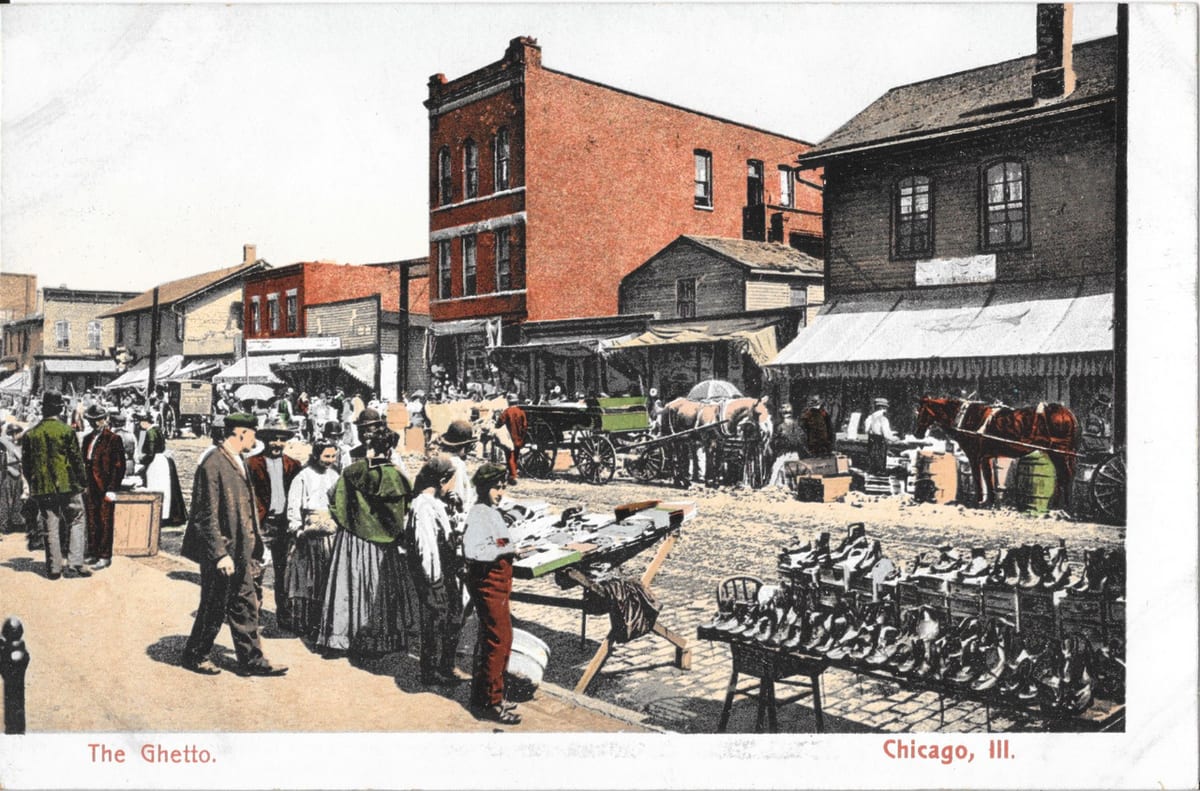 Photo: Wikimedia Commons (Public domain)
Halsted and Maxwell: The Corner of Everything
Stand at Halsted and Maxwell on a Sunday in the market's heyday and you'd have to shout to be heard. Peddlers hawked live poultry, secondhand suits, cut-rate tools, fresh bagels, and, depending on who'd fallen off a truck that week, the occasional item nobody asked too many questions about. "They'll sell you anything from a match to an elephant" was a common line about Maxwell Street, and it wasn't much of an exaggeration. Bargaining wasn't optional; it was the whole point. A price tag on Maxwell Street was less a fact than an opening bid.
The neighborhood earned its rougher reputation honestly. A 1906 Chicago Tribune piece called it "the crime center of the country," and locals nicknamed the surrounding blocks "Bloody Maxwell." The Maxwell Street Police Station, opened in 1888 at Maxwell and Morgan, existed largely to keep pace with pickpockets working the crowd and fences moving merchandise nobody asked too many questions about. None of it stopped the market from growing. If anything, the chaos was part of the draw.
On a single Sunday walk down Maxwell, a shopper might pass:
- Kosher butchers with chickens hanging by their feet, sold live if you wanted proof
- Barrels of pickles and herring straight off the wagon
- Secondhand suits and dresses, pressed and re-sold within hours of being donated
- Cobblers and tinsmiths repairing shoes and pots on the spot
- Peddlers of tools, hardware, and the odd item that had clearly fallen off a truck
- A fiddler or a cantor's voice, drifting out from a doorway or a pushcart corner
The neighborhood was never Jewish alone, and that's worth saying plainly rather than flattening it into one story. Irish, German, Bohemian, Italian, Greek, and Mexican immigrant families lived and sold alongside the Jewish majority from the start, and as the Great Migration brought African American families north from the 1910s onward, Black-owned stalls and storefronts became a defining part of Maxwell Street too. Just a few blocks north stood Hull House, Jane Addams's settlement house, where immigrant families of every background came for English classes, childcare, and a hot meal regardless of what language they'd arrived speaking. What made the market remarkable was less any single group's ownership of it than the fact that so many groups had to figure out, block by block, how to share it.
Barney Ross's Father's Grocery
Some of Maxwell Street's real history is quieter and harder than the postcard version. Isidore Rosofsky, a rabbi and Talmudic scholar who had survived a pogrom in Brest-Litovsk, ran a small grocery on Maxwell Street to support his family. His son Beryl, who would become world champion boxer Barney Ross, grew up in those same crowded blocks. When Isidore was shot and killed resisting a robbery at his shop, fourteen-year-old Barney's family fell apart within it: his mother suffered a breakdown, his younger siblings went to an orphanage, and Barney went on to become one of the era's most famous Jewish athletes, a lightweight and welterweight champion nicknamed "the Pride of the Ghetto." It's a reminder that Maxwell Street's chutzpah wasn't a costume. For a lot of families, it was survival dressed up as ambition.
The Sound of the Street
Keep walking and the market's soundtrack shifts. By the 1930s and '40s, as Black families moved into and through the neighborhood during the Great Migration, Maxwell Street had become an open stage for blues musicians who needed to be heard over pushcart chatter and horse traffic. Guitarists and harmonica players plugged into extension cords borrowed from Jewish merchants' storefronts, went electric to cut through the noise, and helped invent what the world now calls Chicago blues, the sound Muddy Waters carried out of the market and into the clubs, and that would eventually reshape rock and roll. Maxwell Street didn't just sell secondhand coats; it helped invent an American sound, right there on the sidewalk.
Self-Made on Maxwell Street
Follow the market's edge and you'll find the names that turned a pushcart into an institution. Benny Goodman, the future "King of Swing," grew up near this neighborhood and got his start playing in its bands before he ever saw a concert hall. Jacob Arvey, son of Russian Jewish immigrants, worked his way up from Chicago's Jewish West Side to become alderman of the 24th Ward and one of the most powerful Democratic power brokers in the city's history. And a generation later, teenage Ron Popeil stood on a Pepsi crate at Maxwell Street at 5 a.m., slicing vegetables to demonstrate his father's kitchen gadgets, grossing as much as $500 a day before he'd even graduated to a real storefront: the flea-market pitch that eventually built an infomercial empire.
None of them started with capital. All of them started with nerve. It's the same spirit behind our name at Kosher Couture: heritage worn with a wink, pride that doesn't apologize for taking up space.
Deli Counters and Delicatessens
No tour of Jewish Maxwell Street is complete without the food, and some of it outlived the market itself. Nate Duncan spent more than twenty-five years working the counter at Lyon's Delicatessen on Maxwell Street before buying the business from Ben Lyon in 1973, and ran it as Nate's Deli for two more decades, still serving the neighborhood's kosher-style standards. His building at 807 W. Maxwell Street, with its hand-painted sign, was finally demolished in 1995 after Nate sold the property to the University of Illinois. A few blocks away, Jack Raskin, whose family had run the Purity delicatessen at Van Buren and Halsted since 1942, opened his own shop on Roosevelt Road near Maxwell Street after the war. That restaurant became Manny's Delicatessen: still open today on Jefferson Street, still slicing corned beef, still standing as the neighborhood's last direct link to the old market.
Leaving Maxwell Street
By the 1920s, the crowding that had made Maxwell Street a real community was also making it a place families wanted to leave the moment they could afford to. The bulk of Chicago's Jewish population moved west into North Lawndale, which by 1930 held an estimated 110,000 Jews and briefly became the largest and most institutionally dense Jewish neighborhood in the city's history: synagogues, Jewish hospitals, and Yiddish-speaking social clubs all relocated with the population.
That wave, too, was temporary. Jewish families began leaving Lawndale after World War II, and by the mid-1950s most were gone, resettled north into Albany Park, Rogers Park, and, as the postwar suburbs opened up, Skokie, Lincolnwood, and the North Shore towns beyond. Three generations, three neighborhoods: Maxwell Street to Lawndale to Skokie is, in miniature, the whole arc of American Jewish upward mobility in one Midwestern city. Each move traded density for space and struggle for stability, and each one carried a little less of the old market with it — fewer pushcarts, fewer Yiddish signs, more storefronts changing hands to the next community arriving behind them.
The Market's Last Stand
Maxwell Street itself never really recovered from those departures. The Dan Ryan Expressway sliced through the area in 1957, and by the 1980s the University of Illinois at Chicago was quietly buying up buildings on the neighborhood's edges. In 1994, the city relocated what remained of the historic market a few blocks east to Canal Street to make way for UIC's campus expansion, and in 1996 the state legislature gave the university broad power to develop the old market footprint without further local approval. The blocks that had once held the Ellis Island of the Midwest became athletic fields, parking lots, and university housing. The market itself survived in diminished form, drifting from Canal Street to Desplaines Street and settling, since 2008, at Roosevelt Road and South Des Plaines Avenue — present, but a shadow of the original nine square blocks.
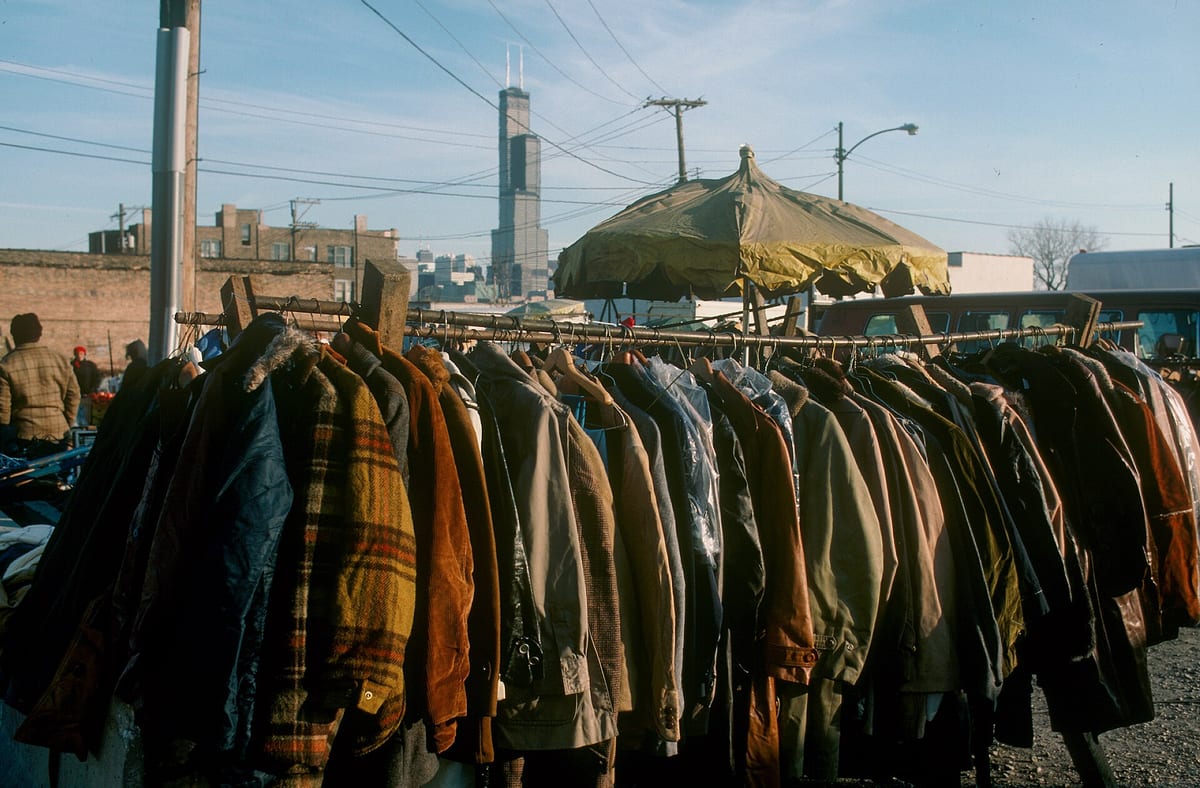 Photo: JDWassmann, Wikimedia Commons (CC BY-SA 4.0)
The Corner That's Still There
Almost nothing physical remains where the pushcarts stood — a few storefronts, a historical marker, the ghost of a street grid absorbed into a college campus. But walk the memory of Maxwell Street the way we've just walked the map of it, and the throughline is obvious: a market built by people with nothing, who turned proximity to a rail yard and a cheap block of rent into forty synagogues, a boxing champion, a swing bandleader, a political machine, an infomercial empire, and a genre of American music, all inside about seventy years.
At Kosher Couture, that's the story we keep coming back to — not nostalgia for its own sake, but the plain fact that Jewish pride in America has always looked like people building something loud, useful, and unmistakably their own out of whatever they were handed. Maxwell Street sold everything from a match to an elephant. What it was really selling, block after block, was the proof that you could arrive with nothing and still make noise.


