
How Miami Beach Became America's Most Photographed Skyline
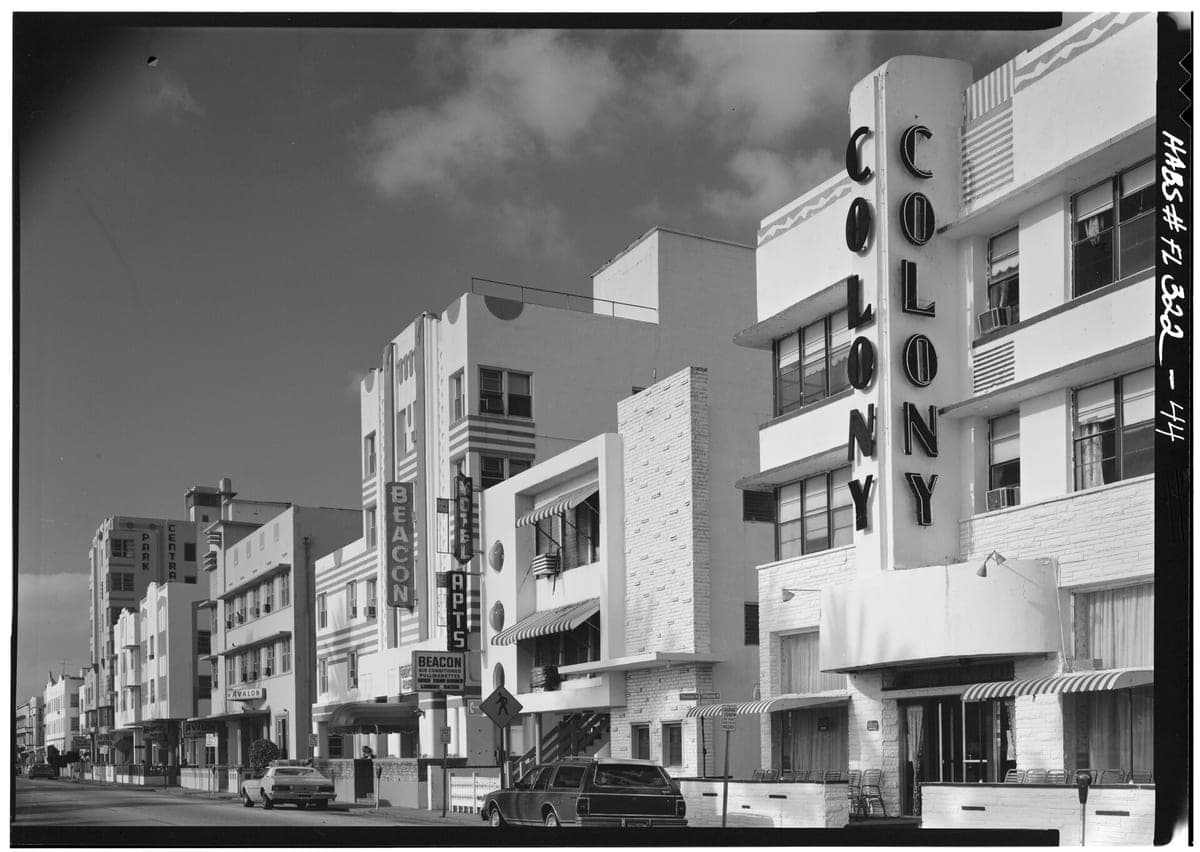
In the 1970s, the pastel hotels lining Ocean Drive in Miami Beach weren't a fashion backdrop. They were faded, run-down, and full of elderly Jewish retirees, many of them Holocaust survivors, sitting on porches in the Florida heat because South Beach had become, in practice, one of the largest naturally-occurring retirement communities in the country. Nobody was photographing the architecture. Developers wanted to tear most of it down.
Fifty years later, that same stretch of low-rise Art Deco buildings is one of the most photographed urban landscapes in America, a fixture of fashion shoots, postcards, and every "top skylines" list a travel magazine can produce. Tourists who visit today mostly assume the pastel hotels were always treated as treasures, protected and adored since the day they went up. The distance between that assumption and what actually happened is a genuinely wild story, and almost none of it occurs without a specific set of Jewish Miami Beach residents who refused to let their neighborhood get bulldozed.
A city built, in large part, by Jewish developers
Start with who put the buildings there in the first place. Miami Beach's Art Deco boom of the 1930s and '40s, small hotels built cheap and fast for a mass tourist market, was designed, financed, and operated in enormous part by Jewish developers and architects. This wasn't incidental. Miami Beach had spent earlier decades restricting Jewish ownership and even Jewish guests at many of its hotels; the Art Deco district, built further south and largely by Jewish money, was in part a response to that exclusion, an entire alternative tourist economy that Jewish Miami built for itself because the existing one wouldn't have them.
That history gets lost in the pastel photographs. The buildings look purely decorative now, all curved corners and neon trim. But the district exists, in its original form, because a specific community was locked out of one part of the city and built something better a few blocks away.
What "no Jews" actually meant on this stretch of coast
It's worth being specific about the exclusion, because it's easy to let a phrase like "restricted hotels" slide past without registering what it meant in practice. Well into the twentieth century, large stretches of Miami Beach's grander hotels, particularly further north along the barrier island, operated with explicit or thinly-coded policies against Jewish guests, echoing the same restrictive-covenant culture that kept Jewish families out of entire neighborhoods and country clubs across much of mid-century America. The message, in effect, was that Jewish tourists and Jewish money were welcome to help build Florida's tourism economy, just not inside the hotels that considered themselves the most desirable address on the beach.
The Art Deco district south of that line became, in part, the answer: cheaper land, fewer entrenched social gatekeepers, and Jewish developers willing to build their own hotels rather than wait for an invitation into someone else's. That's the uncomfortable, specific context behind the architecture's arrival, not a footnote to the design history but one of its actual causes.
Then: a neighborhood of grandparents
By the time those hotels aged into the 1960s and '70s, the district had shifted again, this time into affordable, small-unit housing for a huge population of aging Jewish residents, a large number of them European-born Holocaust survivors who'd rebuilt entire lives in America and then retired to the one place warm enough to make winter bearable on a fixed income. Photographers who documented the era captured a specific, poignant texture: elderly residents playing cards on porches, walking to synagogues that had once been hotel ballrooms, gathering on public benches in a kind of open-air community living room that spanned entire blocks.
It's worth being direct about what that period actually was, because the popular memory of Art Deco Miami tends to erase it entirely: this was not a glamorous era for South Beach. The hotels were cheap because they were deteriorating. The neighborhood's own name for itself, at the time, doubled as a joke about how many old people lived there. Nobody involved thought they were living inside a future historic district. They were just trying to afford Florida on a small pension, among people who spoke their language and remembered the same old world.
What actually makes the architecture Art Deco
It helps, walking the district today, to know what you're actually looking at, since "Art Deco" gets used loosely enough to mean almost nothing. The specific features that define Miami Beach's version, sometimes called Tropical Deco for the local variations, include stepped, ziggurat-like rooflines echoing skyscraper design of the same era; rounded "eyebrow" ledges shading the windows against the Florida sun; porthole windows borrowed from ocean liner design, appropriate for a beach resort; and terrazzo floors embedded with small chips of colored stone, cheap to produce and durable in humidity. Neon signage, vertical marquee lettering, and racing stripes wrapping around building corners completed the look, all of it designed for hotels built fast and cheap for a middle-class tourist market rather than as showpiece architecture for the wealthy.
That budget-conscious origin is part of why the buildings survived long enough to be preserved at all. They were never expensive enough to be worth demolishing quickly for something grander, at least not until Miami real estate heated up decades later. Cheap, fast, and stylish turned out to be a survivable combination, in a way that a handful of more expensive, more architecturally ambitious buildings from the same era did not manage.
The woman who stood in front of the bulldozers
That's the neighborhood Barbara Baer Capitman moved into in 1973. Capitman was a design writer and historic preservation advocate, and where developers and city planners saw a collection of shabby, obsolete buildings ripe for demolition and high-rise replacement, she saw one of the largest surviving concentrations of Art Deco architecture on Earth, a distinct design language rapidly vanishing everywhere else in the country. In 1976, she and a small group of fellow preservationists founded the Miami Design Preservation League specifically to fight for the neighborhood's buildings, block by block, against a city government and a real estate market that mostly wanted them gone.
This was not a polite committee process. Capitman was known, by multiple accounts, to physically stand in front of bulldozers to stop a demolition, an act of pure, stubborn bodily obstruction on behalf of buildings most of the city considered disposable. She fought zoning boards, courted journalists, and rallied the same elderly Jewish residents everyone else had written off as an obstacle to redevelopment, turning them instead into a preservation constituency with real political weight.
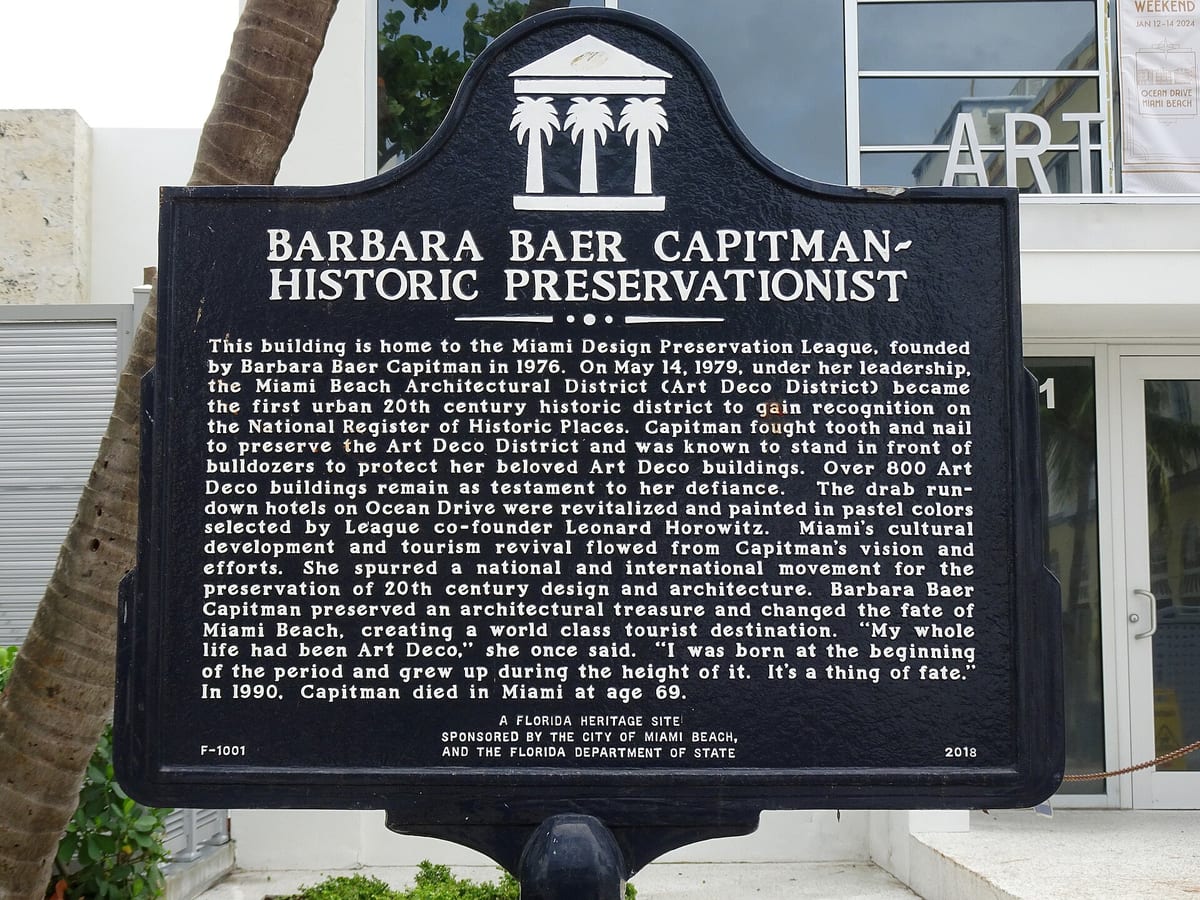 Photo: Spudgun67, Wikimedia Commons (CC0)
It worked. On May 14, 1979, under her leadership, the Miami Beach Architectural District won recognition on the National Register of Historic Places, the first twentieth-century urban district in the country to receive that designation. League co-founder Leonard Horowitz picked the pastel color palette that repainted the district's facades, replacing the buildings' dingy, sun-bleached originals with the pinks, mints, and yellows that are now inseparable from Miami Beach's entire visual identity. Every postcard-ready photo of Ocean Drive you've ever seen is, in a very direct sense, downstream of one Jewish preservationist's refusal to let a bulldozer through.
What "saving" the buildings actually changed
Here's the part of the story that doesn't resolve neatly: preserving the architecture didn't preserve the community that had been living inside it. Historic designation and a fresh coat of pastel paint made the neighborhood desirable again, and desirability brought exactly the redevelopment pressure the preservation fight had been trying to prevent in a different form. Rents climbed. New York and international developers moved in, this time not to demolish the buildings but to renovate and reposition them as luxury hotels, boutiques, and clubs. The elderly Jewish residents who'd filled those porches through the 1970s were, over the following two decades, priced out of the neighborhood their own presence had helped keep affordable and intact long enough to be worth saving at all.
That's a genuinely bittersweet ending, and it's worth sitting with instead of skipping past it for a tidier story. The preservation campaign succeeded completely at the one thing it explicitly set out to do, which was stopping the demolitions and getting the architecture protected. It could not, and was never really positioned to, protect the specific community whose presence had made the neighborhood what it was in the first place. South Beach today is unmistakably beautiful, and unmistakably a different place than the one Capitman moved into in 1973.
Where the community actually went
The Jewish retirees priced out of South Beach's revival didn't vanish from Florida; they mostly moved a few miles north, into Surfside, Bal Harbour, Aventura, and North Miami Beach, where a somewhat younger, more year-round Jewish community remains genuinely concentrated today, still supporting kosher bakeries, day schools, and delis rather than existing only as a preserved historical backdrop. It's the same underlying Jewish Miami that built the Art Deco district in the first place, just relocated a few exits up the coast, still going, still ordinary, simply no longer the photographed part of the story.
That's worth remembering the next time a "best Jewish deli" argument brings up Miami: the current generation of Jewish South Florida, the one keeping delis and bakeries alive today, isn't primarily working out of South Beach's tourist strip at all. It's the community that moved north when the rents changed, carrying the same institutions with it, the same way Jewish neighborhoods have relocated and rebuilt themselves at least once a generation for as long as American Jewish history has been recorded.
A museum where the memory lives now
Some of that erased history is deliberately preserved a few blocks away, at the Jewish Museum of Florida, housed in a former synagogue building on Washington Avenue that itself dates to the neighborhood's Jewish heyday. The museum exists specifically to hold the parts of this story that the pastel facades don't tell on their own: the exclusion that pushed Jewish Miami south in the first place, the wave of survivor-retirees who filled the district's cheapest years, and the community infrastructure, synagogues, delis, social clubs, that made this stretch of Florida coastline a genuine Jewish neighborhood long before it was a photogenic one.
That's the honest, complete version of the Art Deco district's origin story: not simply "beautiful buildings, nearly lost, bravely saved," but a specific Jewish community that built the neighborhood out of exclusion, filled it with survivors who needed an affordable place to grow old together, and then produced, from within that same aging population, the one person stubborn enough to stop the bulldozers before it was too late. The buildings survived. Knowing why they're actually there is the part still worth telling.
Walking it with the fuller story in mind
If you find yourself on Ocean Drive, a few landmarks worth knowing the backstory of:
- The pastel hotel facades — repainted under Leonard Horowitz's original 1980s color scheme, designed to make the district's architectural details pop for exactly the kind of photography that now defines it.
- The Miami Design Preservation League's walking tour route — traces the core of the district Capitman fought to protect, block by block.
- The Jewish Museum of Florida — a former synagogue on Washington Avenue, holding the community history the architecture alone doesn't tell.
- Washington Avenue's older storefronts — the fading remnants of the kosher delis, appetizing shops, and social clubs that once served the neighborhood's Jewish retirees, mostly gone now but not entirely.
- The porches and benches along Ocean Drive — largely repurposed as café seating today, once the daily gathering spot for a generation of Holocaust survivors rebuilding an ordinary life in the Florida sun.
Kosher Couture is drawn to stories like this one precisely because they resist the easy version. For another chapter of Jewish Americans building something out of exclusion and making it last, read our history of the Lower East Side's appetizing trade — a different coastline, the same stubborn instinct to hold onto what you built.


