
L'Shana Tova Meaning: Shana Tova vs. L'Shana Tova & Replies
L'shana tova (לשנה טובה) means "for a good year" in Hebrew, and it's the classic greeting for Rosh Hashanah, the Jewish New Year. If someone says it to you, say "shana tova" right back, or keep it even simpler with "gam lecha" (גם לך, "you too," to a man), "gam lach" (also written גם לך, to a woman), or "gam lachem" (גם לכם, to a group).
That's the whole answer, and you can go greet people now. But the phrase is a shortened version of an older blessing, l'shana tova tikatevu, "may you be inscribed for a good year," and the full version carries one of the oldest images in the Jewish calendar: a Book of Life, open on Rosh Hashanah, with your name somewhere inside. Below you'll find the difference between shana tova and l'shana tova, what tikatevu means, what "lekulam" adds, why some years are wished sweet as well as good, and when the greeting quietly retires until next fall.
Breaking Down the Hebrew
L'shana tova is built from three small, everyday Hebrew words. L' (ל) is a prefix meaning "for" or "to." Shana (שנה) means "year." Tova (טובה) means "good," in the feminine form, because shana is a feminine noun and Hebrew adjectives match their nouns. Put together, literally: "for a good year."
It's a compact, almost telegraphic phrase, and it works because everyone already knows the longer sentence it's standing in for. You'll also see it spelled l'shanah tovah, leshana tova, and l'shana tovah. Those are all the same Hebrew. The final "h" is just a transliteration choice for the silent letter ה at the end of each word, and no spelling is more correct than another.
| Greeting | Hebrew | Literal Meaning | When You'll Hear It |
|---|---|---|---|
| Shana tova | שנה טובה | "A good year" | Rosh Hashanah season, everyday |
| L'shana tova | לשנה טובה | "For a good year" | Rosh Hashanah season, everyday |
| Shana tova lekulam | שנה טובה לכולם | "A good year to everyone" | Group messages, announcements, captions |
| Shana tova u'metukah | שנה טובה ומתוקה | "A good and sweet year" | Rosh Hashanah, cards, the apples-and-honey table |
| L'shana tova tikatevu v'techatemu | לשנה טובה תכתבו ותחתמו | "May you be inscribed and sealed for a good year" | Rosh Hashanah, traditional and formal |
| Gmar chatimah tovah | גמר חתימה טובה | "A good final sealing" | Between Rosh Hashanah and Yom Kippur |
| Tizku l'shanim rabot | תזכו לשנים רבות | "May you merit many years" | Sephardi and Mizrahi communities |
Shana Tova vs. L'Shana Tova
In practice, there's no difference. Both mean "good year," both are heard constantly in the weeks around Rosh Hashanah, and nobody worth listening to will correct you for using either one.
There is a grammar footnote, and it's a fun one. As the Forward's longtime language columnist Philologos pointed out, "l'shana tova" on its own is technically an unfinished sentence. "For a good year" is waiting for a verb, and the verb it's waiting for is tikatevu, "may you be inscribed." If you want to shorten the greeting in a way that stands on its own grammatically, "shana tova," "a good year," is the tidier choice. He also conceded that you'll hear "l'shana tova" from Hebrew-speaking Israelis, which is usually how these debates end: the language shrugs and keeps both.
So here's the practical version. "Shana tova" is the everyday wish. "L'shana tova" is the everyday wish with a little echo of the traditional blessing built in. Use whichever one your grandmother used.
What Does Tikatevu Mean?
Tikatevu (תכתבו) means "may you be written" or "may you be inscribed." It comes from the Hebrew root כ-ת-ב (k-t-v), "to write," in a passive verb form, addressed to more than one person (Pealim lists it as "you [plural] will be written"). The full traditional greeting is:
לשנה טובה תכתבו ותחתמו L'shana tova tikatevu v'techatemu "May you be inscribed and sealed for a good year."
Because Hebrew verbs change with the person you're addressing, the greeting changes too. Chabad.org's greetings guide gives l'shana tova tikatev v'techatem (לשנה טובה תכתב ותחתם) for a man and l'shana tova tikatevi v'techatemi (לשנה טובה תכתבי ותחתמי) for a woman. Tikatevu is the plural, which is why it's the version printed on cards addressed to whole families.
The custom itself is old and on the record. The Rema, Rabbi Moshe Isserles, notes in his glosses on the Shulchan Aruch that on Rosh Hashanah night "everyone says to his fellow, l'shana tova tikatev" (Orach Chayim 582:9 on Sefaria).
Why "written"?
The word points to an image from the Talmud. In Rosh Hashanah 16b, Rabbi Kruspedai teaches in the name of Rabbi Yochanan that three books are opened on Rosh Hashanah: one for the wholly righteous, one for the wholly wicked, and one for everyone in between. The righteous are written and sealed for life right away. The in-betweeners, which is to say nearly all of us, have their judgment left open until Yom Kippur, ten days later.
That's why the greeting says "written" instead of something vaguer. It's a wish with a very particular picture behind it: a name, your name, entered into a book on a specific day of the year. And v'techatemu, "and sealed," looks ahead to Yom Kippur, when that entry is finalized. Wishing someone tikatevu is hoping that whatever gets written this year, in that book, comes out good.
What Does Shana Tova Lekulam Mean?
Shana tova lekulam (שנה טובה לכולם) means "a good year to everyone" or "happy new year, everybody." Lekulam is l' ("to") plus kulam ("all of them," from kol, "all"; see Pealim). In a fully vowelled text you may see it written לְכֻלָּם; in everyday modern Hebrew it's spelled לכולם.
This is the version for a crowd. It's what you post under a holiday table photo, write at the bottom of a group-chat message, say from the bimah, or print on a sign at the office. You'll also see it stacked with the sweet version: shana tova u'metukah lekulam, "a good and sweet year to everyone." If you're wishing one person well, drop the lekulam. If you're wishing the whole family chat well, it's the most efficient greeting in Hebrew.
Shana Tovah vs. Shanah Tovah Umetukah
First, the spelling question. Shana tova, shana tovah, and shanah tovah are the same two Hebrew words, שנה טובה. English just can't agree on whether to show the silent ה with an "h." Pick one and carry on.
The real difference is the extra word. Shanah tovah u'metukah (שנה טובה ומתוקה) means "a good and sweet year." U'metukah is u' ("and") plus metukah ("sweet," again feminine to match shanah). My Jewish Learning gives the fuller form as l'shana tovah u'metukah, "for a good and sweet year."
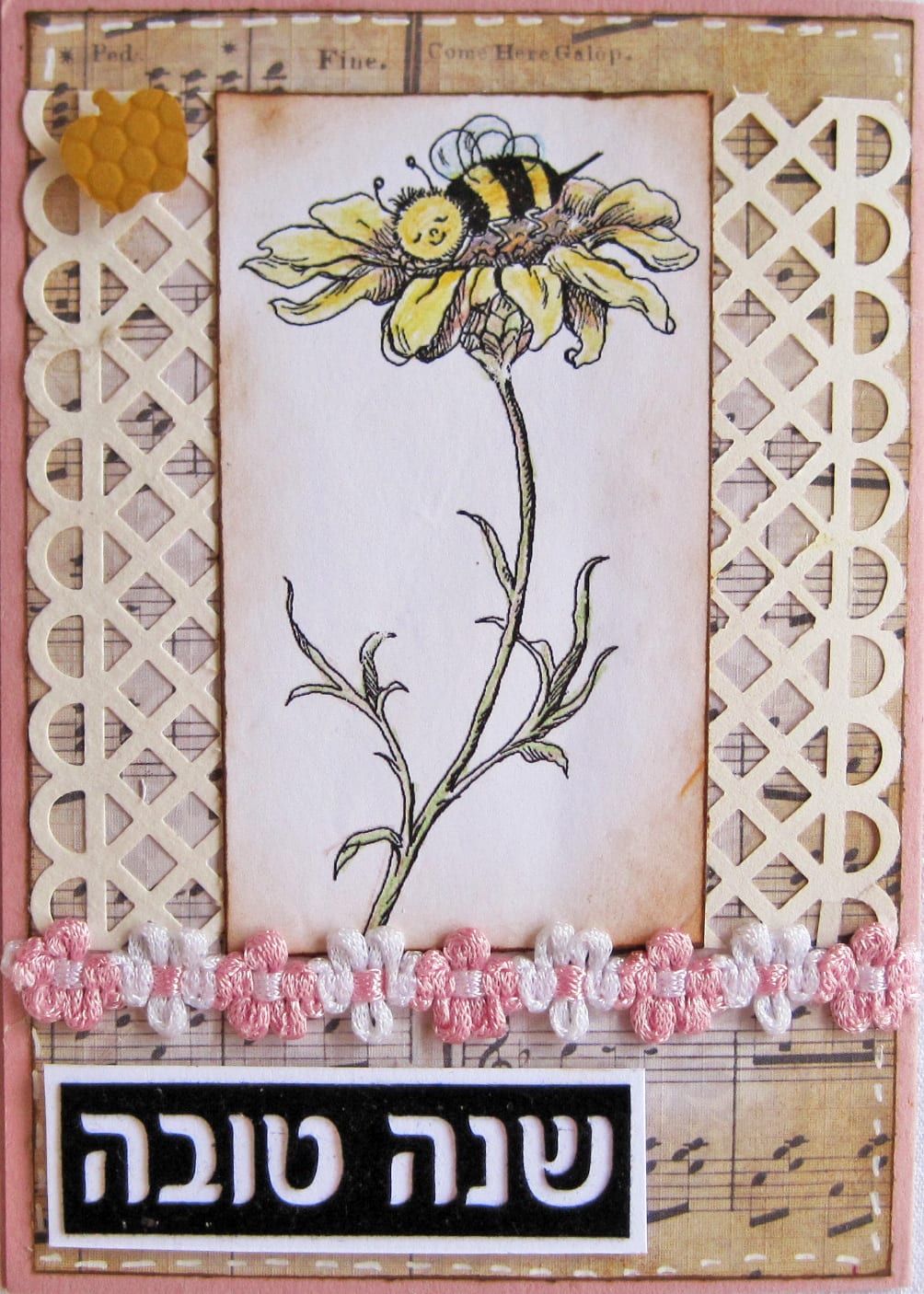 Photo: Itzuvit, Wikimedia Commons (CC BY-SA 3.0)
"Sweet" is doing real work here. It ties the greeting to Rosh Hashanah's best-known table custom, apples dipped in honey, and to a wish that goes a step past "good." A year can be good in the accounting sense and still feel like a slog. Sweet asks for more: the kind of year you'd happily repeat. It's the phrase you'll find printed on cards and honey jars and platters shaped like apples, and it's the one most likely to be said with your mouth full.
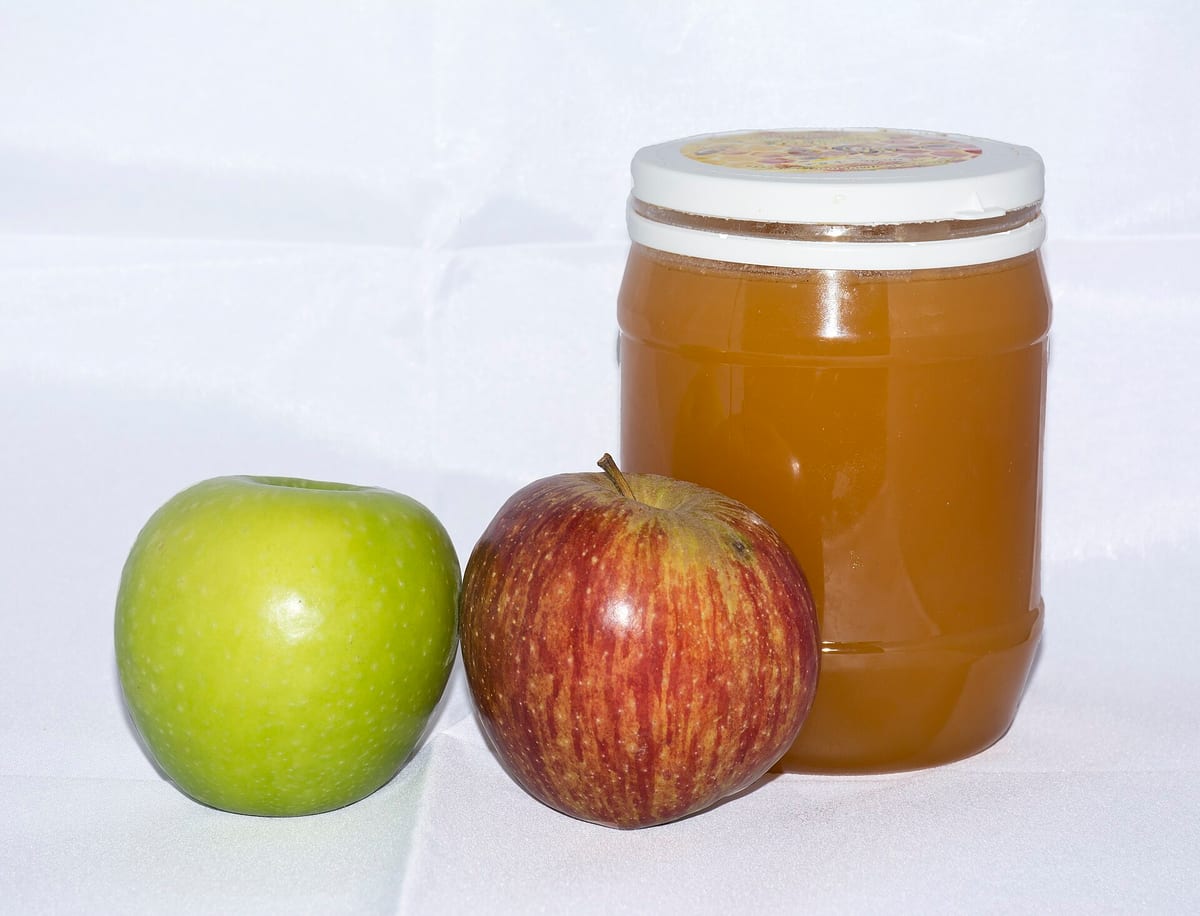 Photo: MathKnight, Wikimedia Commons (CC BY 4.0)
When Do You Stop Saying It?
There isn't one universal cutoff. Different communities follow different customs, and the answer depends partly on which version of the greeting you mean.
The "tikatevu" version. Because this form wishes that you be written for a good year, it's tied to the moment of writing. Chabad.org lists l'shana tova tikatev v'techatem for Rosh Hashanah eve, then says that from noon on Rosh Hashanah, "when our fates are already written," the greeting becomes gmar chatimah tovah (גמר חתימה טובה), "a good final sealing," until Yom Kippur. Not every community is that precise, but the logic is shared widely: once Rosh Hashanah has passed, "sealed" fits better than "written."
Through Yom Kippur and a little beyond. The Jewish English Lexicon describes gmar chatimah tovah as the greeting used between Rosh Hashanah and Yom Kippur, and notes the tradition that the judgment, sealed on Yom Kippur, is "sent out" on Hoshana Rabbah, the seventh day of Sukkot. That's why some people keep saying gmar tov into Sukkot, and why Chabad lists a Yiddish greeting just for Hoshana Rabbah: a gutn kvitl, "a good inscription."
Plain "shana tova." The simple wish for a good year doesn't lean on the Book of Life image the way tikatevu does, so it has no hard stop. Many people start using it in Elul, the month before Rosh Hashanah, and keep it going through the fall holidays for friends they haven't seen yet. Once Yom Kippur is behind you and Sukkot arrives, though, chag sameach, "happy holiday," is usually the more natural thing to say.
If you're unsure, follow the people around you. Nobody has ever been offended by an extra wish for a good year.
How Do You Pronounce It?
For English speakers, "l'shana tova" comes out roughly as luh-shah-NAH toh-VAH, with the stress on the last syllable of each word, which is typical of Modern Hebrew. The "l'" is barely voiced, more a quick consonant leading into "shana" than a syllable of its own, the way "the" melts into the next word in fast speech. Fluent speakers say it almost as one word, which is part of why the shorter "shana tova" wins out in a crowded synagogue lobby after services: it's simply faster.
Tikatevu is tee-kah-TEH-voo. Lekulam is leh-koo-LAHM. U'metukah is oo-meh-too-KAH. And gmar chatimah tovah starts with the throaty "ch" of "Bach," not the "ch" of "cheese."
Sephardi and Mizrahi Greetings
While l'shana tova and its relatives are shared across the Jewish world, Sephardi and Mizrahi communities carry their own layer of new year blessings, often used alongside the familiar Hebrew. One common example is tizku l'shanim rabot (תזכו לשנים רבות), "may you merit many years," a wish that zooms out from this one year's verdict to a long life ahead. It has its own reply, too. My Jewish Learning gives tizkeh v'tihyeh v'orech yamim to a man and tizki v'tihyi v'orech yamim to a woman: roughly, "may you merit it too, and live a long life."
In many Sephardi homes, the blessings also move to the table in the Yehi Ratzon seder, a sequence of symbolic foods (dates, leeks, beets, gourd, pomegranate, and others), each paired with a short wordplay blessing recited before eating it. It turns the new year greeting into a whole evening's worth of good wishes, one course at a time.
Where You'll See and Hear It
L'shana tova shows up everywhere the holiday touches: on cards mailed weeks in advance, in the synagogue lobby as people file out after services, in texts sent to every relative and group chat at once, and under Rosh Hashanah table photos and honey-cake posts across social media. It also turns up at work. A short "wishing you a shana tova" in an email or a Slack message has become a friendly, widely understood way of acknowledging the holiday, including from colleagues who aren't Jewish.
Plenty of English-speaking Jews also just say "Happy New Year," especially with neighbors who might not know the Hebrew. But l'shana tova and its variants remain the standard inside Jewish life, in the same family as mazel tov and l'chaim: words so settled into Jewish English that translating them feels like losing something, even when a decent English equivalent exists.
A Greeting With Its Theology Showing
Most new year greetings, in most cultures, don't claim much. "Happy new year" makes no particular promise about January 1st. L'shana tova is different. Folded into three small words is a whole picture: a day of judgment, an open book, and a hope that what gets written down still has room to turn out well. People say it by reflex, several times a year, and most have long stopped noticing how much belief rides inside it.
That's the kind of density we love at Kosher Couture: small phrases doing big, quiet work, spoken or worn without a footnote. There's a little chutzpah in it, too, in greeting everyone you know, every single fall, with the confident hope that this year will be better than the last. For the holiday behind the greeting, read our guide to what Rosh Hashanah actually celebrates, and for the stretch it opens, our piece on the Ten Days of Repentance. If you'd like to wear the season, our High Holidays picks are ready when you are.
Frequently Asked Questions
What does l'shana tova mean?
L'shana tova (לשנה טובה) means "for a good year" in Hebrew. It's the standard Rosh Hashanah greeting and a shortened form of l'shana tova tikatevu, "may you be inscribed for a good year," which refers to the tradition that each person's year is written in the Book of Life on Rosh Hashanah.
What do you say back when someone says l'shana tova?
Say "shana tova" or "l'shana tova" right back. You can also answer "gam lecha" ("you too," to a man), "gam lach" (to a woman), or "gam lachem" (to a group). In Sephardi communities, if someone wishes you tizku l'shanim rabot, the traditional reply is tizkeh v'tihyeh v'orech yamim (to a man) or tizki v'tihyi v'orech yamim (to a woman).
Is it shana tova or l'shana tova?
Both are correct and both are used everywhere. "Shana tova" means "a good year" and stands on its own grammatically. "L'shana tova" means "for a good year" and is a shortened piece of the longer blessing l'shana tova tikatevu. Spellings like "shanah tovah" and "shana tova" are the same Hebrew words transliterated differently.
What does tikatevu mean?
Tikatevu (תכתבו) means "may you [plural] be written" or "may you be inscribed." The full phrase l'shana tova tikatevu v'techatemu (לשנה טובה תכתבו ותחתמו) means "may you be inscribed and sealed for a good year." To one man it's tikatev v'techatem; to one woman, tikatevi v'techatemi.
What does shana tova lekulam mean?
Shana tova lekulam (שנה טובה לכולם) means "a good year to everyone." It's the greeting for groups: social posts, announcements, and messages to the whole family. Shana tova u'metukah lekulam means "a good and sweet year to everyone."
When do you stop saying l'shana tova?
Customs vary. Some, following the practice recorded by Chabad, switch from l'shana tova tikatevu to gmar chatimah tovah ("a good final sealing") from noon on the first day of Rosh Hashanah through Yom Kippur. Others keep saying gmar tov until Hoshana Rabbah, near the end of Sukkot. A simple "shana tova" has no strict cutoff, though after Yom Kippur most people switch to chag sameach for Sukkot.


