What Is Rosh Hashanah? Meaning, Traditions & Symbolic Foods
Rosh Hashanah is the Jewish New Year, a two-day observance marking the start of the Hebrew calendar year and the beginning of the Ten Days of Repentance leading to Yom Kippur. It's rooted in Leviticus 23:24, which calls the first day of the seventh month, Tishrei, a "sacred occasion commemorated with loud blasts" — the blowing of the shofar. It falls in early autumn each year, and it's celebrated with prayer, reflection, and a table full of symbolic foods meant to sweeten the year ahead.
What Does "Rosh Hashanah" Actually Mean?
Rosh Hashanah (רֹאשׁ הַשָּׁנָה) translates literally to "head of the year." It's a little poetic, when you think about it: not "start" or "beginning," but head — the part that directs everything else. Jewish tradition holds that how you show up on Rosh Hashanah, the intentions you set, ripples through the rest of the year.
Interestingly, the Torah itself never actually calls this day "Rosh Hashanah." Leviticus 23:24 refers to it as Yom Teruah, the "Day of the Shofar Blast," and Numbers 29:1 calls it Zichron Teruah, a "remembrance of blasts." The name "Rosh Hashanah" comes later, from the Mishnah (Rosh Hashanah 1:1), which identifies four different "new years" on the Jewish calendar for different legal purposes — this one, in Tishrei, is the new year for years themselves, and it's the one that stuck in popular use.
By the traditional Hebrew calendar, this is considered the anniversary of the creation of humanity — not the universe as a whole, but the sixth day, when Adam and Eve were formed. That's part of why the day carries such weight: it's framed less as a countdown-and-confetti kind of new year and more as a birthday for humankind, complete with an accounting of the year behind you.
When Does Rosh Hashanah Happen?
Rosh Hashanah begins at sundown on the first of Tishrei and lasts two days (even in Israel, where most holidays are observed for one day). Because the Hebrew calendar is lunisolar, the date shifts on the secular calendar year to year, but it always lands in September or early October. Tishrei itself marks the start of the fall holiday season, which runs in quick succession from Rosh Hashanah through Yom Kippur, Sukkot, and Simchat Torah — a stretch some people jokingly call "the Jewish marathon," since it's a lot of holiday cooking and synagogue-going packed into about a month.
What Happens During Rosh Hashanah Services?
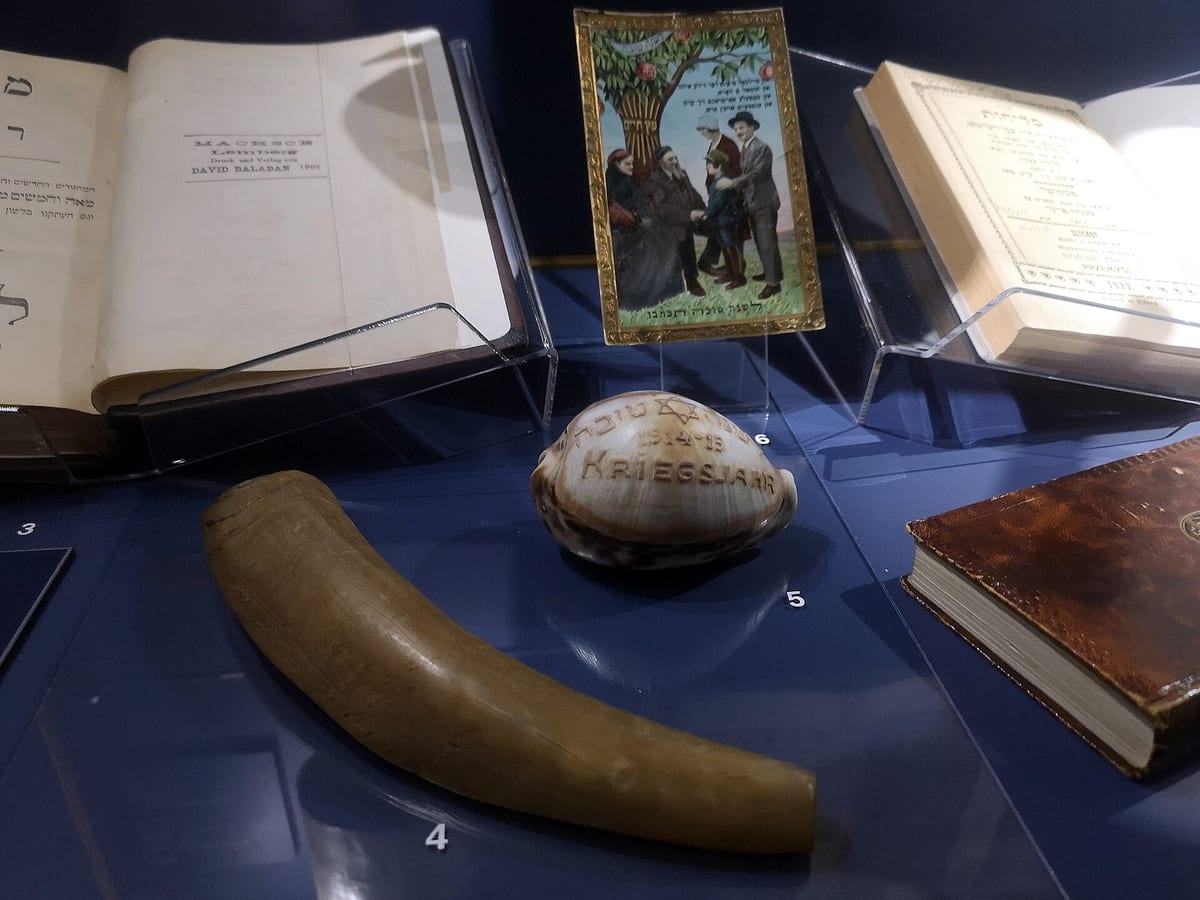 Vintage postcard, Wikimedia Commons (CC BY-SA 4.0)
The single most recognizable ritual of Rosh Hashanah is hearing the shofar, a hollowed ram's horn blown in a specific pattern of blasts: tekiah (one long blast), shevarim (three broken blasts), and teruah (a rapid series of short blasts), typically sounded around 100 times over the course of the service. Maimonides described the shofar's piercing sound as a kind of spiritual alarm clock — a call to "wake up" from routine and take honest stock of one's life (Mishneh Torah, Laws of Repentance 3:4).
The liturgy for Rosh Hashanah also introduces powerful, image-rich prayers unique to the day, most famously the Unetaneh Tokef, which describes the day as one when "it is written" and Yom Kippur as when "it is sealed" who will live and who will die, who by fire and who by water — stark, sobering language that sets the emotional register for the entire season. It's paired, though, with the reassurance that repentance, prayer, and charity can "avert the severity of the decree." The custom of wishing someone a "good and sweet year" and the greeting "Shanah Tovah" (a good year) or the fuller "Shanah Tovah U'Metukah" (a good and sweet year) comes directly out of this hopeful half of the holiday's mood.
Many communities also observe Tashlich, a custom — not a biblical commandment — of walking to a body of flowing water on the afternoon of the first day and symbolically casting away sins, often by emptying pockets or tossing breadcrumbs into the water while reciting verses from the Book of Micah about God casting sins "into the depths of the sea" (Micah 7:19). It's become one of the most beloved, visually memorable Rosh Hashanah traditions precisely because it turns an abstract idea — starting fresh — into something you can physically do with your hands.
Why Do Jews Eat Apples and Honey on Rosh Hashanah?
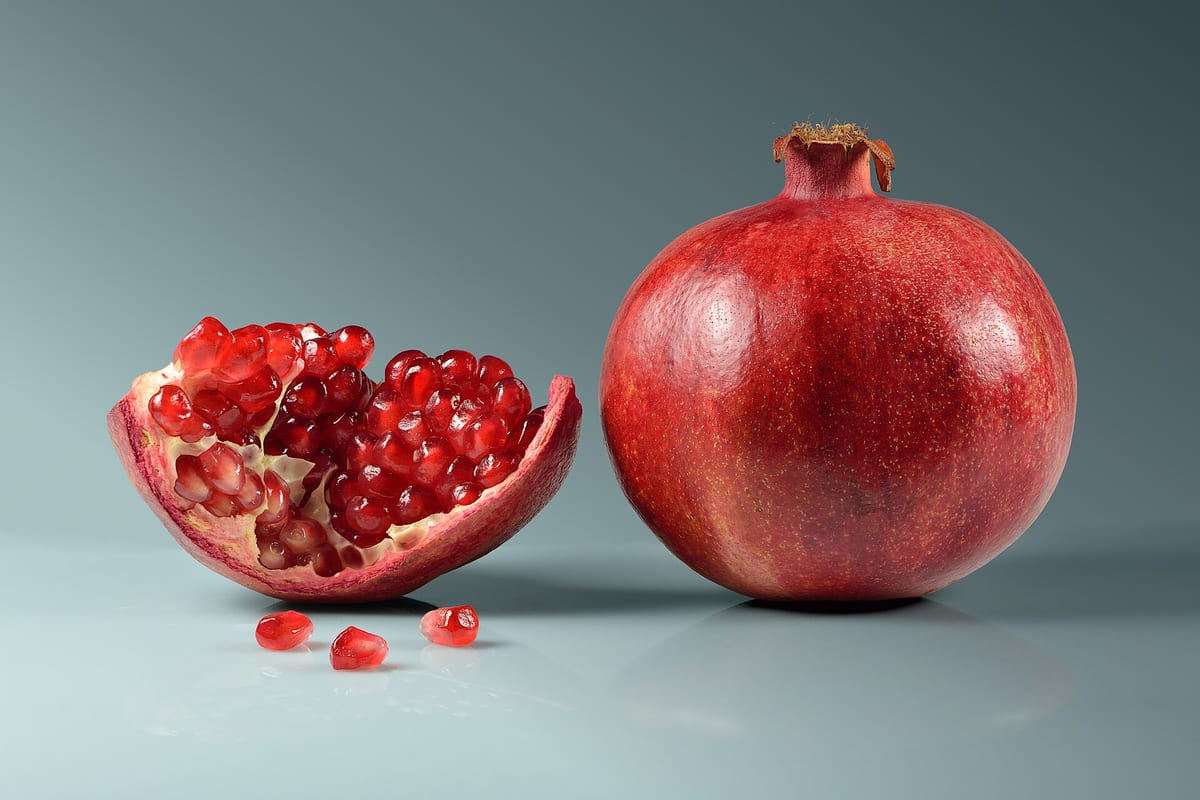 Photo: Ivar Leidus, Wikimedia Commons (CC BY-SA 4.0)
Rosh Hashanah's dinner table is arguably as symbolically loaded as its prayer book. The most iconic pairing is apple slices dipped in honey, eaten while reciting a short prayer asking for a "good and sweet year" — the apple representing the year itself, the honey representing the sweetness we're hoping for.
But the custom goes much further, into an entire ritual meal called the simanim (סימנים, "signs" or "omens"), documented as far back as the Babylonian Talmud (Horayot 12a and Keritot 6a), where the sage Abaye recommends eating foods whose names or qualities symbolize positive things for the year ahead. Common simanim include:
| Food | Symbolic Wish |
|---|---|
| Apple in honey | A sweet new year |
| Pomegranate | A year as full of merits as the fruit is full of seeds |
| Fish head (or a whole fish) | Being like "the head and not the tail" — moving forward |
| Dates | An end to enemies or negativity (based on wordplay in Hebrew/Aramaic) |
| Leek, beet, or spinach | The removal of adversaries (again, based on wordplay) |
| Round challah | A year that comes full circle, with no sharp edges |
The wordplay versions can look strange in English, but they make perfect sense in Hebrew and Aramaic, where the name of a food often puns on a verb like "to end," "to increase," or "to tear away." It's less superstition than a kind of edible mnemonic device for the hopes you're trying to set for the year — and honestly, it's one of the most delicious rituals in the entire Jewish calendar.
What's the Sephardic Rosh Hashanah Seder?
Ashkenazi households typically keep the simanim simple: apple and honey, maybe a round challah, and call it a table. But in many Sephardic and Mizrahi communities, the symbolic foods are formalized into an entire ritual called the Yehi Ratzon seder — yes, a seder, like Passover, though a much shorter one. Before eating each symbolic food, the household recites a short blessing beginning "Yehi ratzon milfanecha" ("May it be Your will") that plays on the Hebrew or Aramaic name of that food. Over the pomegranate: a wish to be as full of good deeds as the fruit is full of seeds. Over the leek (karti in Aramaic, which sounds like yikartu, "cut off"): a wish that enemies be cut off.
Communities from Iraq, Persia, Morocco, Turkey, and beyond each carry their own version of this seder, sometimes with a dozen or more foods on the table — a reminder that "Jewish tradition" is rarely one single script, but a family of related customs shaped by centuries in different corners of the world. If you only grew up with apple slices and a honey jar, it's worth asking a Sephardic friend or in-law what their family's table looked like. Odds are good you'll walk away with a new food to add next year.
What Happens During the Ten Days of Repentance?
Rosh Hashanah doesn't end when the second day does — it opens a ten-day window, the Aseret Yemei Teshuvah, that runs straight through to Yom Kippur. Jewish tradition, echoed in the Talmud (Rosh Hashanah 16b), describes three books opened on Rosh Hashanah: one for the wholly righteous, one for the wholly wicked, and one for everybody in between — the vast majority of us — whose fate hangs in the balance until Yom Kippur sees it "sealed."
Practically, that period is used for teshuvah (repentance, though the Hebrew root more literally means "return"), which traditionally involves three steps: recognizing where you've fallen short, sincerely regretting it, and — the part most people skip — actually going to the person you wronged and asking forgiveness directly, not just praying about it in the abstract. Many people also increase charitable giving during these ten days, and daily penitential prayers called Selichot are added to services, some communities beginning them even a week or more before Rosh Hashanah itself.
The middle Shabbat of this period even has its own name, Shabbat Shuvah ("the Sabbath of Return"), named for the opening word of that week's special haftarah portion from the prophet Hosea, which calls on Israel to "return" to God. It's traditionally a day when rabbis give their most substantial sermon of the year, precisely because the room is unusually full and unusually reflective.
Why Do Some People Wear White on Rosh Hashanah?
It's not universal, but in many communities — Ashkenazi and Sephardic alike — it's customary for the prayer leader, and sometimes the whole congregation, to wear white on Rosh Hashanah and Yom Kippur. The association is with purity and the fresh start the day represents, and some traditions tie it to imagery from the Book of Isaiah (1:18) about sins becoming "white as snow." It's also, practically, a visual echo of the kittel — a simple white garment some Ashkenazi men wear on the High Holidays and at their own wedding and, eventually, burial — tying together the beginning-and-ending symbolism the day is soaked in. You don't need a kittel to mark the day meaningfully, but plenty of people do choose to dress a little more simply and a little more deliberately for it, which is really its own kind of ritual.
How Is Rosh Hashanah Different From a Secular New Year?
A secular New Year's Eve tends to be a countdown and a party. Rosh Hashanah is closer to a solemn, hopeful checkpoint. There's no ball drop — there's a shofar. There's no resolution written on a whim at midnight — there's a structured ten-day period, the Aseret Yemei Teshuvah (Ten Days of Repentance), stretching from Rosh Hashanah to Yom Kippur, meant for honest self-assessment, repairing relationships, and asking forgiveness from people you may have wronged before asking it from God. The tone is reflective rather than celebratory, even as the food and greetings stay warm and sweet.
That contrast is part of what makes the holiday season so rich: joy and seriousness sitting at the same table. At Kosher Couture, we think that tension — solemn and sweet, historic and completely alive — is a pretty good description of Jewish culture generally, which is a big part of why we keep coming back to these holidays in our own designs and, now, on this blog.
Frequently Asked Questions
Is Rosh Hashanah the same as the Jewish New Year? Yes. Rosh Hashanah literally means "head of the year" and marks the start of a new year on the Hebrew calendar. It's the most widely observed of the four "new years" the Mishnah identifies on the Jewish calendar.
Do you have to fast on Rosh Hashanah? No. Fasting is reserved for Yom Kippur, ten days later. Rosh Hashanah is instead marked by festive meals, including the symbolic simanim foods like apples and honey.
Why is the shofar blown on Rosh Hashanah? The Torah refers to the day as Yom Teruah, the "day of the blast," and the shofar's raw, wordless sound is understood as a spiritual wake-up call urging self-reflection ahead of Yom Kippur, rather than a musical instrument in the ordinary sense.
What do you say to someone on Rosh Hashanah? The standard greeting is "Shanah Tovah" (a good year) or "Shanah Tovah U'Metukah" (a good and sweet year). You may also hear "L'shanah tovah tikatevu," meaning "may you be inscribed for a good year," referencing the holiday's Book of Life imagery.
How long does Rosh Hashanah last? Two days, even in Israel — one of the only Jewish holidays observed for two days universally, a practice that dates back to calendar uncertainty in ancient times and has remained by long-standing custom ever since.
Ready to wear a little of that Tishrei spirit year-round? Browse Kosher Couture for apparel that carries Jewish pride well past the holiday season, or dig into our piece on dressing for the High Holidays for what to actually wear to synagogue this time of year.


