
The Ten Days of Repentance, Explained

The Ten Days of Repentance, or Aseret Yemei Teshuvah, are the ten days that run from Rosh Hashanah through Yom Kippur, traditionally understood as a window when introspection, apology, and change feel more urgent — and, according to Jewish tradition, more effective — than at any other point in the year. Judgment is written on Rosh Hashanah and sealed on Yom Kippur, and the ten days between are, in effect, the editing period.
What Does "Aseret Yemei Teshuvah" Mean?
Aseret Yemei Teshuvah (עֲשֶׂרֶת יְמֵי תְּשׁוּבָה) translates directly as "the Ten Days of Repentance," from aseret (ten), yemei (days of), and teshuvah — a word usually rendered as "repentance" but more precisely meaning "return." Teshuvah isn't really about guilt; the root of the word (שוב) means "to turn back" or "to return," and the concept describes a person turning back toward who they actually want to be, not simply confessing to who they've been. That distinction matters a lot to how the whole ten-day period is meant to feel: less like a trial, more like a course correction with a deadline attached.
The ten days include Rosh Hashanah itself (two days) and Yom Kippur as the bookends, with the days in between sometimes referred to separately as the Shloshet Yemei Teshuvah (the "Three Days of Repentance," referring to the ordinary weekdays sandwiched in the middle) plus Shabbat Shuvah, the Sabbath that falls within the period.
The Book of Life: Where the Ten Days Actually Come From
The framework behind the Ten Days rests on a specific piece of rabbinic imagery, developed in the Talmud, describing three books opened in heaven on Rosh Hashanah: one for the thoroughly righteous, who are inscribed for life immediately; one for the thoroughly wicked, inscribed for the opposite; and one for everyone in between — the vast majority of people — whose verdict is left open until Yom Kippur. That middle category is what gives the Ten Days their entire purpose. If judgment were finalized on Rosh Hashanah itself, there'd be nothing left to do with the days that follow. Because it isn't, the period between the two holidays functions as an active, and according to tradition genuinely consequential, opportunity to change the outcome.
This is also the source of the well-known Rosh Hashanah greeting l'shana tova tikatevu — "may you be inscribed for a good year" — and its Yom Kippur counterpart, gmar chatimah tovah, "may you be sealed for good," which reflects the shift in verb tense between the two holidays: writing on Rosh Hashanah, sealing on Yom Kippur, with the Ten Days as the space in between where the ink is still wet.
What Actually Changes During the Ten Days?
A few concrete shifts happen during this period, both in liturgy and in everyday practice:
Prayer additions. Several fixed lines are added to the daily Amidah (the central standing prayer, recited three times a day) throughout the Ten Days, referencing God as king and asking for inscription in the Book of Life — additions unique to this stretch of the calendar and left out the rest of the year. Getting them right is enough of a challenge that many siddurim print them in a highlighted box as a reminder.
Extra care in daily conduct. Beyond formal prayer, many people treat the Ten Days as a heightened window for the ordinary work of teshuvah: reaching out to apologize to people they've wronged over the past year, being more deliberate about small acts of kindness, and paying closer attention to speech, since Jewish tradition places enormous weight on the damage careless words can do.
Tzedakah. Increased charitable giving during this period is a widespread custom, tied to the idea that repentance, prayer, and charity together are understood to have the power to "avert the severity of the decree" — a line from the High Holiday liturgy itself (u'teshuvah u'tefillah u'tzedakah ma'avirin et ro'a hagezeirah).
Kapparot and other pre-Yom Kippur customs. In the days immediately before Yom Kippur, some communities observe kapparot, a symbolic atonement ritual (traditionally involving a chicken, though money donated to charity is a widely used substitute today), alongside general preparation — a festive final meal before the Yom Kippur fast begins.
Visiting graves. In many communities, it's customary to visit the graves of parents or other close relatives sometime during the Ten Days, understood less as a request for the deceased to intervene and more as a moment of reflection and connection to family history during a period already built around taking stock.
None of these practices are treated as a checklist to complete mechanically. The common thread running through all of them is that the Ten Days are meant to be lived differently than an ordinary stretch of the calendar — more attentive, a little more deliberate, with the ordinary rhythm of the year briefly interrupted on purpose.
What Is Shabbat Shuvah?
The Shabbat that falls during the Ten Days has its own name: Shabbat Shuvah, the "Shabbat of Return." The name comes from the opening word of that week's haftarah (the prophetic reading that accompanies the Torah portion), from the Book of Hosea, which opens with the call "Return, O Israel, to the Lord your God." Along with Shabbat Hagadol, the Shabbat before Passover, Shabbat Shuvah is traditionally one of the two occasions each year when rabbis deliver a longer, more substantial sermon than usual — a custom old enough that it predates the modern weekly d'var Torah by centuries. Some traditions hold that the teshuvah accomplished on Shabbat Shuvah carries particular weight, since it combines the introspective urgency of the Ten Days with the elevated spiritual quality traditionally associated with Shabbat itself.
| The Ten Days at a Glance | |
|---|---|
| Hebrew name | Aseret Yemei Teshuvah |
| Literal meaning | "The Ten Days of Repentance" (or "Return") |
| Begins | Rosh Hashanah |
| Ends | Yom Kippur |
| Special Shabbat | Shabbat Shuvah, named for its haftarah from Hosea |
| Key liturgical change | Special additions to the Amidah, recited only during this period |
| Core themes | Teshuvah (return), tefillah (prayer), tzedakah (charity) |
Is Teshuvah Only About Religious Observance?
No — and this is one of the more commonly misunderstood parts of the whole period. Classical Jewish sources, most famously Maimonides' laws of teshuvah, are explicit that repentance between one person and another (bein adam l'chaveiro) isn't resolved through prayer alone. Wronging another person and then only apologizing to God doesn't complete the process; Yom Kippur itself is traditionally understood to atone for sins against God, but not for sins against other people until the person actually wronged has been approached directly. That's a big part of why the Ten Days so often show up as a season of overdue phone calls and slightly awkward, long-postponed apologies — the tradition genuinely expects it, rather than treating it as a nice bonus.
The Steps of Teshuvah, According to Maimonides
The twelfth-century philosopher and legal codifier Maimonides (Rambam) laid out what's become the standard framework for what teshuvah actually requires, in his Mishneh Torah, Laws of Repentance. It isn't a single feeling or a single sentence of apology — it's a process with distinct stages:
- Recognizing the wrong. Naming, specifically, what was done and why it was wrong, rather than staying in a vague, general sense of having messed up somehow.
- Genuine regret. Actually feeling the weight of it, not just intellectually cataloguing it.
- Verbal confession (vidui). Articulating it out loud — to oneself in prayer for sins against God, and directly to the person wronged for interpersonal harm.
- A firm resolution not to repeat it, tested, according to Maimonides, by facing a genuinely similar situation again in the future and choosing differently.
That fourth step is the one that gives Jewish teshuvah its particular edge over a simple apology: Maimonides considered the proof of complete teshuvah to be standing in the same circumstance again — same temptation, same opportunity, same pressure — and making a different choice. Intentions alone don't close the loop.
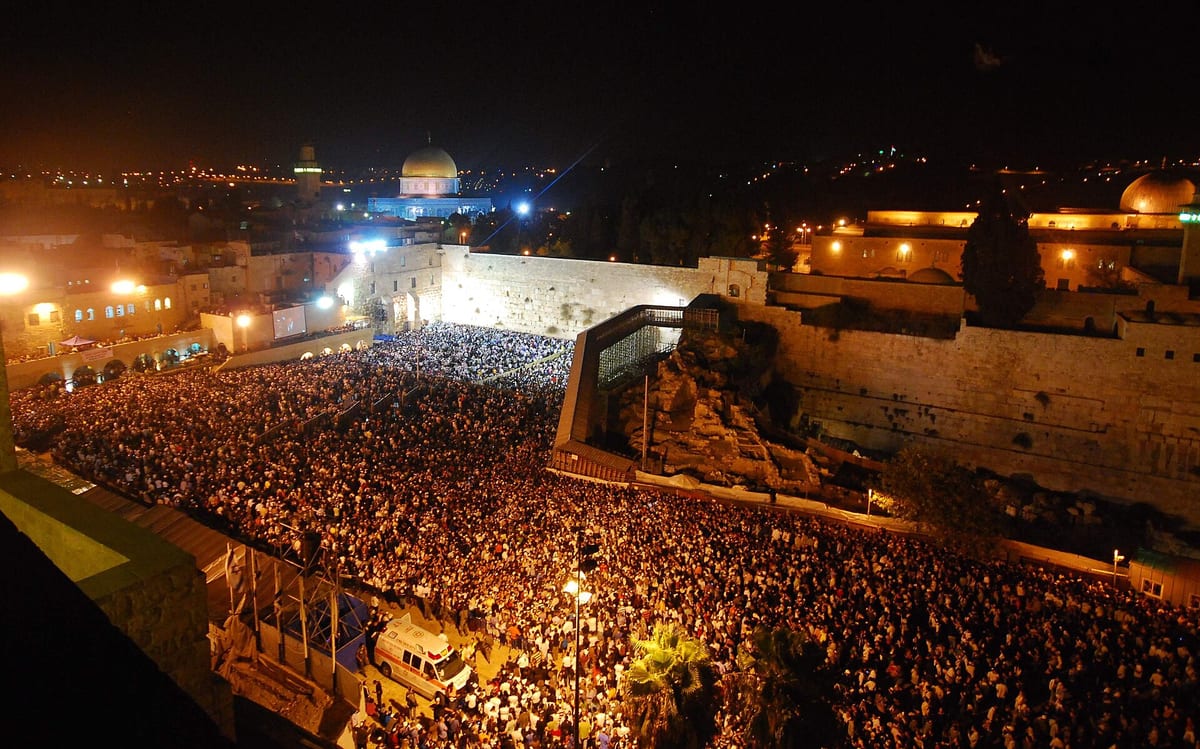 Photo: Yael Shilo, Wikimedia Commons (CC BY 3.0)
Selichot: The Run-Up to the Ten Days
For many communities, the Ten Days don't arrive out of nowhere — they're preceded by Selichot, a set of penitential prayers recited in the lead-up to Rosh Hashanah and continuing through Yom Kippur. Ashkenazi custom typically begins Selichot on the Saturday night before Rosh Hashanah (or a week earlier if Rosh Hashanah falls very early in the week), often at a distinctive, slightly haunting midnight service that doubles as many people's first real signal that the season has turned. Sephardic and Mizrahi communities generally begin Selichot much earlier, often for the entire month of Elul that precedes Rosh Hashanah, reflecting a longer, more gradual on-ramp into the same introspective work the Ten Days bring to a head. Either way, by the time Rosh Hashanah itself arrives, the ten days that follow aren't really a cold start — they're the most concentrated stretch of a process that, in many communities, has already been quietly underway for weeks.
A Season Built Around the Idea That People Can Actually Change
What makes the Ten Days distinctive, compared to New Year's resolutions or other secular versions of "starting fresh," is the specific claim underneath it: that a person mid-course, imperfect and undecided, still has real leverage over how the year ahead gets written. It's a framework that takes both accountability and possibility seriously at the same time, without letting either one cancel out the other.
That combination — serious purpose, worn without heaviness — runs through a lot of what Kosher Couture makes, even outside the High Holiday season. Chutzpah is in our DNA, and there's a certain chutzpah in believing, year after year, that this time the changes will actually stick. If you're spending the Ten Days thinking about who you want to be for the next one, it's also worth knowing that 10% of Kosher Couture's net profits support Jewish community charities as a standing part of the business, in roughly the same spirit as the tzedakah custom that runs through this season. Browse Kosher Couture's collections for pieces built to be worn well past the holidays that inspired them.
For more on the holidays that bookend this period, see our guides to what Rosh Hashanah celebrates and what Yom Kippur means.
Frequently Asked Questions
Do the Ten Days include Rosh Hashanah and Yom Kippur themselves, or just the days between? They include both holidays as the bookends. Rosh Hashanah (observed for two days) opens the period, and Yom Kippur closes it, with the days in between sometimes called the Shloshet Yemei Teshuvah.
What's the difference between teshuvah on Rosh Hashanah and on Yom Kippur? Tradition frames Rosh Hashanah as when judgment is written and Yom Kippur as when it's sealed — reflected in the shift from "may you be inscribed" (l'shana tova tikatevu) to "may you be sealed" (gmar chatimah tovah). The Ten Days in between are considered the last real opportunity to influence the outcome.
Can teshuvah for wronging another person happen through prayer alone? No, prayer alone does not complete the process. Classical sources are explicit that sins against another person require actually approaching that person, not just addressing God in prayer. Yom Kippur is understood to atone for sins against God; direct amends are needed for sins against people.
What is Shabbat Shuvah? It's the Shabbat that falls during the Ten Days, named for the opening word of its haftarah from Hosea: "Return, O Israel." It's traditionally one of two occasions a year (with Shabbat Hagadol before Passover) when rabbis give an especially substantial sermon.
Is kapparot required during this period? No, kapparot is a custom, not a commandment, and practice varies widely by community. Many people who observe it today use money donated to charity rather than the traditional chicken.
Why is it exactly ten days, no more and no less? The span is fixed by the calendar itself — Yom Kippur always falls on the tenth of Tishrei, ten days after Rosh Hashanah begins on the first. Tradition has layered meaning onto that fixed gap over the centuries, but the number itself is simply a function of when these two holidays land relative to each other.
Ten days is a strange, almost arbitrary-sounding amount of time to hang an entire framework of change on — and yet, every year, it's just enough.


