
Langer's vs. Katz's: L.A. Is America's Real Pastrami Capital
Every pastrami argument in America eventually turns into a New York argument, and that's the first mistake. Katz's on Houston Street gets the tour buses, the "When Harry Met Sally" plaque, and the deli counterman barking your number over the crowd. It earned every bit of that reputation. But if you actually want to eat the best pastrami sandwich in the country, you get on a plane, land at LAX, and drive to a corner of Westlake that most tourists never see. You go to Langer's.
This isn't a New York-bashing exercise. Katz's is a genuine institution, and no one at Kosher Couture is telling you to skip it. This is simply the case for Los Angeles, a city nobody associates with Jewish deli culture, which happens to be exactly why it's been able to protect it so well.
The tailor's son who perfected a knife trick
The Langer family's story starts nowhere near a deli. Harry and Rose Langer arrived at Ellis Island from Odessa in 1905 and settled in Newark, New Jersey, where Harry worked as a tailor, one more thread in the enormous fabric of Jewish immigrants who went into the needle trades because it was the work available to them. Their son Al started in food service at eleven years old, bussing tables in a Newark delicatessen. By the time he was an adult, he'd built one specific, uncommonly difficult skill: hand-slicing pastrami on the bias, thin enough that the fat renders into every bite, in a technique that takes years to get right and that most delis have long since replaced with a machine.
In 1936, the Langers followed the same westward pull that sent so many East Coast Jewish families to Los Angeles, chasing warmer winters and a fresh start. Al tried a deli in Palm Springs first. It failed within a year. Then he bought a small, unglamorous restaurant called The Famous Deli in the Westlake neighborhood, just west of downtown L.A., and in June of 1947 he reopened it under his own name: Langer's Delicatessen, twelve seats, one counter, one knife.
That knife is still the whole story. Langer's pastrami is hand-cut to this day, and the restaurant estimates it has sold more than twenty million pounds of it since 1947 (enough meat, if you want to picture it, to outweigh the Statue of Liberty several times over). Al's son Norm started working the floor in 1963 and has shown up nearly every day since: three generations of one family, protecting one recipe, in a neighborhood that isn't glamorous and has never needed to be. Norm is in his eighties now and still greets regulars by name, which is either a charming detail or the entire business model, depending on how cynical you want to be about customer loyalty.
What actually makes L.A. pastrami different
Here's the part the New York loyalists don't want to hear: Langer's isn't just "New York pastrami, but in California." It's a distinct regional style, built by people who left the East Coast but refused to leave the standard behind.
The difference starts with the bread. Langer's double-bakes its rye: bakes the loaves, lets them cool, then bakes them again just before service, so the crust turns brittle and shattering while the inside stays soft enough to take on the meat's steam without turning soggy. It's a structural engineering problem as much as a culinary one: how do you build a piece of bread that can hold three-quarters of a pound of hot, wet meat for the entire time it takes a customer to eat it without falling apart in their hands? Most delis don't bother solving that problem. Langer's has spent seventy-plus years on it.
Then there's the meat itself. New York pastrami, at its best (Katz's, the 2nd Ave Deli, Katz's again because it deserves the repetition) tends toward a heavier pepper crust and a more aggressively smoky cure. Langer's version is peppery too, but the hand-slicing changes the texture entirely: thinner cuts mean more surface area touching the steam, which means the fat renders more evenly and the whole sandwich eats lighter, even though nothing about a pound of pastrami on double-baked rye is actually light. The L.A. style isn't a knockoff of the New York style. It's an answer to it.
Why nobody expects this from Los Angeles
Part of what makes the L.A. case so satisfying is how little credit the city gets for any of it. New York's Jewish food identity is baked into the city's mythology: the Lower East Side pushcarts, the appetizing stores, the delis that became movie sets. Los Angeles's Jewish food story gets treated as an afterthought, a transplant of someone else's tradition dropped into a place better known for entertainment industry lunches and green juice.
That reputation is wrong, and it's wrong in a specific, checkable way: Los Angeles and its surrounding municipalities contain more continuously family-owned Jewish delis than any other American city. Not more delis, period. More that have stayed in the same family's hands for generations, the way Langer's has. Canter's has been open in the Fairfax district since 1931 and never left. Brent's Deli has been serving the San Fernando Valley since 1967. Nate 'n Al's, in Beverly Hills, has been an industry breakfast fixture since 1945. This isn't a scene that sprang up to serve nostalgia tourism. It's a scene that never stopped running, quietly, in neighborhoods most out-of-towners don't think to visit.
The tradition isn't frozen in amber, either. A newer generation, Wexler's Deli downtown for instance, opened by a chef who trained under old-guard smokehouse traditions rather than being born into a deli family, has spent the last decade proving that L.A.'s appetite for this food isn't just inherited nostalgia. People are still choosing to build delis here, from scratch, because the city can actually support them. That's a healthier sign for a food culture's future than any number of plaques on a wall.
Chicago has a real claim too: Manny's Cafeteria has been dishing out corned beef in the South Loop since 1942, and it deserves its own piece someday. Miami has Josh's Deli in Surfside, young by deli standards but serious enough to land in the Michelin Guide. Neither city, though, has the density or the unbroken family lineage that Los Angeles quietly built while everyone was looking at New York.
The sandwich that started as an argument and became a landmark
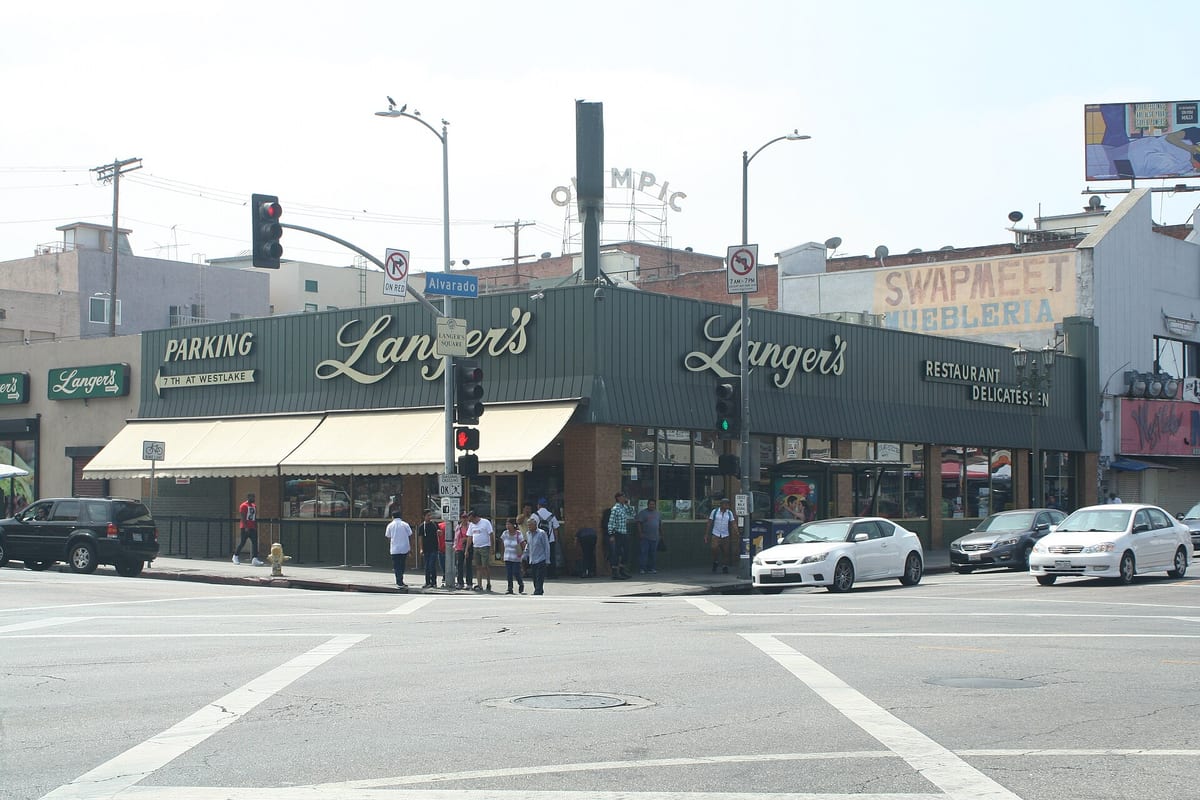 Photo: Josh Lim (Sky Harbor), Wikimedia Commons (CC BY-SA 4.0)
Langer's No. 19 — pastrami, Swiss, coleslaw, and Russian dressing on that double-baked rye — has been called, by the Los Angeles Times, "the Marilyn Monroe of pastrami sandwiches." That's not hometown hyperbole. It's a description of a sandwich that manages to be genuinely famous in a city that's famous for almost nothing else that isn't on a screen.
The neighborhood around Langer's tells its own version of this story. Westlake isn't Beverly Hills or the Fairfax District; it's a dense, working-class part of Los Angeles, largely Latino today, a long way from the glossy image most people have of the city. Langer's has stayed exactly where it opened in 1947, through decades of neighborhood change, through a period in the 1990s when some advised Al and Norm to move somewhere "safer." They didn't. The restaurant's own plaza is named Langer's Square now, a small, specific kind of civic recognition that New York's more famous delis, oddly, don't have.
That's the throughline in almost every serious L.A. Jewish deli story: immigrant families who came from somewhere else entirely (tailoring in Newark, tailoring across the Lower East Side, tailoring in a dozen cities that never got the credit New York did) and who built something permanent in a place nobody expected them to stay. It's the same instinct that built the garment trade a generation earlier: take a skill, refuse to cut corners on it, and let the work outlast the neighborhood's reputation.
Kosher-style, and why that isn't a contradiction
One thing worth clearing up, since it trips up a lot of people encountering this world for the first time: neither Langer's nor Katz's nor most of the famous names on this list are kosher in the certified, rabbinically-supervised sense. They're "kosher-style": built entirely on the flavors and techniques of Ashkenazi Jewish cooking, staffed and founded overwhelmingly by Jewish families, but open on Saturdays, serving cheesecake alongside corned beef, and carrying no supervision certificate. That's not a loophole or a lapse. It's simply a different, older lane of Jewish food culture, one that grew up serving working immigrant neighborhoods where a strictly kosher restaurant wasn't always financially viable, and where the food itself, not the certification, was the thing worth preserving.
That distinction matters here because it's part of why this cuisine ended up so widely beloved outside Jewish communities entirely. Kosher-style delis became, for a huge swath of twentieth-century America, the most common point of contact with Jewish food and Jewish culture generally: the place a Catholic kid from Queens or a Protestant family visiting Los Angeles first tried rye bread, first heard Yiddish words tossed around a counter, first understood that Jewish culture was something you could taste as well as read about. Langer's and Katz's are both, in that sense, doing quiet cultural work that has nothing to do with religious observance and everything to do with visibility.
An argument you're allowed to lose gracefully
None of this requires Katz's to be lesser. Katz's earned its plaque, its line out the door, its cameo in one of the most quoted scenes in American film. If you're in Manhattan and you want pastrami, walk in and order it — you will not regret it, and telling you otherwise would be dishonest.
But "best" and "most famous" aren't the same claim, and American food writing conflates them constantly, usually in New York's favor, because New York has always been better at telling its own story. Los Angeles's Jewish deli tradition didn't get the same mythologizing, and so it never had to perform for it. It just kept slicing, by hand, one knife, one family, one Tuesday lunch rush at a time, in a neighborhood most people drive past without knowing what they're passing.
That's the case for Langer's, and for Los Angeles more broadly: not louder, not more photographed, just quietly, stubbornly better at the one thing the whole argument is actually about. Order the No. 19. Argue about it after.
What "hand-sliced" actually costs a business
It's worth pausing on why so few delis still hand-slice their pastrami, because the answer explains a lot about why Langer's is treated as exceptional rather than merely traditional. A slicing machine is faster, more consistent, cheaper to staff, and doesn't require years of apprenticeship to operate safely. Every incentive in a modern restaurant business points toward automating that step. Hand-slicing means paying a skilled person a skilled wage to do, by hand, at a fraction of the speed, something a machine can do all day without complaint.
Restaurants that keep doing it anyway are making a specific bet: that the texture difference is real, that customers can tell, and that the slower, more expensive version is worth protecting even when nobody would notice if you quietly switched to a machine on a Tuesday afternoon. Langer's has made that bet for over seventy years running. It's the kind of decision that only looks obvious in retrospect, once the sandwich is already famous. In the moment, every single day, it's a choice to spend more and produce less, on the theory that the difference will still matter to the person ordering the No. 19.
A running list, if you want to make your own case
- Langer's (Los Angeles, 1947) — hand-sliced pastrami, double-baked rye, three generations, same family.
- Katz's (New York, 1888) — the original heavyweight, still worth the wait.
- Canter's (Los Angeles, 1931) — Fairfax District fixture, open since before Langer's existed.
- Manny's (Chicago, 1942) — South Loop cafeteria-style institution.
- Nate 'n Al's (Beverly Hills, 1945) — where the industry has eaten breakfast for eighty years.
- Josh's Deli (Surfside, Miami) — the new generation's entry, already Michelin-recognized.
Every city on that list has a family behind the counter who left somewhere else to build this. That's the real American Jewish deli story — not one capital, but a map of stubborn, specific places, each one arguing, quietly, that they got it right.
Kosher Couture was built on the same instinct that keeps Langer's slicing by hand: heritage worn daily, done properly, without shortcuts. If pastrami arguments are your love language, you'll probably also enjoy our take on the Lower East Side's appetizing stores — the other half of the classic New York deli spread.


