
Twelve Blocks That Once Out-Sang Broadway
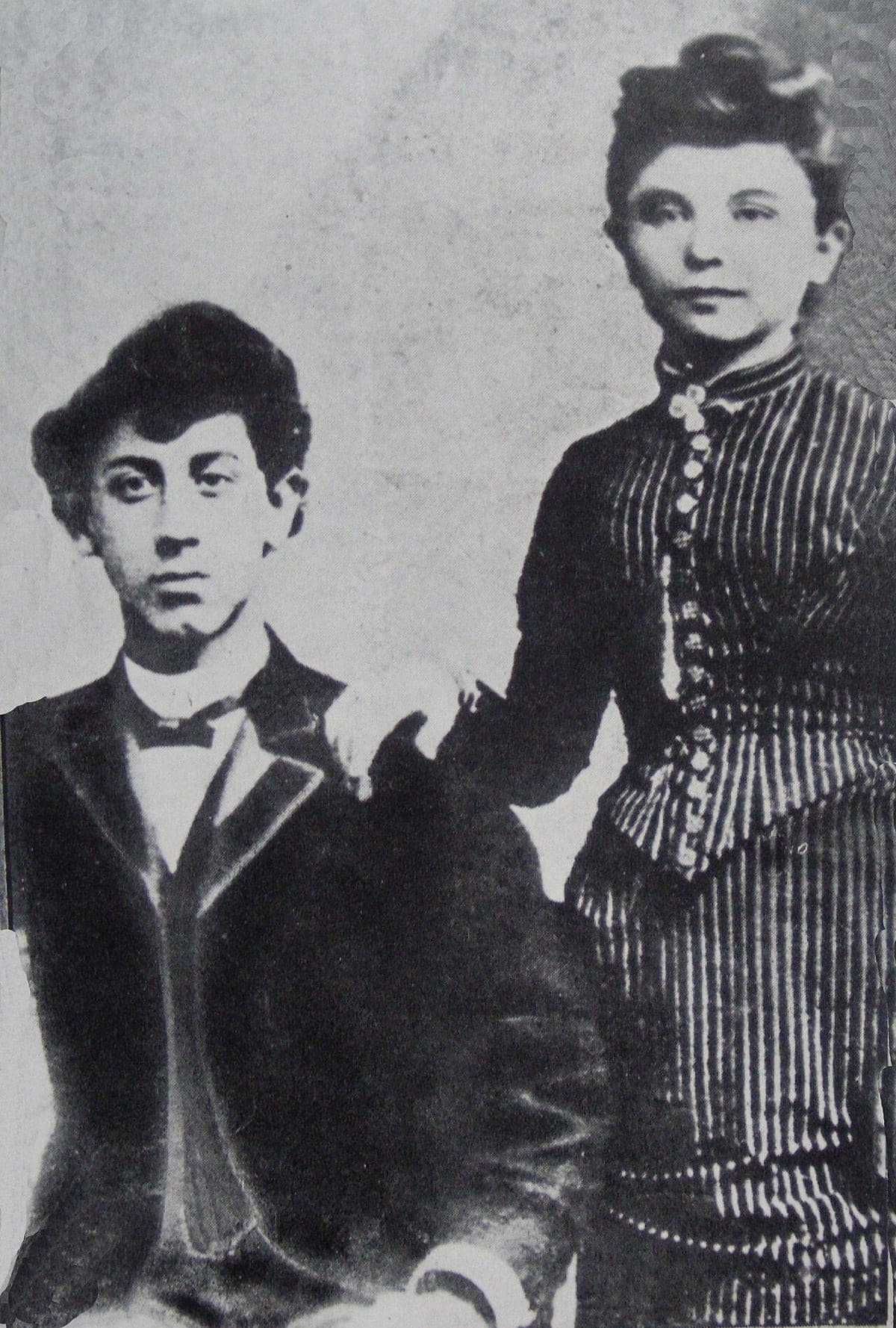
Start at Houston Street and walk north up Second Avenue toward 14th. Today you'll pass a Trader Joe's, some NYU housing, a few surviving diners, and the ordinary churn of the East Village. Nothing about the sidewalk tells you that for roughly fifty years, this stretch of avenue was the busiest, most electric theater district most Americans have never heard of, bigger, for a while, than anything happening a mile west on the actual Broadway.
They called it the Yiddish Rialto. Some called it Yiddish Broadway. By 1925 it had more than a dozen working theaters packed into a corridor running from 14th Street down to Houston, and it was pulling in audiences that Broadway itself would have envied: over a million and a half first- and second-generation Eastern European Jewish immigrants passed through these houses in the neighborhood's peak decades, watching everything from Shakespeare translated into Yiddish to original musical comedies to political dramas that would never have made it past a Broadway producer's desk. This is a walking tour of a street that mostly no longer exists, told through the people who made it, whose names are still, quite literally, embedded in the sidewalk.
Houston Street: where the walk of fame starts
Begin at the southern end, near Houston Street, and look down. Village Preservation, the local historic preservation group, installed a set of granite plaques into the pavement here, the Yiddish Theatre Walk of Fame, bearing the names of fifty-eight performers who built this district. You're standing on a memorial that most pedestrians walk over without noticing, for an industry that once employed thousands of actors, musicians, stagehands, scenic painters, and theater managers within a few square blocks.
This is also roughly where the immigrant Lower East Side itself began to shade into the East Village, which tells you something about why the theater district sat exactly here. It needed to be close enough to the tenements where its audience actually lived (the same streets where Joel Russ was building his appetizing business and where thousands of families worked in the nearby garment shops), but it also needed real theater-sized buildings, which meant edging slightly north and east into blocks that could support that kind of construction.
The Thalia, and the sound of a neighborhood arguing with itself
Walk a few blocks up and you'd have passed the site of the Thalia Theatre, one of the district's foundational houses. Yiddish theater in New York wasn't one thing. It was, from the start, an argument between competing visions of what immigrant culture should be. One faction wanted "shund": broad, unapologetically commercial melodrama and musical comedy, full of coincidence plots, comic relief, and crowd-pleasing songs. Another wanted serious literary theater: August Strindberg and Henrik Ibsen in Yiddish translation, original work wrestling with assimilation, labor politics, and religious identity. The Thalia and its rival houses fought this argument out nightly, with real box office money on the line, in front of audiences who were themselves living through the exact tensions the plays were dramatizing: how much of the old world do you keep, how fast do you become American, who gets to decide.
That argument, it's worth saying, never really ended. It just moved. You can hear its descendants in every debate American Jewish communities still have about assimilation, observance, and what gets preserved versus what gets let go.
The Yiddish Art Theatre and the case for taking immigrant audiences seriously
A few blocks further sat the Yiddish Art Theatre, built and run by Maurice Schwartz, an actor-manager who insisted, against the shund faction's commercial instincts, that immigrant, working-class, Yiddish-speaking audiences deserved genuinely serious theater, not condescending entertainment. Schwartz mounted ambitious, artistically rigorous productions and built a company disciplined enough to be taken seriously by non-Yiddish-speaking critics who wandered down to see what the fuss was about.
That's a bet that could easily have failed. Serious theater about serious subjects, performed in a language most of literary New York couldn't read a review of, aimed at an audience working six-day weeks in garment shops and appetizing stores: nothing about that combination screams commercial viability. It worked anyway, for decades, because Schwartz correctly judged that his audience's appetite for real drama was being badly underestimated by everyone who wasn't in the room with them.
Second Avenue Theatre, and the stars who filled it
Keep walking and you'd reach the district's other big houses: the Second Avenue Theatre, the National, the Grand, the Windsor, the People's Theatre, the Yiddish Folks Theatre, each one competing for the same nightly foot traffic, each one built to hold a genuinely large crowd. This wasn't a scrappy storefront-theater scene. These were real houses, built at real scale, because the audience was real and it showed up.
The performers who filled those houses became, within the immigrant community, as famous as any Broadway star of the era. Boris Thomashefsky and his wife Bessie arrived from Eastern Europe as teenagers in the 1880s and helped build Yiddish theater in New York from something close to nothing into the institution it became. Molly Picon became one of the form's biggest crossover stars, beloved enough that her name eventually meant something to American audiences who'd never seen a Yiddish-language production. Paul Muni started here before Hollywood ever heard of him. His path from the Yiddish Rialto to major studio pictures is one of the clearest lines running from this specific street to the American entertainment industry writ large.
Here's the detail that still catches people off guard: Boris Thomashefsky's grandson is Michael Tilson Thomas, the celebrated conductor who spent decades leading the San Francisco Symphony. Boris died before his grandson was born, but Bessie lived until Michael Tilson Thomas was seventeen, and in 2005 he staged "The Thomashefskys," a full orchestral concert built around his grandparents' lives and work, a direct, deliberate act of a world-class classical musician reclaiming his family's Yiddish theater roots for a modern concert hall audience. That's not a coincidence of genealogy. It's a fairly direct illustration of how far this specific street's influence actually traveled.
What Second Avenue actually gave American entertainment
It's tempting to file all of this under nostalgia: a vanished neighborhood attraction, interesting the way an old postcard is interesting. That undersells what actually happened here. The comic timing, the musical-comedy structures, the specific blend of pathos and joke that defined Yiddish theater's popular wing didn't disappear when the theaters closed. It migrated. Historians trace direct lines from Second Avenue's stagecraft into the Catskills resort comedy circuit a generation later, into early television variety shows, into the DNA of Broadway productions that followed, Fiddler on the Roof being the most obvious inheritor, a show that essentially translated the Yiddish theater's own subject matter back into English for a mainstream American stage.
Performers who started here scattered into every corner of American entertainment. Leonard Nimoy, a name nobody associates with Second Avenue, is counted among the figures whose work carries traceable roots back to this same tradition. That's the real scale of what happened on these twelve blocks: not a self-contained ethnic theater scene that lived and died in isolation, but a training ground and proving stage that fed directly into the mainstream of American popular culture for the rest of the century.
The building that's still standing, if you know where to look
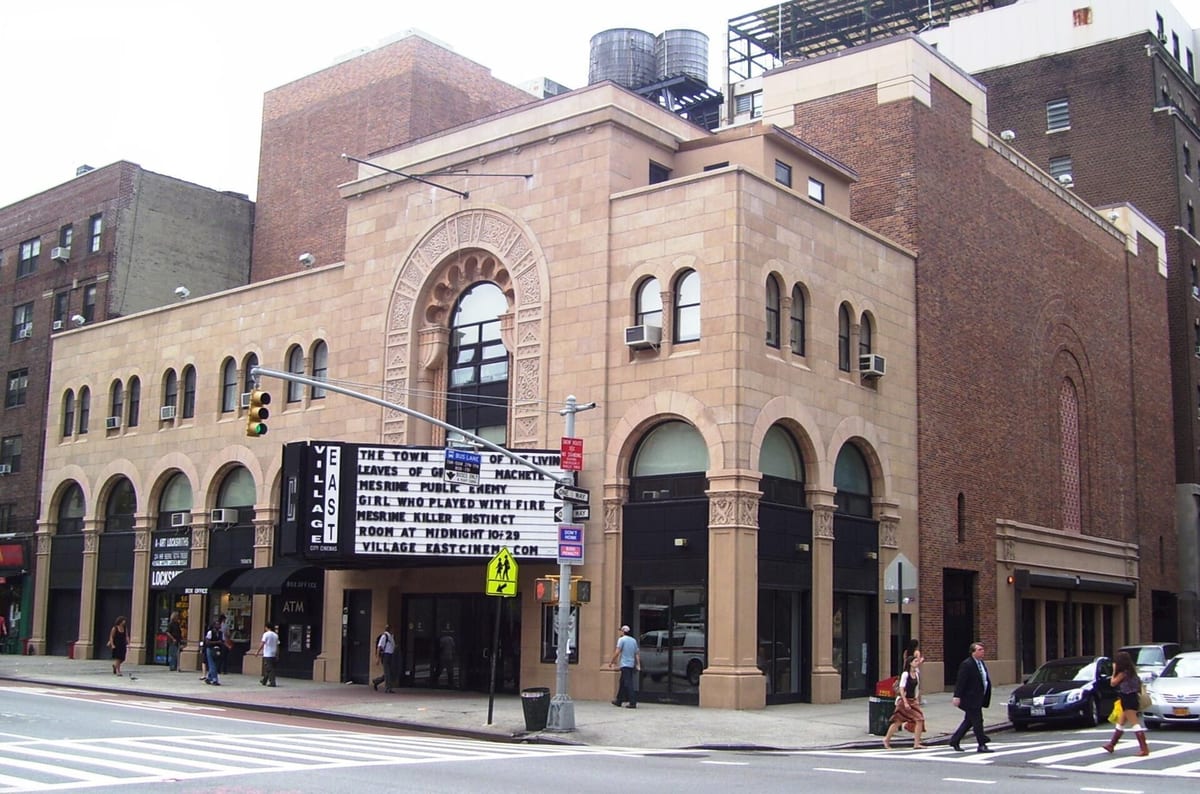 Photo: Beyond My Ken, Wikimedia Commons (CC BY-SA 4.0)
Not everything is gone. A block or so up from Houston, the building that once housed the Yiddish Art Theatre is still standing. These days it operates as the Village East Cinema, a multiplex most New Yorkers know only for its ordinary movie showtimes. But look up past the marquee and you'll see it: an ornate, Moorish-revival stone facade with a deep arched window, unmistakably built for something grander than a chain movie theater. That arch is original. It was designed to signal exactly what this neighborhood no longer advertises about itself: that this was once a serious, architecturally ambitious cultural institution, built to compete with anything happening on the actual Broadway a mile away.
Inside, the theater's bones are largely intact too, repurposed rather than demolished, which is more than most of the district's other houses can say. It's one of the only places left on this walk where you can stand in a room that Maurice Schwartz's company actually performed in, watching a very different kind of show, in a building that hasn't stopped being a theater in over a century, even if almost nobody buying a ticket today knows what it used to be.
Why the street itself disappeared
None of the houses that anchored this district are still operating as Yiddish theaters. Assimilation did some of the work: as immigrant families moved to the outer boroughs and their English-speaking children stopped needing Yiddish-language entertainment, the built-in audience shrank generation by generation. Film and then television did more of it, offering the same comic and dramatic appetites in a cheaper, more convenient format. By the middle of the twentieth century, the theaters were closing, converting to movie houses, or simply being demolished.
What's left is mostly underfoot: the Walk of Fame plaques near Houston Street, a scattering of building facades that theater historians can still identify if you know what you're looking at, and an oral and archival record kept alive by institutions like the Museum of the City of New York and the Yiddish Book Center, which have both mounted serious exhibitions reconstructing exactly what this district looked and sounded like at its peak.
The songwriters who crossed the room
One more connection is worth making before this walk ends, because it explains why Second Avenue's influence didn't stay confined to theater at all. The same Lower East Side and East Village blocks that housed the Yiddish Rialto were also, in these same decades, producing an enormous share of the songwriters, composers, and music publishers who built what became known as Tin Pan Alley, the Midtown sheet-music industry that essentially invented the commercial American popular song. Musicians moved constantly between the two worlds: a composer might write a melody for a Second Avenue melodrama on Monday and sell a pop song built on the same musical instincts to a Tin Pan Alley publisher by Friday. The theatrical training this street provided (how to build a tune that lands with an audience in real time, how to time a laugh line against a musical cue) turned out to transfer directly into the commercial songwriting trade a few subway stops away.
That's the pattern running underneath this entire tour, if you zoom out far enough: Second Avenue wasn't a side room off of American culture. It was one of the rooms where American popular culture, in something close to the form we'd recognize now, actually got built.
Walking it yourself
If you want to actually do this walk, here's the rough shape of it, north to south along Second Avenue between Houston and 14th Street:
- Start at Houston Street and find the Yiddish Theatre Walk of Fame plaques set into the sidewalk.
- Move north through the blocks that once held the Thalia, the National, and the Grand — mostly unmarked today, but historically documented.
- Note the Yiddish Art Theatre's former site, associated with Maurice Schwartz's ambitious, literary programming.
- Continue toward 14th Street, roughly the district's northern edge, where the Second Avenue Theatre and several of the larger houses once stood.
- Finish by looking up, not down — most of what survives is in upper-floor window shapes and building outlines original to the 1910s and 1920s, easy to miss if you're only watching the sidewalk.
None of the theaters are still there to walk into. But the street still runs the same twelve blocks it always did, and knowing what used to fill them changes what an ordinary East Village walk actually is: a walk through the single most productive few blocks of Jewish American culture that most people, Jewish and otherwise, have simply never been told about.
Kosher Couture exists because we think stories like this deserve to stay in circulation, not just in an archive. For more on the neighborhood immediately south of here, read our history of Russ & Daughters and the Lower East Side's appetizing stores, a different immigrant institution, built the same decade, a short walk away.


