
Why Jewish Humor Belongs on a T-Shirt

Jewish humor is one of America's founding comic traditions: it ran from the wedding jesters of Eastern Europe through vaudeville, the Catskills' Borscht Belt resorts, and the golden age of stand-up, then straight into sitcoms like Seinfeld and The Marvelous Mrs. Maisel. A famous 1978 study by psychologist Samuel Janus found that while Jews were about 3 percent of the U.S. population, they made up roughly 80 percent of the country's professional comedians. We'd argue the pun T-shirt is this tradition's latest chapter, and we're going to make that case with a straight face, mostly.
Yes, we sell joke shirts, so of course we'd say that. But hear us out, because the history genuinely backs us up. Jewish humor has always been portable, communal, and worn on the outside: a way of saying who we are, out loud, in public, with a grin. A good pun tee does exactly what a Borscht Belt tummler did. It walks into a room and gets the whole place laughing together.
Before the Punchline: Humor as Survival Equipment
Long before comedy clubs, Eastern European Jewish life had a professional comedian on the payroll: the badchen, the wedding jester whose job was to make the bride cry with a sentimental rhyme and then make the whole hall roar. Humor wasn't a break from Jewish life; it was built into its biggest moments.
The shtetl produced a whole comic literature to match. Sholem Aleichem, the Yiddish writer whose Tevye stories became Fiddler on the Roof, perfected the voice that still defines Jewish humor: the wry monologue of a man arguing with God, fate, and his horse, and losing all three arguments with style. The classic folk tales of Chelm, the legendary town of fools, taught generations that laughing at absurdity is a way of surviving it.
That's the root of the whole tradition. Jewish humor grew up in communities that had little power and less security, and it did what humor does best under pressure: it turned fear into wit and made the joke land before anyone else could throw a punch. Sigmund Freud noticed this as early as 1905, observing in his book on jokes how remarkably Jewish humor turned inward, a people telling jokes about themselves, on their own terms. Self-deprecation, done right, is self-possession. You can't humiliate someone who got there first, laughing.
Vaudeville and the Second Avenue Stage
When two million Eastern European Jews arrived in America between 1880 and 1924, the humor came steerage class with them, and it found stages fast. New York's Second Avenue Yiddish theater district packed houses nightly with melodrama and comedy, while vaudeville turned Jewish performers into national names: the Marx Brothers, whose anarchic wordplay was shtetl absurdism at Broadway speed; Fanny Brice, whose comic songs made her a superstar decades before Barbra Streisand played her in Funny Girl; Sophie Tucker; Eddie Cantor; George Burns; Jack Benny, whose whole act was a masterclass in the comic pause.
Notice what traveled: the wordplay, the timing, the self-owned exaggeration. And notice the direction of the jokes, at ourselves, at pomposity, at life's absurdity, almost never downward at someone else. That instinct wasn't an accident. It was the tradition's oldest rule, and it would define everything that came next.
The Borscht Belt: Comedy's Greatest Training Ground
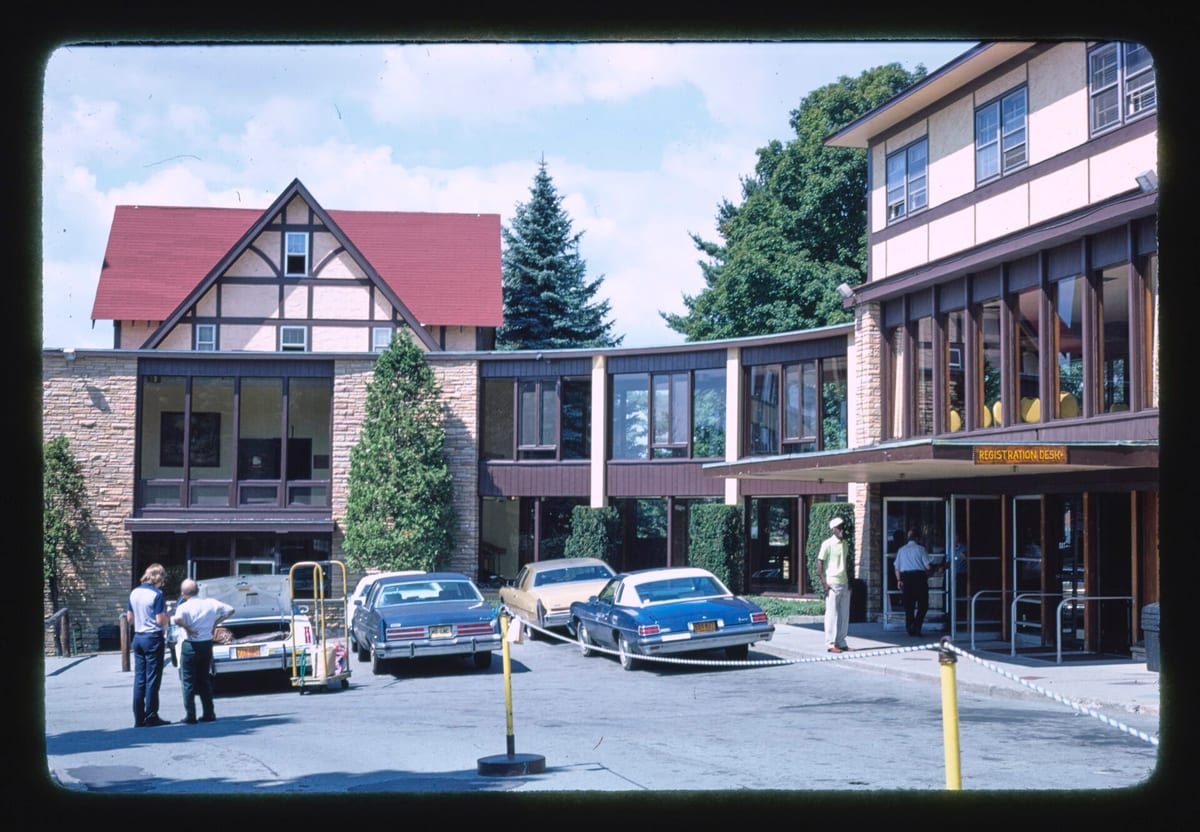 Photo: John Margolies, Library of Congress (Public domain)
From the 1920s through the 1960s, and peaking between 1945 and 1965, the Catskill Mountains of upstate New York hosted the Borscht Belt: a sprawling constellation of Jewish-owned resorts, hotels, and bungalow colonies that grew out of farmhouses taking in summer boarders. The big ones were small cities. Grossinger's covered 1,200 acres with 35 buildings, its own airstrip and post office, and the distinction of being the first resort anywhere to ski on artificial snow. The Concord's dining and entertainment hall seated 3,000. Kutsher's and the Nevele rounded out a circuit where a comic could work every night of the summer.
And what a graduating class it produced. Sid Caesar, Mel Brooks, Jerry Lewis, Joan Rivers, Buddy Hackett, Jackie Mason, Lenny Bruce, Phyllis Diller, and a young Jerry Seinfeld all worked Catskills stages. Henny Youngman perfected the one-liner there ("Take my wife, please" remains the most efficient joke in the English language). The audiences were famously merciless, which is exactly why the training worked: if you could make a room full of people who'd heard everything laugh after a five-course dinner, you could make anyone laugh.
The Borscht Belt style, fast, verbal, self-mocking, warm underneath the needling, became the DNA of American stand-up. When television arrived, it hired the whole mountain. Milton Berle, a vaudeville and Catskills veteran, became "Mr. Television" when his Texaco Star Theater helped sell America on the new medium in 1948; families reportedly bought their first TV sets just to watch him on Tuesday nights. Sid Caesar's Your Show of Shows put a writers' room together that included Mel Brooks, Carl Reiner, and Neil Simon, possibly the highest density of comic talent ever assembled in one room, and Brooks and Reiner's "2000 Year Old Man" routine carried the cadence of the Catskills onto million-selling records.
From Stand-Up to Sitcom to Streaming
By 1978, when psychologist Samuel Janus presented his decade-long study of American comedians, the numbers were staggering: Jews were roughly 3 percent of the U.S. population and about 80 percent of its professional comedians. His interview list read like a comedy hall of fame: Milton Berle, George Burns, Sid Caesar, Mort Sahl. Janus argued the humor was forged in hardship and outsiderness, which tracks with everything the tradition had been saying about itself since Chelm.
Television and film carried it into every American living room. Woody Allen and Joan Rivers reinvented stand-up as confession. Mel Brooks put Yiddish in the mouths of cowboys and Indians in Blazing Saddles. Gilda Radner and Andy Kaufman bent it into new shapes. Then came the sitcom age: Seinfeld, which ran from 1989 to 1998 and turned kvetching about nothing into the most successful comedy in television history, and Curb Your Enthusiasm, where Larry David proved the kvetch could carry prestige TV. The Marvelous Mrs. Maisel closed the loop in 2017, sending its heroine from a Manhattan bra fitting to a Catskills resort stage, a loving recreation of the exact world where the whole style was sharpened. Even the Catskills themselves are back: a Borscht Belt Museum now celebrates the region's comedy heritage in Ellenville, New York.
Follow the thread from the badchen to the Borscht Belt to your streaming queue and one thing never changes: the humor is an identity worn proudly in public. Which brings us, at last, to your chest.
The Case for the Pun Tee
A T-shirt is the most democratic stage ever invented. No cover charge, no two-drink minimum, no gatekeeper deciding who gets five minutes. You put the joke on in the morning and perform it all day, in line for coffee, at the school pickup, across the gym. Sound familiar? It's tummling, the Borscht Belt art of roaming the resort making strangers laugh, minus the salary.
And the Jewish pun is uniquely suited to the format. Jewish humor has always been compressed, verbal, and bilingual, bouncing between Yiddish, Hebrew, and English for effect, and a shirt gives you exactly one line to work with. Henny Youngman would have understood the constraint perfectly. The pun tee is the one-liner's retirement home, and the one-liner has never looked healthier.
There's something else, too, and we'll say it in our earnest voice. Wearing a Jewish joke is a double statement: the joke itself, and the deeper statement that we're still here and still laughing. The tradition has a name for this register, laughter through tears, the mode Sholem Aleichem made his life's work, and it has never stopped being relevant. This company was founded after October 7th, in a season when many of us felt the pull to be visibly Jewish in daily life and found that most pride apparel was priced like a luxury good. We built a cheaper way, because joy shouldn't have a velvet rope. Choosing to laugh, publicly, in a Jewish voice, is not a small thing right now. It never was.
A tradition that survived everything history threw at it by turning pain into punchlines deserves to be celebrated in daylight, not filed away in a drawer. Humor with pride is one of the four pillars this company stands on, and it's why our Yiddish Yarns collection exists: real wordplay, rooted in real language, worn out loud. Every shirt is printed on demand rather than warehoused, and ten percent of net profits goes to Jewish community charities, which means the joke on your chest is quietly doing a mitzvah behind your back.
The Family-Simcha Test
Not every joke earns the shirt, and the tradition itself tells us where the line is. Jewish humor at its best is self-owned: we tell the jokes about ourselves, with affection, from the inside. It punches with pride, never down and never at anyone.
So here's the test we run every design through: would you wear it to a family simcha? Picture the bar mitzvah, the wedding, the bris. Your bubbe is there. The rabbi is there. Your most easily delighted cousin and your most easily offended one are both there. If the shirt would make that whole room smile, including the people the joke is nearest to, it passes. If it mocks rather than celebrates, if it trades on a stereotype instead of a shared wink, it dies on the drawing board, no matter how clever the wordplay. (For the full what-to-wear playbook, we wrote a bar mitzvah dressing guide.)
That's not a marketing filter; it's the same rule the badchen worked under. The wedding jester's job was to make the community laugh together, the bride and the beggar at the same table, at the same moment. Every great practitioner of this tradition, from Fanny Brice to Jerry Seinfeld, understood the assignment: the laughter is the glue, not the weapon. The day the joke divides the room, it stops being Jewish humor and starts being something cheaper.
FAQ
What was the Borscht Belt?
The Borscht Belt was a collection of Jewish-owned resorts, hotels, and bungalow colonies in New York's Catskill Mountains, flourishing from the 1920s through the 1960s. Resorts like Grossinger's, the Concord, and Kutsher's hosted thousands of guests and nightly entertainment, and their stages trained a generation of American comedians.
Why have so many famous comedians been Jewish?
Samuel Janus's 1978 study found Jews were about 3 percent of the U.S. population but roughly 80 percent of its professional comedians, and he traced the gap to humor forged by hardship and outsider status. Centuries of using wit as a survival tool, plus institutions like Yiddish theater and the Borscht Belt that professionalized it, turned a coping mechanism into a craft.
What makes Jewish humor different from other comedy traditions?
Its signature is self-deprecation with dignity: the jokes point inward or upward at life's absurdity, not downward at the vulnerable. It's verbal rather than physical, thrives on wordplay across Yiddish, Hebrew, and English, and treats laughing at trouble as a form of resilience rather than denial.
What makes a Jewish joke shirt tasteful instead of offensive?
Ask who's laughing and at whom. A good design celebrates from the inside, would pass at a family simcha, and never leans on stereotypes or sacred text. If the people closest to the joke would grin and ask where you got it, you're on the right side of the line.
Is it okay to wear a Jewish pun shirt if I'm not Jewish?
If you get the joke and wear it with affection, most of us will just be delighted you got the joke. Gift buyers and friends of the community have always been part of the audience; the Marx Brothers didn't check tickets for ancestry. Wear it with warmth and be ready to explain the pun, badly, at parties.
The tradition's next stage is a cotton one; browse our tees and find the one-liner you were born to deliver.


