
In Praise of the Shabbos Elevator
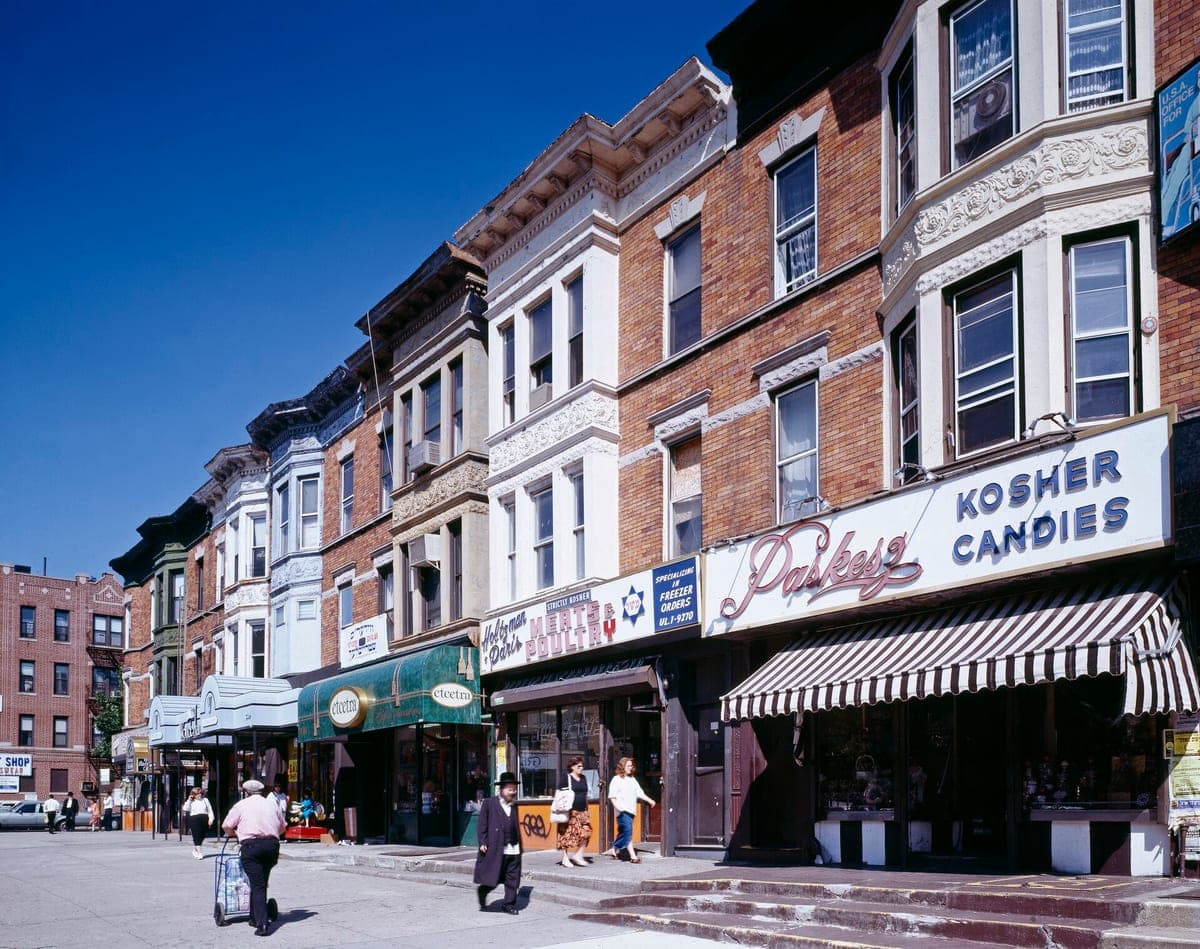
It's Friday evening in Crown Heights. Candles are already lit two floors up, the challah's under a cloth, and a man juggling grocery bags steps into the lobby elevator of his apartment building. He doesn't reach for the panel. He doesn't need to. The doors close, the car starts to rise, and it stops — patiently, unhurriedly — at two, then three, then four, doors sighing open and shut at every floor whether anyone's waiting there or not. Nobody in the car touches a button the entire ride. This is a Shabbos elevator, and if you've never lived near one, the first ride feels like keeping time with the building's own unhurried heartbeat.
For six days a week, that same elevator behaves like any other elevator in New York: call it, press 9, get where you're going. But from candle-lighting Friday to nightfall Saturday, and on the major Jewish holidays, the panel goes quiet. A pre-set timer takes over, cycling the car up and down, opening the doors at every floor in sequence, no request required. It's an engineering answer to a religious question, and it's one of the most quietly ingenious pieces of infrastructure most people who've never spent time in Boro Park, Crown Heights, or Lakewood have never even heard of.
Why Not Just Push the Button?
The prohibition against work on Shabbat is about as foundational as Jewish law gets. It's right there in the Ten Commandments: "Six days you shall labor and do all your work, but the seventh day is a sabbath of the ETERNAL your God... you shall not do any work" (Exodus 20:9-10). A few chapters later, right after the Torah spends chapter after chapter laying out, in painstaking detail, how to build the Mishkan — the portable sanctuary the Israelites carried through the wilderness — it circles back to Shabbat again, calling it "a sign for all time" between God and the Jewish people (Exodus 31:12-17).
That placement isn't an accident, according to the rabbis of the Mishnah. Mishnah Shabbat 7:2 lists the melacha — the categories of labor forbidden on Shabbat — sowing, plowing, baking, weaving, building, kindling a fire, and more, thirty-nine in total, or "forty-less-one" in the Mishnah's own economical phrasing. The traditional understanding is that these categories are drawn precisely from the kinds of labor used to build the Mishkan: if it was work involved in constructing God's dwelling place, it's work set aside on the day set aside for God.
Nowhere on that list, obviously, is "operate an elevator." The rabbis who compiled the Mishnah roughly two thousand years ago had never seen a light switch, let alone a hydraulic lift. Electricity as a category of Shabbat concern is a modern question, worked out over the last century-plus by rabbinic decisors (poskim) responding to a world their sources never anticipated — this is applied halacha, reasoned out one responsum at a time, not a ruling handed down at Sinai. Many halachic authorities hold that completing an electrical circuit falls within the broader framework of melacha, variously analyzed under categories like building (boneh) or kindling (mav'ir); poskim differ on the precise mechanism even where they land on the same practical conclusion. Nothing in the Torah or the Talmud mentions electricity, because electricity as we use it didn't exist yet. What exists is a live, ongoing tradition of applying an ancient framework to a genuinely new problem — and doing it seriously.
Which is really the point of the whole story. The elevator button isn't avoided because some ancient text foresaw elevators. It's avoided because pressing it completes a circuit, and a great many halachic authorities have concluded that doing so falls under categories of melacha first defined two millennia ago. Somebody — several somebodies, engineers and rabbis working in tandem — looked at that conclusion and asked a better question than "how do we get around this." They asked: how do we build something that simply doesn't create the problem in the first place?
A Machine Built Around a "No"
That's what makes the Shabbos elevator — also spelled Shabbat elevator — such a satisfying piece of design. It doesn't ask anyone to compromise, and it doesn't require an attendant, a special key, or a workaround performed in a moment of forgetting. The building itself changes its behavior for about twenty-five hours a week, plus the holidays, running a slow, automatic, floor-by-floor cycle so nobody riding it ever needs to touch a control. No circuit gets completed by a human hand. Nobody has to choose between getting upstairs and keeping Shabbat.
That's worth sitting with for a second. A lot of what passes for religious accommodation in public life amounts to a note taped to a door, an exception granted if you ask nicely, a workaround you have to advocate for in the moment. The Shabbos elevator is a different animal entirely. It's baked into the building. Nobody has to explain themselves to a doorman or feel like a guest in their own home one day out of seven. Observance, quite literally, engineered into the architecture — thought through in advance so that on the day itself, nobody has to think about it at all.
Mechanically, it's not exotic — a timer or programmable controller switches the elevator into an automatic cycling mode, and the car simply stops at every landing in sequence, holds the doors long enough for someone to get on or off, and moves on, over and over, for the length of Shabbat. What makes it remarkable isn't the wiring. It's the coordination it represents: building management, elevator manufacturers, and rabbinic authorities all working from the same set of specifications, agreeing on exactly what the halacha requires and translating that into a control panel. Some installations use a certified "Shabbos mode" package from the elevator manufacturer itself; older or smaller buildings sometimes rely on a simpler timer retrofit. Either way, it's the rare piece of building code that exists because a religious community asked for it, explained precisely why, and got an engineering answer instead of a shrug.
Where You'll Find Them
Shabbos elevators show up wherever a critical mass of Shabbat-observant residents, patients, or guests makes it worth programming one in. That includes:
- Apartment buildings in Boro Park and Crown Heights, Brooklyn — two of New York City's largest Orthodox communities, where a building with dozens of observant families might run every elevator on Shabbat mode from Friday afternoon on.
- Lakewood, New Jersey, home to one of the largest yeshiva communities outside Israel, where the same logic applies to apartment complexes and public buildings alike.
- Hospitals, both in heavily Orthodox neighborhoods and well beyond them — a hospital serving any Shabbat-observant patients, visitors, or staff has real reason to keep at least one elevator bank running automatically, because a hospital doesn't get to close for the weekend.
- Hotels in and near Orthodox communities, and near major Jewish pilgrimage and tourism sites.
- Jerusalem, where Shabbat elevators are common enough in apartment buildings, hotels, and public buildings that many visitors encounter one before they've fully adjusted to the time zone.
None of this is universal, and it shouldn't be read as a checklist for "real" observance. Plenty of Shabbat-observant Jews live in buildings without one and simply take the stairs — some by choice, some because their building never installed one, some because they hold by an approach to electricity on Shabbat that doesn't lean on this particular workaround at all. And plenty of people who ride Shabbos elevators every week keep Shabbat in a dozen other ways that have nothing to do with elevators. Observance isn't a ladder with the elevator riders at the top; it's a wide, varied practice, and this is one especially clever expression of it — a solution to one specific, very literal problem: how do you get from the lobby to the ninth floor without anyone having to choose.
The Slow Ride Is Part of the Charm
Here's the part longtime riders will tell you with a laugh: a Shabbos elevator is not fast. If you're headed to the top floor of a fifteen-story building and it's already stopped at two, three, and four before you even got on, you are going to have some time to think. There's a particular, very specific patience that comes from knowing your ride home involves a full tour of every landing in the building, whether or not a single other person gets on or off. Regular riders learn to budget the extra minutes the way New Yorkers budget for a delayed train — with mild resignation and zero real complaint, because everyone in the car is in on the same joke.
It's a small, self-aware kind of humor, and it belongs to the people who actually live with it — the Boro Park grandmother running late for candle-lighting, the Crown Heights teenager doing the math on whether the stairs are actually faster, the hospital chaplain who's ridden the same slow car a thousand times. Nobody's mocking the mitzvah by noting that the ride is long. They're just telling the truth about it, the way you'd tell the truth about a beloved but cranky family car. The slowness isn't a flaw in the design. It's the design working exactly as intended — every floor, every time, no exceptions, no judgment calls.
Quiet Design, Loud Values
The Shabbos elevator isn't the only piece of everyday engineering built around Shabbat observance, though it might be the most architecturally ambitious. Several major appliance manufacturers offer a "Sabbath mode" on ovens and ranges — a setting that disables the digital displays, beeps, and automatic on/off functions that would otherwise involve prohibited actions, so a pre-set oven can keep food warm through Shabbat without anyone touching a control once it starts. Timers on lights serve a similar purpose in homes without a smart-home solution at all. None of it gets discussed nearly as much as it deserves, mostly because it's designed to be invisible — which is, in its own way, the highest compliment you can pay a piece of engineering built around someone else's values.
That's the throughline running under all of it, and under a lot of what we care about at Kosher Couture: heritage that gets lived daily rather than reserved for special occasions. A Shabbos elevator isn't a statement piece. Nobody points at it. It's just there, quietly doing its job, the same way a grandmother's recipe or a specific melody at the seder table just is — inherited, functional, and completely unremarkable to the people who grew up with it, and completely remarkable to everyone else. We think that's worth noticing out loud, the same way we think wearing your heritage on a T-shirt on a random Tuesday is worth doing, not just on the holidays. If any of this resonates, our shelves at Kosher Couture are built on that same idea — and if you want the fuller picture of what a Shabbat actually involves beyond the elevator ride, our guide to observing Shabbat is a good next stop.
The Point of the Whole Thing
What gets us about the Shabbos elevator, in the end, isn't the mechanism. It's the intention behind it. Somewhere, at some point, a community looked at a piece of infrastructure that every single resident needed to use every single day, recognized that as currently built it would force some of them into an impossible choice, and decided the correct response wasn't a workaround or an apology. It was a redesign. Quiet, unglamorous, permanent — a machine that says, in its own patient, floor-by-floor way, that nobody in this building should ever have to choose between where they're going and who they are.
That's chutzpah of a very specific kind: the confidence to say a piece of shared infrastructure should bend to fit a religious life, not the other way around, and the follow-through to actually build it. It's in Kosher Couture's DNA the same way it's in that elevator's wiring. Next time you're standing in a lobby in Boro Park or Crown Heights or Jerusalem, watching the numbers light up one floor at a time with nobody touching a thing, give it a second look. It's slow because it's thorough. It's automatic because somebody cared enough to make it that way. And it gets absolutely everyone where they're going — on time for candle-lighting, without a single button pressed.


