
Keeping Kosher: A Modern Guide to Kashrut

Keeping kosher means following kashrut, a system of dietary laws rooted in Torah that shapes what observant Jews eat and how they prepare food. These laws are far more than health guidelines, they're a spiritual practice woven into daily life, a visible reminder of Jewish identity, and a bridge connecting modern Jews to thousands of years of tradition. Whether you're exploring kashrut for the first time or deepening your practice, understanding the "why" behind these rules transforms them from a set of restrictions into a meaningful expression of heritage.
Where Kashrut Comes From
The Torah's Books of Leviticus and Deuteronomy contain the biblical foundations of kashrut, written roughly 3,000 years ago. But the Torah doesn't hand out a complete instruction manual, it provides principles, and the real complexity comes from how rabbinical tradition interpreted and expanded those principles over centuries.
The Talmud, the Mishnah, and the writings of medieval rabbis like Maimonides built an entire legal framework around the biblical verses. This wasn't about rewriting Torah; it was about translating ancient rules into livable practice for Jews scattered across continents, facing different climates, different animals, and different food systems.
The Torah itself gives few explicit reasons for the laws. Medieval and modern scholars have offered spiritual, philosophical, and practical explanations: that kashrut marks Jewish distinctiveness and helps preserve cultural identity; that it cultivates mindfulness about consumption; that certain practices reflect ethical principles about animal treatment. The honest answer is that we don't know definitively why each specific prohibition exists. What we do know is that keeping kosher has survived every exile, diaspora, and cultural pressure for millennia.
The Core Rules of Kashrut
Permitted and Prohibited Animals
The Torah provides straightforward criteria: land animals must have split hooves and chew their cud. Fish must have both fins and scales. Birds are identified by a list of prohibited species (mostly birds of prey and scavengers), so "kosher birds" are those not on that list, chicken, turkey, duck, goose. Shellfish, reptiles, insects, and certain mammals like pork and rabbit are off-limits.
This isn't arbitrary. Some rules align with practical concerns, shellfish spoil quickly and caused real health risks in ancient times. Others seem to have no obvious reason beyond tradition. The point isn't to justify every restriction but to understand that kashrut isn't a diet; it's a legal system with philosophical weight behind it.
Today, buying kosher-certified meat from a reputable source is the simplest path. A kosher certification means an independent certifier has verified the animal, the slaughter method, and the handling.
Shechita: Kosher Slaughter
One of the most misunderstood parts of kashrut is shechita, the ritual slaughter of animals. A trained, certified shochet (slaughterer) performs this work, using a perfectly sharp blade to make a swift, precise cut to the neck, severing the major arteries and veins. Done correctly, it's over in seconds, the animal doesn't see it coming.
The point isn't cruelty; it's the opposite. The specific method exists precisely because it's designed to minimize suffering and ensure the fastest possible loss of consciousness. The blood is then drained completely, because consuming blood is explicitly prohibited in Torah.
If this feels foreign, remember that most of modern food production is far less humane. Shechita, by design, is one of the least stressful methods of slaughter.
Meat and Dairy Separation
"You shall not cook a kid in its mother's milk." This single verse appears three times in the Torah, and from those three repetitions, Jewish tradition draws a comprehensive rule: you may not cook meat and dairy together, eat them together, or even benefit from a dish that mixes them.
This separation is absolute for observant Jews: separate dishes, separate utensils, separate sponges. Some keep a gap of several hours between eating meat and dairy (the waiting time varies by community, Ashkenazi tradition often calls for six hours, Sephardic communities sometimes less). The reasoning varies: some cite the ethical principle of not cooking an animal in its mother's nourishment; others see it as a discipline that slows consumption and builds mindfulness.
In practice, modern kashrut navigates this beautifully. You can have a meat dinner and a dairy dessert, you just can't make a single dish that combines them. Pareve foods (those containing neither meat nor dairy) can bridge both meals. Fish, vegetables, grains, and fruits pair with both.
Passover and Seasonal Kashrut
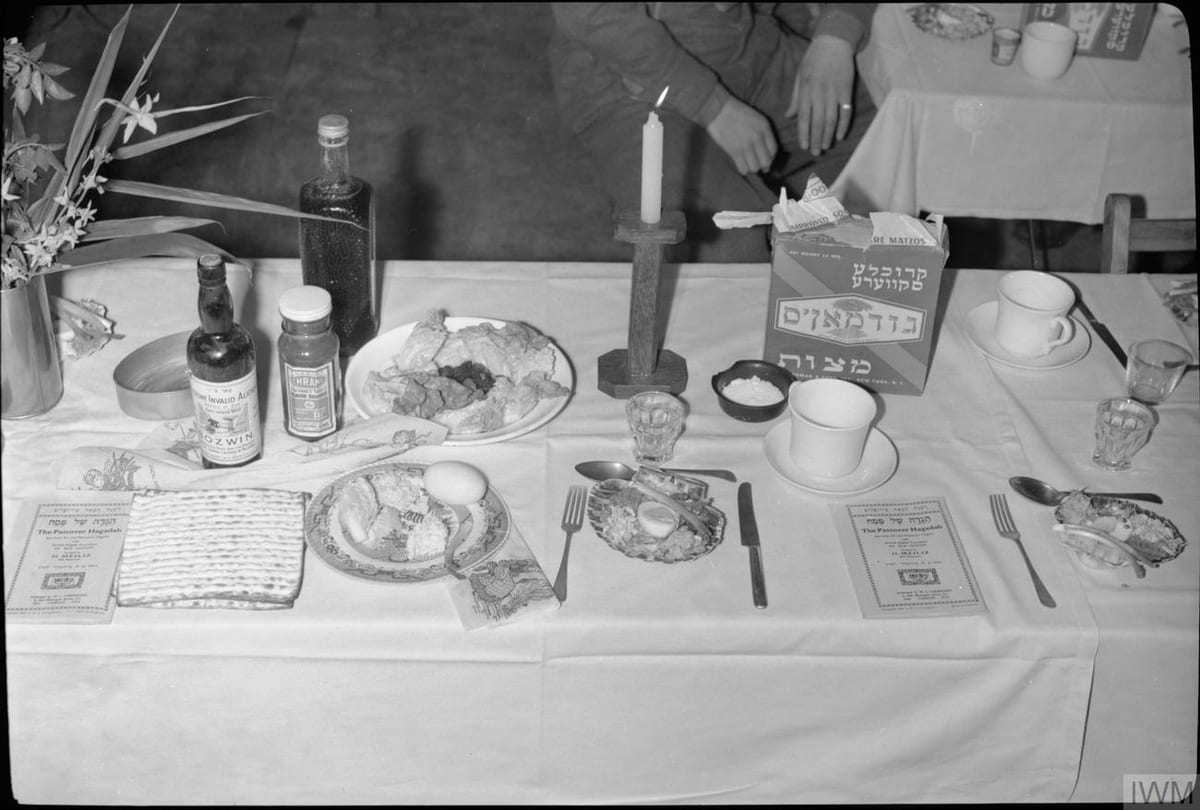 Allied Forces Celebrate Passover, Imperial War Museum (Public domain)
Passover (Pesach) layers another level of observance onto kashrut. For eight days each spring, the Torah prohibits eating chametz, leavened grain products. Bread, pasta, cereals, and even some alcohols are off-limits. The rule is simple: if it's wheat, barley, rye, oats, or spelt that has been leavened or "puffed up," you can't eat it during Passover.
The matzah alternative is both limitation and ritual centerpiece. Matzah is made by mixing wheat flour with water and baking it in under 18 minutes, no time for leavening. It's dense, unleavened, and symbolic of the Jews' hurried exodus from Egypt. Passover forces a reset in how people cook and eat, which is precisely why it's such a powerful ritual experience.
Preparing for Passover means thoroughly cleaning the home of chametz, selling or storing any leavened products, and often using dedicated Passover dishes and utensils. Many observant Jews have an entirely separate kitchen setup, or at least a separate section, reserved for Pesach. The effort signals a profound shift: for eight days, you're eating differently, remembering differently, thinking differently about your relationship to food and freedom.
Why People Keep Kosher Today
The reasons are as varied as the people who observe. Some keep kosher for purely religious reasons: it's a commandment in Torah, it's part of their covenant with God, and observing it is an act of spiritual discipline. For these Jews, kashrut is non-negotiable, it's a framework for living a Torah-centered life.
Others keep kosher because it's part of their cultural identity. Eating kosher connects them to their families, their communities, their grandparents. It's a language spoken in the kitchen, a way of saying "I belong to this people" without words.
Some are somewhere in between: they keep kashrut at home or for certain holidays, but eat more flexibly outside the home. This partial observance is as legitimate as full observance. Judaism has always been a religion that accommodates many levels of commitment.
What's changed is that keeping kosher is no longer a marker of isolation or extreme religiosity. It's mainstream enough that kosher restaurants, groceries, and certified products exist in virtually every Jewish community. The infrastructure around kashrut has made it accessible to people across the spectrum of observance.
Keeping Kosher Across Levels of Observance
Not all Jews keep kosher, and not all who do keep it at the same level. This diversity is baked into Jewish tradition.
Some Orthodox Jews observe Glatt kosher (a stricter standard for meat) and use only certified-kosher products. They maintain separate kitchens for meat and dairy and observe strict rules even at restaurants. This is a full commitment.
Conservative and Reconstructionist Jews might keep kosher at home but not worry about eating out, or observe core rules (no pork, no shellfish) but be more flexible about mixing meat and dairy. Reform Jews might keep some elements of kashrut while skipping others, or observe it seasonally or for specific meals.
Many Jews don't keep kosher at all and still feel deeply connected to Jewish culture and identity. There's no hierarchy here, no level of observance is "more Jewish." Kashrut is an option, a framework, a spiritual tool. How or whether you use it is between you and your conscience.
What matters is intention. A Jew who keeps kosher thoughtfully, asking "what does this mean?" is engaging with tradition differently from someone following rules by rote. A Jew who doesn't keep kosher but celebrates Passover and thinks carefully about their food choices is also engaging with the tradition.
Living Kashrut in the Diaspora
For Jews living outside of Israel, keeping kosher often requires intention and community. You can't walk into a random grocery store in many places and assume the meat is shechita'd or that processed foods don't contain hidden non-kosher ingredients.
But diaspora communities have adapted. Jewish organizations certify products and maintain lists of kosher restaurants. Grocery delivery apps let you shop specifically for kosher goods. Online communities share recipes, certifications, and advice for keeping kosher in places without robust kosher infrastructure.
The diaspora has also created opportunity for creativity. Jews in New York developed bagel culture in part because kosher egg creams and lox-and-cream-cheese were the affordable Jewish foods available. Jewish communities everywhere have built food traditions around the constraints and possibilities of their particular homes.
Traveling while keeping kosher requires planning, packing approved snacks, researching restaurants ahead of time, sometimes eating simply (fruit, nuts, certified packaged goods) rather than elaborate meals. It's manageable, and for many, the discipline of maintaining practice in unfamiliar places deepens commitment rather than straining it.
Practical Kosher Living Today
If you're considering keeping kosher or deepening existing practice, here's what modern kashrut looks like:
Shopping: Find a kosher grocery if you can; use online resources for certifications. Most major supermarkets now stock a kosher section. Look for the hechsher (certification symbol) on packaging, major certifying agencies include OK, Star-K, and the Orthodox Union (OU), though hundreds exist worldwide.
Meat and poultry: Buy from a certified-kosher butcher when possible. Many regular butchers now work with kosher certifiers, so options have expanded.
Fish: Easier than you'd think, any fish with both fins and scales works. Salmon, tuna, herring, halibut are all good. (Shellfish and swordfish are out.)
Dining out: More restaurants offer kosher options than ever. Even non-kosher restaurants can accommodate if you explain your needs, hold the shellfish, cook this on a clean surface.
The emotional piece: Keeping kosher is partly about logistics and partly about mindfulness. You're slowing down your consumption, asking questions about your food, thinking about ethics and tradition with every bite. That's the real power of kashrut.
Kashrut as Heritage Worn Daily
Keeping kosher is one of the most practical ways to live Jewish identity. You don't need a special occasion or a trip to Israel, you practice it three times a day, every single meal. It's woven into the rhythm of family life, into how you shop, cook, and gather at the table.
For many Jews, especially in diaspora, this daily practice anchors connection to tradition. It says: "This is who we are, and I'm choosing to carry it forward." It links you to your ancestors, to communities around the world, to millennia of Jewish people making the same choices about what they eat and why.
That's what kashrut really is, not a restriction, but an affirmation. It's tradition that tastes good.
FAQ
Q: Can I keep kosher outside of a Jewish community? A: Yes. It requires more planning, you'll need to research certifications and potentially order some items online, but it's entirely possible. Many rural and suburban Jews keep kosher using online resources and trusted brands. The infrastructure around kashrut certification has made this much easier than it once was.
Q: Does keeping kosher cost more? A: Certified-kosher products can be pricier, especially specialty items. But basic kosher foods, meat from a certified butcher, whole grains, produce, eggs, don't necessarily cost more than their non-certified equivalents. The larger cost is time: shopping at a kosher grocery, checking certifications, and planning meals takes more thought than grabbing whatever's convenient.
Q: What if I keep kosher at home but want to eat out? A: Many observant Jews do exactly this. You can find restaurants with kosher certifications in most cities, or call ahead to explain your needs. Some keep strict rules only at home and are more flexible when eating out; others maintain full kashrut everywhere. The level is entirely your call.
Q: Is there a "kosher enough"? A: Kashrut isn't a pass-fail test. Some Jews keep full hechsher-certified practice; others observe core rules (no pork, no shellfish) more loosely. Some keep Passover strictly but eat regular food the rest of the year. What matters is intentional engagement with the practice, not perfection.
Q: Can you explain the meat and dairy rule one more time? A: You can't eat meat and dairy in the same meal or cook them together. After eating meat, you wait before eating dairy (usually a few hours, depending on tradition). The reasoning spans ethics, spirituality, and tradition. Pareve foods (neither meat nor dairy) can bridge both, so a vegetable stir-fry works with either meal.
Q: What if I accidentally eat something not kosher? A: It's not a moral failure, and it's not contagious. If you're observing kashrut, you acknowledge the accident and move on. Accidentally eating non-kosher food happens to everyone keeping kashrut, sometimes in a restaurant, sometimes through mislabeled packaging. It doesn't undo your practice or your commitment to tradition.


