Jewish Symbols and Their Meanings: Magen David, Chai & More
Jewish visual culture runs on a handful of symbols with serious mileage: the Magen David (Star of David), the chai, the hamsa, the pomegranate, the menorah, the mezuzah on the doorpost, the dove with its olive branch, and the lion of Judah. Some are ancient, some are surprisingly recent, and almost none of them mean quite what people assume. This guide covers where each one actually comes from, what it means, and how people wear it today, including honest answers to the questions people quietly Google, like whether the hamsa is really Jewish and whether non-Jews can wear a Magen David.
Symbols work faster than words. A single image carries identity, pride, belief, and belonging in a way paragraphs of explanation never quite manage, which is why these marks have done so much work for so long: marking sacred spaces, signaling who we are, passing meaning from one generation to the next. And here's the thing about wearing a symbol: it wears better when you know its story.
Magen David: The Six-Pointed Latecomer
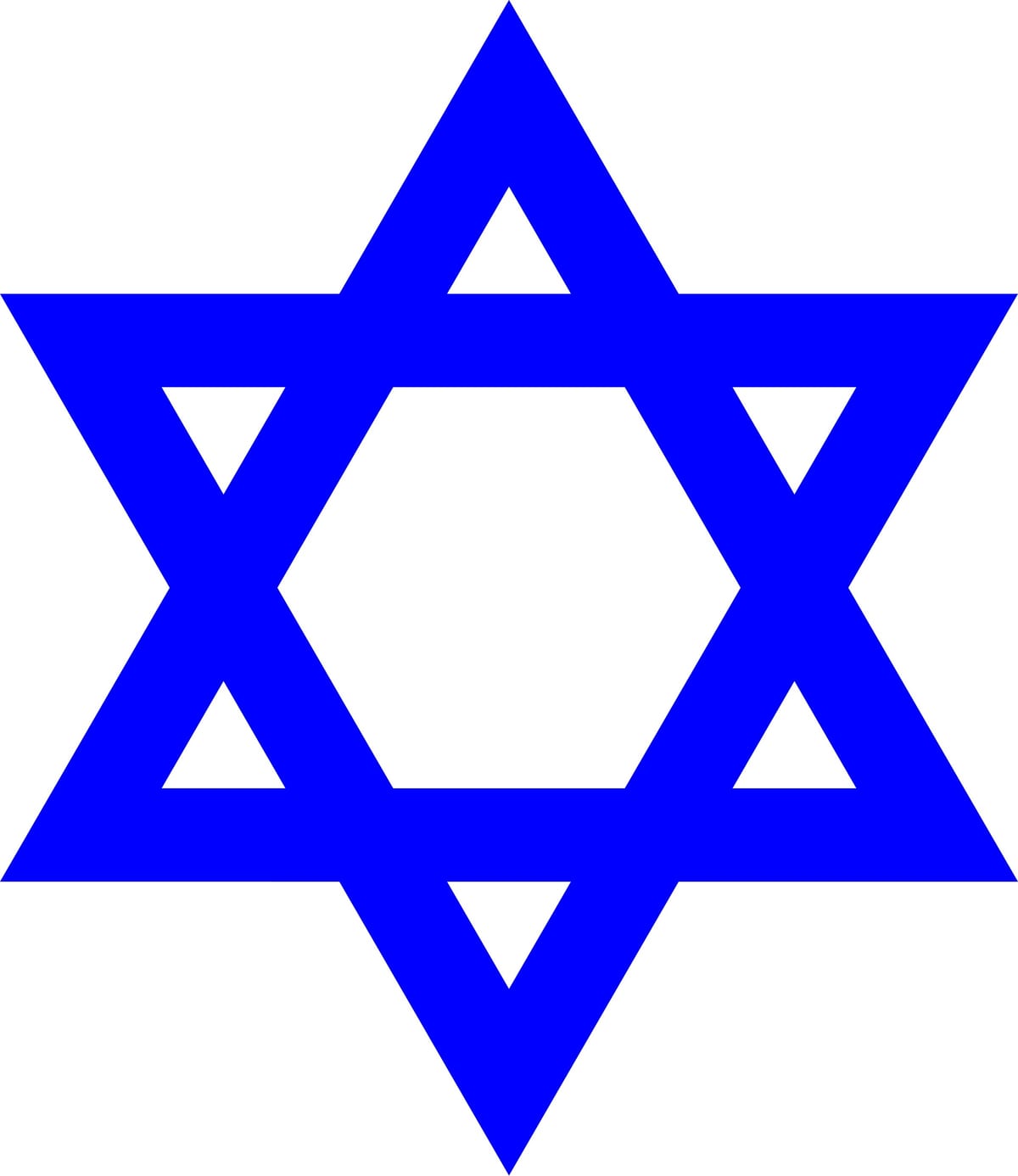 Zscout370, Wikimedia Commons (Public Domain)
Start with the surprise. The Magen David, "Shield of David," the six-pointed star formed from two overlapping triangles, is the most recognizable Jewish symbol on earth. It is also one of the newest.
The hexagram shape itself is ancient and was never exclusively Jewish. It appears as decoration and as a magical sign across the Bronze Age world, from Mesopotamia to Britain, and in medieval Christian and Islamic art. Ancient synagogues used it here and there, but so did everyone else; it carried no more Jewish meaning than a rosette.
The turning point came in Prague. In the mid-14th century, Holy Roman Emperor Charles IV granted the Jewish community of Prague the right to carry its own flag, and the community chose the six-pointed star. Prague's Jews became the first to use it as an official communal symbol, and from the 17th century onward it spread as the seal of Jewish communities across Europe, a graphic shorthand meaning "the Jews of this city," the way a cross marked a church.
Then Zionism made it global. The First Zionist Congress in 1897 put the star on its flag, and in 1948 the new State of Israel adopted that flag as its own. In between came the darkest chapter in the symbol's history: the Nazis forced Jews to wear a yellow star as a badge of persecution. Part of what the star means today, worn openly and by choice, is the deliberate reversal of that history. A mark once imposed in shame, reclaimed in pride.
As for the name: legend connects the shape to the shield of King David, but there's no archaeological evidence his shield looked like anything of the sort. Later readers layered their own meanings onto the geometry. A popular interpretation sees one triangle pointing up, toward heaven, and one pointing down, toward earth and humanity, so the star becomes a bridge between the spiritual and the material. Lovely, and a reading rather than a history. The real power of the Magen David was never about David. It's about seven centuries of Jews choosing it, over and over, as the sign of who we are.
How it's worn today: everywhere and every way. Delicate gold pendants, chunky streetwear graphics, tattoos (a whole separate conversation), embroidery on kippot, a small star on a pocket or a big one across the chest. Since it reads instantly as "Jewish" to everyone, wearing one is the most visible identity statement in the toolkit. That's precisely why so many people started wearing them daily after October 7th: a quiet, personal refusal to be less visible.
Chai: Two Letters, One Word, Everything
The chai (חי, pronounced with the guttural KH, "khai," rhymes with "hi") is the Hebrew word for "life," built from two letters: chet (ח) and yud (י). As a worn symbol it's relatively modern, popularized in the 20th century, but the idea behind it is as old as Judaism gets: the tradition's relentless orientation toward life. "L'chaim," to life, is the toast. "U'vacharta ba'chaim," choose life, is the instruction.
The chai carries a number, too. In gematria, the tradition of assigning numeric values to Hebrew letters, chet is 8 and yud is 10, so chai equals 18. That's why Jews give gifts and charity in multiples of $18. Giving $36 or $180 is literally giving "double life" or "ten times life." (We wrote a whole companion piece on chai and the number 18; the short version lives on our chai meaning page.)
How it's worn today: the chai pendant is a classic, commonly given at bar and bat mitzvahs, weddings, and births, and famously worn onstage by Elvis Presley in his final years; his gold chai necklace still sits at Graceland. It's simple enough for a ring and roomy enough for a hoodie, and it celebrates identity without asking anything about how observant you are. It reads warmer and more personal than the Magen David: less flag, more blessing. If the star says "I am Jewish," the chai says "and it's a life."
Hamsa: The Open Hand (and the Honest Answer About Where It's From)
The hamsa is the open right hand, palm out, often with an eye in the center, and it prompts the question we hear most: is the hamsa actually Jewish?
Honest answer: the hamsa is older than Judaism and belongs to the whole Middle East and North Africa. Hand-shaped amulets appear in the ancient Near East long before the Abrahamic faiths; scholars connect early versions to Mesopotamia and to Tanit of Carthage. The name comes from the Arabic khamsa, "five," for the five fingers (Hebrew hamesh is the cognate). In Islamic cultures it's the Hand of Fatima; in Jewish communities of North Africa and the Middle East, living side by side with Muslim neighbors, it became the Hand of Miriam, named for the sister of Moses.
So it's a shared symbol, and in Jewish hands it's been thoroughly, lovingly Jewish for centuries, especially in Sephardic and Mizrahi tradition, where hamsas hang in homes, guard cradles, and gleam on necklaces. Its job everywhere is the same: protection, particularly against ayin hara, the evil eye. Ashkenazi Jews largely adopted it later, and today it's pan-Jewish.
Is it appropriation for Jews to wear it? No. Jewish communities have carried this symbol as their own for a very long time; it's inheritance, not borrowing. Is it exclusively ours? Also no, and pretending otherwise would take real chutzpah. The hamsa is one of the rare symbols that Jews and Muslims share, and some wearers today consider that part of its meaning, a small emblem of how far the diaspora traveled and whom it lived beside.
How it's worn today: pendants, wall hangings, phone cases, tattoos. Fingers up or fingers down are both traditional. The down-turned hamsa is often associated with welcoming blessing, the upturned with warding off harm, though customs vary by community and nobody is checking.
Pomegranate: The Fruit With 613 Rumors
The pomegranate (rimon in Hebrew) is one of the seven species the Torah uses to praise the Land of Israel, and it's been Jewish visual shorthand for abundance, fertility, beauty, and righteousness for three thousand years. Pomegranates were embroidered on the hem of the High Priest's robe, alternating with golden bells, and carved into the columns of Solomon's Temple. To this day, the decorative crowns on Torah scroll handles are called rimonim, pomegranates.
Then there's the famous claim: that a pomegranate contains 613 seeds, one for each of the Torah's commandments. Is it botanically true? No. Actual seed counts vary widely from fruit to fruit. But the tradition was never a botany claim. It's a blessing: the hope, voiced especially on Rosh Hashanah, that our merits be as numerous as the seeds of a pomegranate. The number is aspiration, not inventory.
How it's worn today: the pomegranate is the connoisseur's Jewish symbol, less instantly legible to outsiders than a star and rich with meaning to those who know. It shows up in jewelry, ketubah art, and textile prints, often on pieces celebrating harvest or connection to the land of Israel, and it's a favorite Rosh Hashanah motif.
Menorah: The Oldest One We've Got
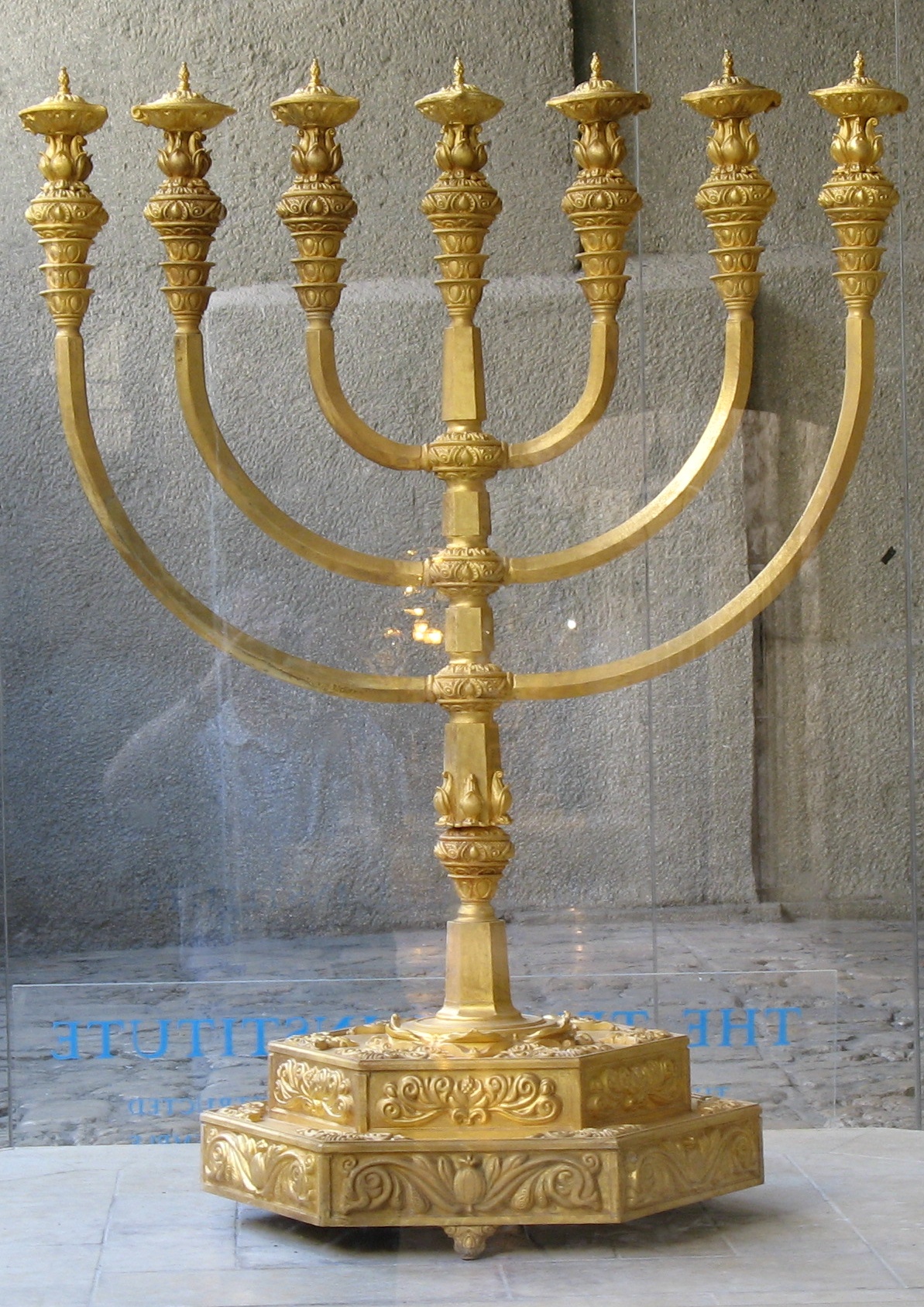 Photo: The Temple Institute, Wikimedia Commons (Public Domain)
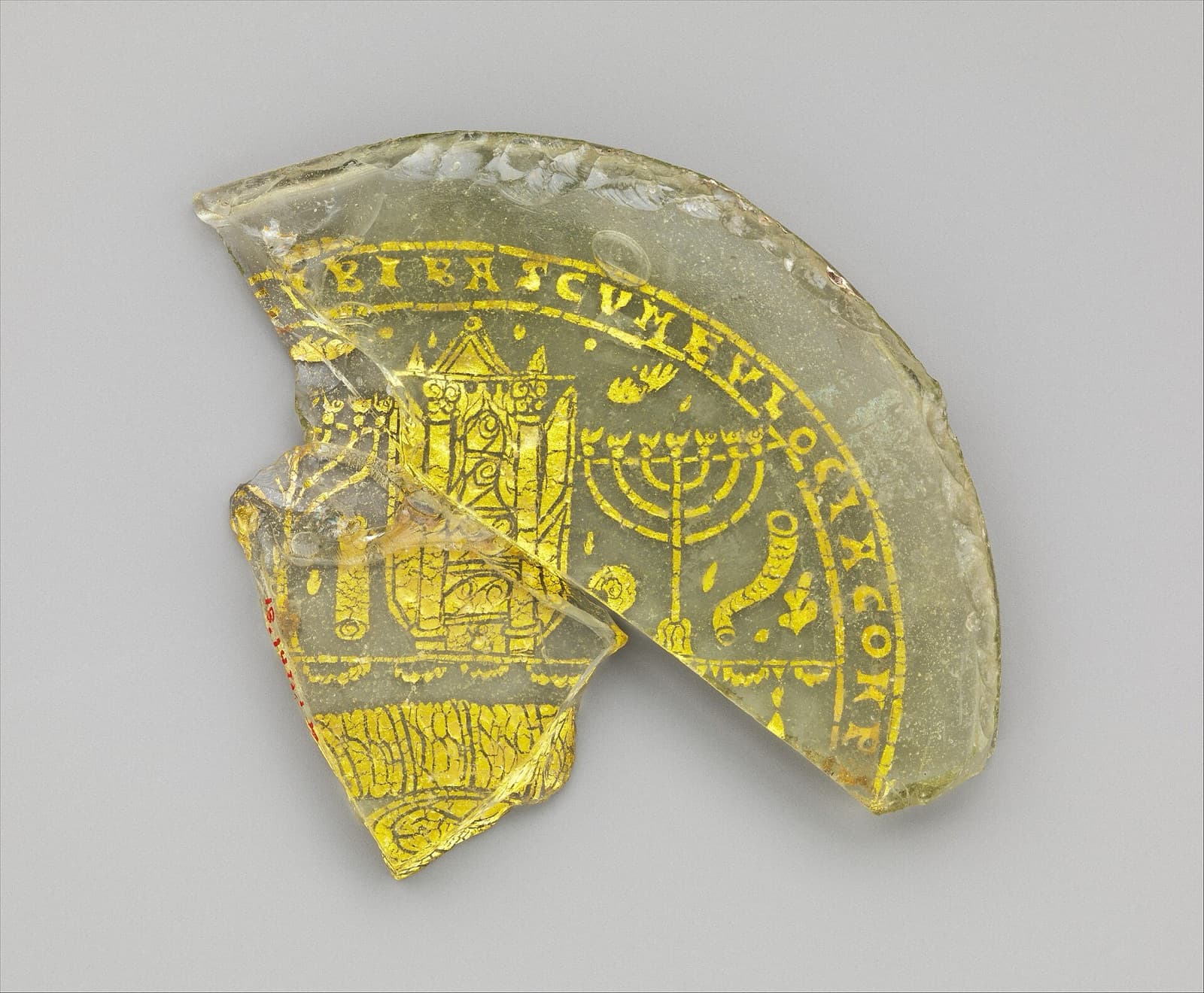
If you want the symbol with seniority, it's the menorah, the seven-branched lamp described in Exodus, which stood first in the Tabernacle and then in the Temple in Jerusalem, lit daily by the priests. Jewish tradition connects its seven branches to the seven days of Creation, and it became the tradition's great image of illumination: wisdom, spiritual light, the ongoing presence of the Divine. Long before the Magen David meant anything, the menorah was the symbol of the Jewish people, carved into ancient synagogue floors, tombs, and coins.
Its most famous ancient portrait is a bitter one. The Arch of Titus in Rome, completed after 81 CE, shows Roman soldiers hauling the Temple menorah away as loot after the destruction of Jerusalem in 70 CE. Nineteen centuries later, the modern State of Israel chose the menorah, modeled on that same Titus relief, as its national emblem. The symbol the empire carried off in triumph came back as the seal of a sovereign Jewish state. As reversals go, that one's hard to top.
One clarification worth making: the seven-branched menorah and the nine-branched Hanukkah lamp are different objects. The Hanukkah version, properly a hanukkiah, has eight lights plus the shamash (helper candle), one for each night of the holiday. All hanukkiot are menorahs; not all menorahs are hanukkiot. Now you can be insufferable at exactly one party per year.
The hanukkiah carries its own story. Hanukkah commemorates the second-century BCE Maccabean revolt against the Seleucid Greek empire, which had desecrated the Second Temple. When the Jews reclaimed and rededicated the Temple, they found only one jug of ritually pure oil, enough for a single day. According to tradition, it burned for eight, long enough to prepare new oil. So each night, families light one more candle, building the light night by night, and in the darkest stretch of winter you literally increase the light in your home. It's one of the few Jewish rituals that is close to universal; plenty of Jews who observe little else still light Hanukkah candles.
How it's worn today: more often displayed than worn, but menorah motifs appear in Hebrew-lettered graphics and vintage-style prints, where the old-coin aesthetic does a lot of work, and a hanukkiah tee in the weeks before the holiday is practically a tradition of its own.
Mezuzah: The Doorpost Declaration
The mezuzah is different from everything else here. It's not a decorative motif but a functional religious object grounded in Jewish law. Mezuzot (the plural) are small cases affixed to the doorposts of Jewish homes, and inside each one is a handwritten parchment scroll containing the Shema and related passages from the Torah.
The practice comes from Deuteronomy 6:4-9, which commands inscribing these words "on the doorposts of your house and on your gates." The Shema is the central declaration of Jewish faith: observant Jews recite it daily, and it is traditionally said at the end of life. Affixing a mezuzah is both a mitzvah (commandment) and a statement: a Jewish household lives here.
That visibility has always cut both ways. In times of persecution, it told neighbors exactly where Jews lived. Where it was safe, putting one up was a public declaration of identity and commitment, a way of saying, "We are here, and we will not hide." The cases themselves are often works of art, from simple wood or metal to silver, ceramic, glass, or Israeli olive wood. Many people touch the mezuzah, or kiss their fingers, as they pass through the doorway.
How it's worn today: it isn't, and that's the point. The scroll inside holds sacred text, which is exactly why you'll never find the Shema printed on our shirts. Clothing goes through the laundry and into places sacred words shouldn't go. The mezuzah stays on the doorpost, whether the home inside is highly observant or simply, proudly, culturally Jewish.
Dove, Olive Branch, and Shalom: The Symbol Everyone Borrowed From Us
The dove carrying an olive branch is now the universal peace sign (the UN era ran with it), but its source is Genesis. After the flood, Noah sends out a dove; it returns with a freshly plucked olive leaf in its beak, the sign that the waters have receded and the world is livable again. Hope, after catastrophe, with evidence.
In Jewish usage the dove carries extra layers: the Song of Songs calls the beloved "my dove," and the rabbis compared the people of Israel to a dove, soft-voiced, loyal, protected not by talons but by its wings. It's the gentlest symbol in the set, and lately one of the most needed.
Its natural companion is a word rather than an image. Shalom, written in Hebrew letters, is at once a greeting, a goodbye, and a blessing of peace, and it has become a symbol in its own right, a favorite of people who care about coexistence and tikkun olam, repairing the world.
How it's worn today: often paired with Hebrew lettering, shalom especially, on pieces that read as both Jewish and universal at once.
Lion of Judah: The Roar in the Room
The lion enters Jewish symbolism in Genesis 49, when Jacob blesses his sons and calls Judah "a lion's cub," gur aryeh Yehudah. The tribe of Judah took the lion as its emblem, the Davidic royal line descended from that tribe, and the lion became shorthand for Jewish sovereignty and strength. It rampages across ketubah borders, Torah ark curtains, and synagogue carvings, usually in heraldic pairs. It's also the official emblem of the city of Jerusalem today.
How it's worn today: the lion is the bold pick: strength, royalty, and roots in a single image. It pairs naturally with Hebrew script and suits people who want their symbolism with some volume.
Wearing Your Heritage, Your Way
The best part of wearing any of these is that you don't have to wait for a holiday or a synagogue visit. A symbol you put on in the morning is pride that comes along to work, to class, to the grocery store. Some people like theirs subtle, a small embroidery or a minimalist line. Others want a statement that carries across the room. Some wear symbols for spiritual reasons, some for cultural connection, most for a little of both. There's no one right way.
And every one of them opens a door. Somebody asks, "What does that mean?" and suddenly you're telling the story of a Prague flag, a pomegranate's worth of blessings, or a lamp that came home from Rome.
FAQ
Can non-Jews wear a Star of David?
There's no religious prohibition. The Magen David is a cultural and national symbol, not a sacred object, and wearing one respectfully (many Christians wear one in solidarity, for instance) generally lands as support, not appropriation. The one real guideline is intent and context: worn as an identity you don't hold, it can confuse; worn as solidarity, it's usually welcomed.
Is the hamsa a Jewish symbol or not?
Both things are true: the hamsa predates Judaism and is shared across Middle Eastern and North African cultures, and it has also been an authentically Jewish symbol, the Hand of Miriam, for many centuries, especially in Sephardic and Mizrahi communities. Jews wearing hamsas are drawing on their own tradition.
What is the oldest Jewish symbol?
The menorah, by a wide margin. It's described in the Torah, stood in the Temple, and appears on ancient Jewish coins and synagogue art centuries before the six-pointed star meant anything Jewish. The Magen David only became a distinctly Jewish emblem in the Middle Ages, starting with the Prague community's flag in the 1300s.
What does a chai necklace mean?
Chai (חי) is Hebrew for "life," and its letters add up to 18 in gematria, Judaism's luckiest number. A chai necklace is essentially a wearable blessing for long life, which is why it's a classic gift for bar and bat mitzvahs, weddings, and new babies.
What is a mezuzah, and why is it on the doorpost?
A mezuzah is a small case holding a handwritten parchment scroll with the Shema and related Torah passages, affixed to the doorposts of Jewish homes. Putting one up fulfills a commandment from Deuteronomy and marks the home as Jewish.
Are Jewish symbols religious, cultural, or both?
Both, depending on the symbol. The mezuzah is a ritual object rooted in Jewish law. The chai and the Magen David work as cultural and religious signs at once. For many Jews, culture and religion are hard to pull apart anyway.
Is it okay to wear an evil eye and a hamsa together?
Yes. They're teammates, not rivals. The hamsa's traditional job is protection against the evil eye, which is why so many hamsas have an eye built into the palm. Layering them is common and traditional, particularly in Sephardic custom.
However you wear your story, star, hand, letters, or lion, our Chai Fashion collection and Hebrew Script collection were made for exactly this kind of knowing.