The Original Digital Detox Doesn't Need an App
Somewhere in San Francisco right now, a product manager is pitching a feature that turns your phone gray for twenty-four hours so you stop reaching for it. Somewhere in Brooklyn, a woman is lighting two candles, covering her eyes, and doing the exact same thing her great-great-grandmother did in a shtetl that no longer exists, for the exact same reason: to make the phone, or the horse cart, or whatever the century's distraction happened to be, disappear for a day.
The wellness industry calls this a digital detox. Judaism has called it Shabbat for roughly three thousand years, and it worked before anyone needed a word for the problem it solves.
A Word Silicon Valley Just Rediscovered
In 2010, the filmmaker Tiffany Shlain and the roboticist Ken Goldberg started taking one day a week completely off screens: no phones, no laptops, no television. They called it Technology Shabbat, borrowing the name on purpose, and it caught on. Reboot, a nonprofit built around reinterpreting Jewish tradition for a secular audience, turned the idea into the National Day of Unplugging, an annual event that now invites people of every background, not just Jews, to put their devices away from sundown to sundown. Wellness writers, productivity coaches, and burned-out tech employees have spent the years since rediscovering, one think piece at a time, that stepping away from a screen for a full day does something to a person that a ten-minute meditation app cannot.
None of them were wrong to notice it. They were just late. The system they were describing already had a name, a structure, and a three-thousand-year head start. By its tenth anniversary in 2019, the National Day of Unplugging had drawn participants in 125 countries, from the obvious to the genuinely surprising, including Bhutan, Mongolia, and Kazakhstan, and had spread well past Jewish organizers to Catholic, Muslim, Hindu, and Buddhist groups running their own version of the same sundown-to-sundown pause.
The Original Terms and Conditions
Here is where most modern write-ups about Shabbat and technology get the emphasis backward. The point was never simply "no work," in the sense of no spreadsheets and no emails. Jewish law defines thirty-nine categories of restricted activity on Shabbat, a list the Talmud derives from the kinds of labor used to build the Tabernacle in the desert, everything from planting to writing to lighting a fire. Rabbis have long debated where electricity and its descendants fit inside those categories, and different communities land in different places on how strictly to apply that to a given device. But the underlying design has nothing to do with technology being bad. It has to do with drawing a hard, structural line around one day so that a person is not the one deciding, moment to moment, whether to check the thing in their pocket. The Talmud, in tractate Eruvin, even credits King Solomon with instituting the eruv, a rabbinic refinement of what counts as carrying within those boundaries, and describes a divine voice praising him for the addition.
That distinction matters more now than it did in 1935. Nobody in 1935 was deciding, forty times an hour, whether to break Shabbat by checking a notification. Today, everybody is making some version of that decision constantly, which is exactly why a modern digital detox pledge is so much harder to keep than an ancient one. A pledge you renegotiate with yourself every few minutes is not a boundary. It is a diet, and everyone knows how diets go.
Why Unplugging Alone Doesn't Work
Most secular attempts at a digital detox fail for a boring, predictable reason: removing something leaves a hole, and a hole gets filled with whatever is nearest, which is usually the phone again by hour three. Tell a person to put their device in a drawer for a day and give them nothing else to do, and you have built a very effective test of willpower and not much else.
Shabbat was never just a subtraction. It is a full replacement of one kind of time with another, built and refined over centuries specifically for this purpose. The candles get lit before sundown, which means someone had to plan the week around this moment rather than letting the week simply happen to them. There is a meal, usually a long one, usually with other people at the table, with songs that have been sung at that table for generations and a blessing over wine and bread that takes about ninety seconds and forces everyone in the room to sit still and pay attention at the same time. There is, depending on the household, a walk to synagogue, a study session, a nap taken without guilt, a conversation that runs long because nobody is glancing at a screen mid-sentence. None of it is structured around absence. All of it is structured around presence, and the technology restriction is simply what clears enough space for the presence to actually happen.
The Oldest Commitment Device on Record
Behavioral economists have a term for what makes a boundary actually hold: a commitment device, a rule you agree to in advance precisely because you know your in-the-moment self cannot be trusted to make the call. Ulysses tying himself to the mast before the ship passed the sirens is the classic example, chosen deliberately because it removes the decision from the exact moment when the decision would be hardest to make well. A gym membership with a cancellation fee is a weak, modern version of the same idea. An app that locks your phone for an hour is a weaker one still, since the same thumb that opened the app can usually find the setting to turn it back off.
Shabbat is a commitment device with three thousand years of social reinforcement behind it. Nobody negotiates their way out of it privately at nine on a Friday night, because the boundary was never set by that individual in that moment. It was set by an entire community, generations deep, meeting at the same hour every week, which makes backing out a visible, social act rather than a quiet, private one. That is a very different kind of pressure than a screen-time notification a person can dismiss with one tap and forget about by the next.
The Line That Outlasted the Reason for It
The essayist Ahad Ha'am, writing at the end of the nineteenth century, is widely quoted for the line that more than the Jewish people have kept Shabbat, Shabbat has kept the Jewish people. He meant it as an argument about cultural survival in an era of assimilation, but it holds up just as well as a description of attention and memory. A community that stops, together, on the same day, for the same reasons, using the same handful of ancient words, does not just rest. It keeps remembering who it is, out loud, once a week, whether or not any individual member fully believes every part of the theology behind it.
That's a claim about durability, not about screens being bad for you, which is true but not especially interesting anymore. Wellness trends cycle through in a few years. Juice cleanses gave way to intermittent fasting gave way to cold plunges gave way to whatever is trending on a given app this month, and each one required constant reinvention, a new influencer, and a new set of branded products to stay relevant. A practice that has needed no marketing department and no seasonal rebrand for three millennia is doing something structurally different than a wellness trend, whatever a person's relationship to the religious claims underneath it. It doesn't need to go viral again next spring, because it was never trying to go viral in the first place.
You Do Not Have to Be Observant to Feel the Pull
Plenty of Jews who would not describe themselves as religious still light candles on Friday night now, specifically because the phone-off, table-on structure is the thing they are missing the other six days of the week, not because of a specific halachic obligation they feel bound by. It's the whole tradition working exactly as designed, quietly available to people at every level of observance, asking nothing more up front than an hour with the phone somewhere else and people you like at the same table.
At Kosher Couture, we hear some version of this from our own community constantly: putting on something that says who you are before a Friday night table, even just a soft T-shirt with a phrase your grandmother would have recognized, turns out to be a small, low-stakes way back into a practice a person drifted from years ago. Chutzpah is in our DNA, but so is the plain fact that our grandparents figured out the burnout cure a very long time before anyone put a screen-time widget on a phone. Silicon Valley is welcome to keep discovering it. The rest of us can just light the candles.
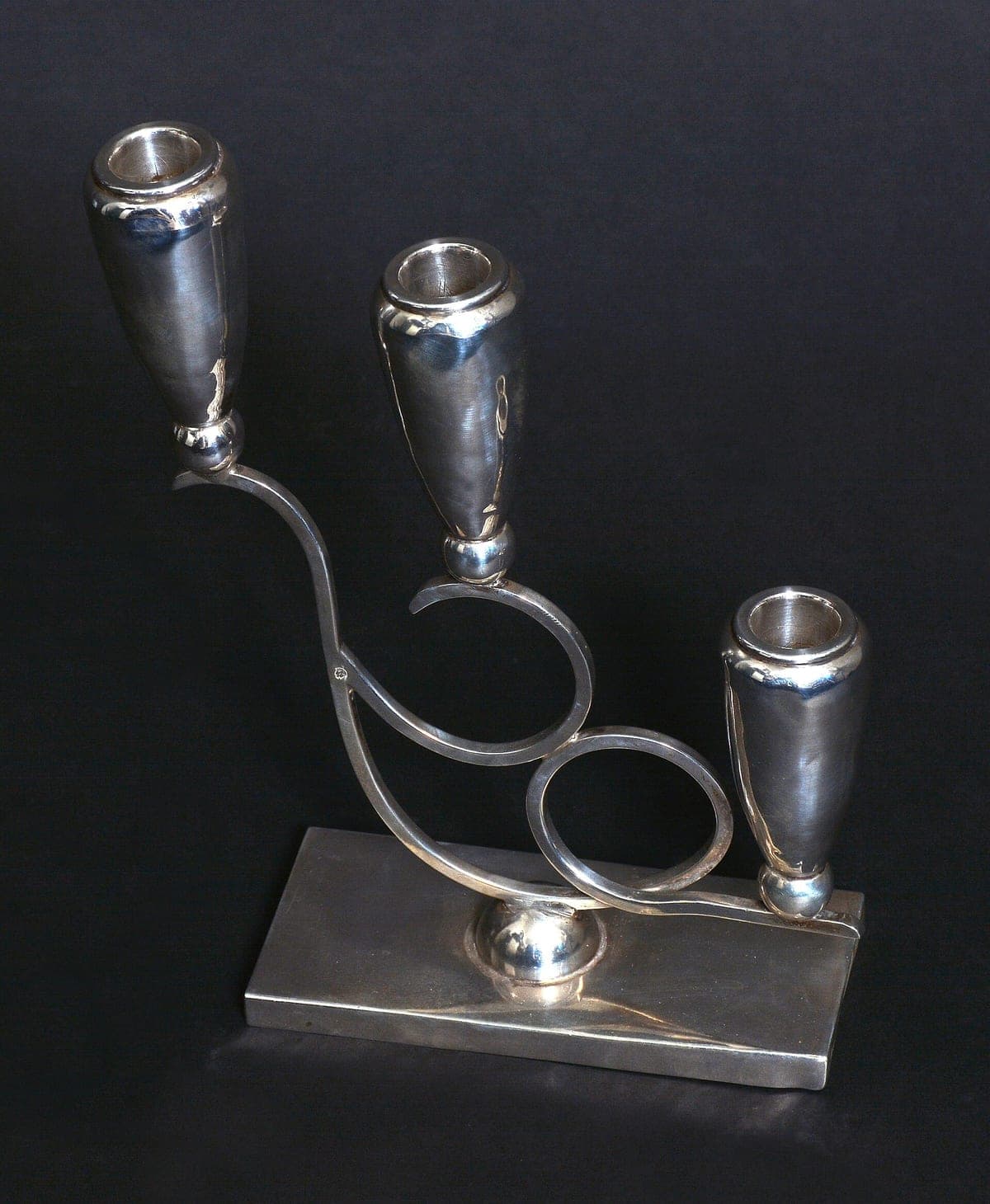
Cover image: Zalminsk, Wikimedia Commons (CC BY-SA 4.0)


