
Jewish Wedding Traditions Explained: The Full Ceremony
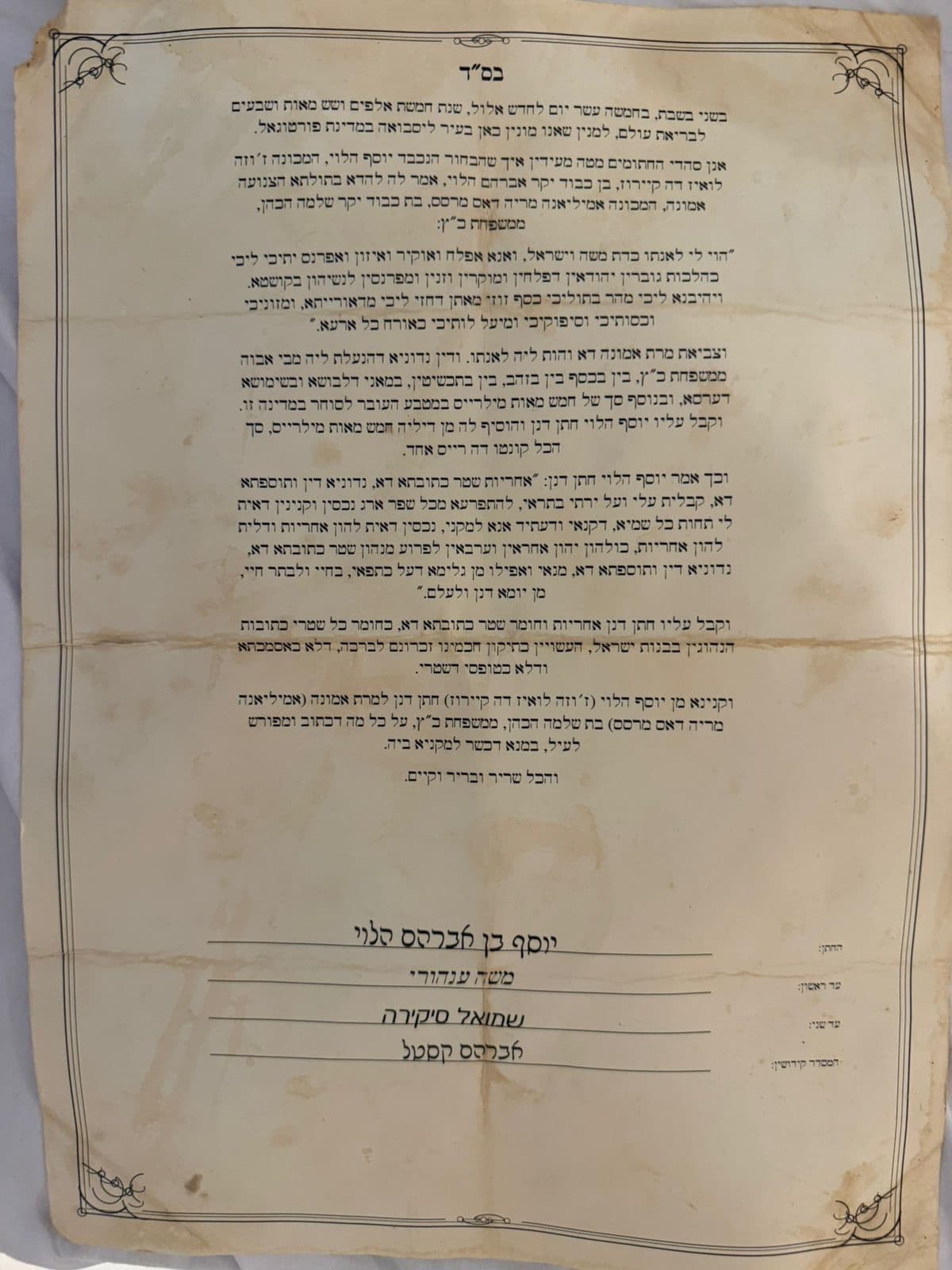
A Jewish wedding asks for a lot more than two people saying yes. It's a ceremony steeped in thousands of years of law, legend, and love, a celebration where every gesture, every blessing, and every symbolic act connects the couple to their ancestors and their community. From the iconic breaking of the glass to the intimate moments of yichud, each tradition carries weight and intention.
Jewish weddings blend solemn commitment with unbridled joy. The rituals honor loss and rejoicing in equal measure, reflection and celebration woven together in ways that make the day feel both deeply personal and profoundly communal. And whether the wedding is Ashkenazi, Sephardic, Mizrahi, or something blended, the ceremonies share a common foundation: two individuals becoming one household, witnessed and blessed by community.
The Ancient Roots: Two Pieces of One Promise
Jewish marriage law comes from the Torah and Talmud, which makes the wedding one of Judaism's oldest rituals. The Talmud distinguishes two core elements. The first is kiddushin, betrothal, when the groom formally consecrates the bride. The second is the set of obligations written into the ketubah. Together they create a marriage that is both spiritual and legally binding.
The legal core is surprisingly compact. The groom gives the bride an object of value (traditionally a ring, though any valuable item works) while saying specific words in Hebrew, she accepts, and two valid witnesses see it happen. That's what makes the marriage binding under Jewish law. Everything else, from the canopy to the dancing, is custom layered around that center, and the customs are where communities got gloriously different. An Ashkenazi wedding in Poland looked different from a Sephardic one in Morocco, which differed again from a Yemenite celebration. All of them shared the same commitment to meaning, family, and the continuity of Jewish life.
The Chuppah: Home and Sanctuary
 Wikimedia Commons (Public Domain)
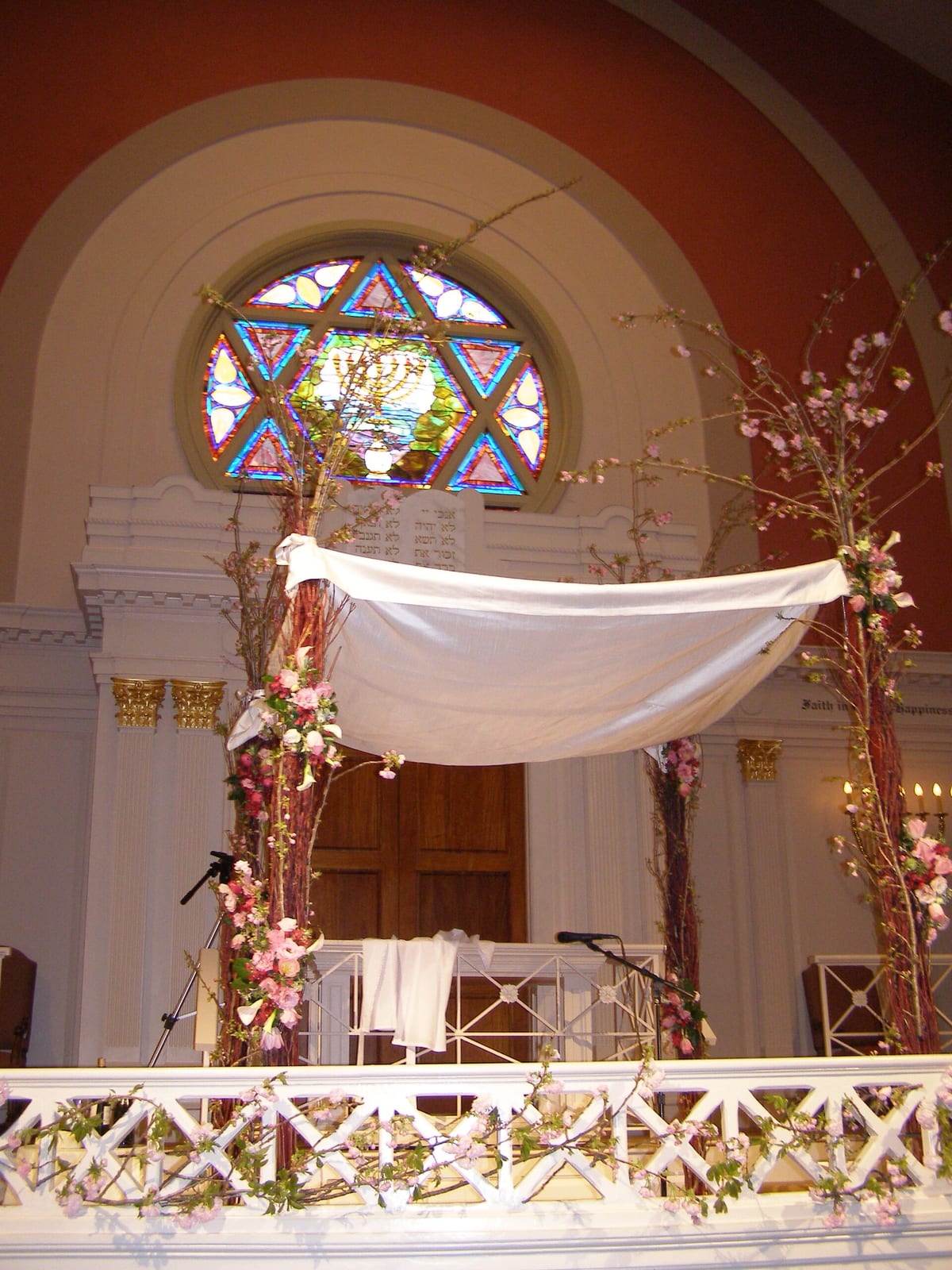
The chuppah (sometimes spelled huppah) is the wedding canopy, and it's the heart of the ceremony. The couple stands beneath it while the vows and blessings unfold, creating an intimate space within the larger celebration.
Symbolically, the chuppah represents the new home the couple will build together, a concept rooted in Talmudic law. That's why it's open on all four sides, not enclosed, not exclusive. Their home will be welcoming, their doors open to family, friends, and community. No walls to keep people out.
Traditionally, four people hold up the poles of the chuppah, often chosen from among close family or friends. This role is an honor. The four pole-holders are literally supporting the foundation of the marriage. Some families rotate who holds the poles, while others keep the same four throughout. Either way, the symbolism holds: a marriage is supported by the people we love.
The chuppah itself can be as simple as a tallit (prayer shawl) stretched across four poles, or as ornate as a flowering structure dripping with garlands and greenery. In many Ashkenazi communities it's set up outdoors or somewhere the stars can be seen, echoing God's promise to Abraham in Genesis to make his offspring as numerous as the stars of the sky. Whatever the style, the meaning stays constant: a threshold between the life the couple knew and the life they're building together.
The Ketubah: Written Promise
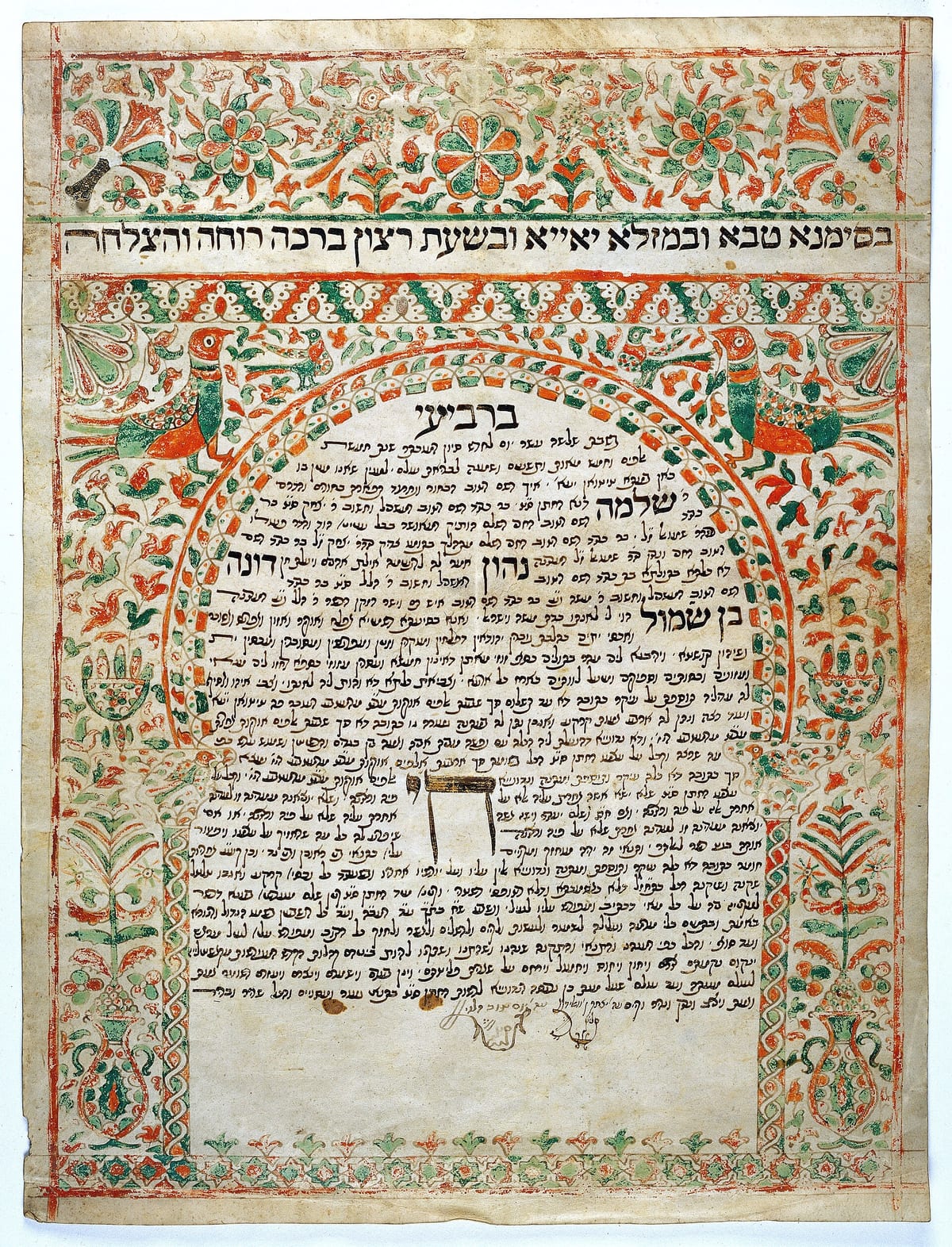 Photo: Wellcome Collection (CC BY 4.0)
Before the ceremony even begins, there's a signing. The ketubah is the Jewish marriage contract, a legal and spiritual document that outlines the commitments and rights of both bride and groom (though the traditional version centers the groom's obligations to the bride).
People sometimes call it the world's oldest prenup, which misses the point. Historically, the ketubah formalized the groom's financial obligations to his bride, protecting her economically: what he promised to provide and what she brought into the marriage. In an era when women had few legal rights, that was radical. It gave a wife recourse and recognition.
The ketubah is typically written in Aramaic, the language spoken by Jews in ancient times, though modern ketubahs often include Hebrew or English translations. It's both deeply traditional and remarkably flexible: couples can use classical texts passed down for centuries, choose egalitarian versions in which both partners make explicit promises, or commission a completely personalized ketubah. The artwork alone can be stunning, with illumination, hand calligraphy, and paintings that tell the couple's story. Many couples frame it, and it hangs in Jewish homes as both a legal record and a daily reminder of the day two people promised to build a life together.
The signing is a formal affair. Two kosher witnesses (not family members, and traditionally male, though many communities have evolved this practice) sign the document along with the groom. The bride also signs on modern ketubahs. The witnesses are there to verify that both parties entered the agreement freely and of sound mind. Then, during the ceremony, the ketubah is read aloud: a public declaration of the promises made, the community hearing the terms of the commitment and the proof that this union is real and witnessed.
The Bedeken: Seeing and Being Seen
Before the bride processes to the chuppah, there's a moment called the bedeken (beh-DEK-en), the veiling. The groom sees his bride's face, and then the veil is lowered over her eyes.
This ritual comes with a biblical story. In Genesis, Jacob was tricked into marrying Leah when he thought he was marrying Rachel, all because Leah wore a veil and he couldn't see her face. The bedeken is meant to prevent that deception: the groom confirms he knows who he's marrying. There's a practical sweetness to it, too. In all the wedding chaos, there's one moment where the two of them see each other, just them, before everything gets ceremonial.
Different traditions handle the bedeken differently. In some families, the groom veils the bride himself, a tender moment often accompanied by quiet blessings. In others, the bride's mother or the rabbi handles the veil. Some families lift the veil again after the ring is given, marking the move from private to public recognition of the marriage. Some ceremonies skip the bedeken entirely. What matters is that the tradition, when observed, centers presence and intention.
Fasting: A Personal Yom Kippur
In Ashkenazi tradition, the bride and groom often fast on their wedding day. The logic mirrors Yom Kippur: a day of spiritual intensity and a fresh start before entering a new life. The fast breaks at the wedding feast, which makes that first meal a true celebration and transition.
Sephardic practice goes the other way. According to Sephardic law, particularly as codified by Rabbi Ovadia Yosef, the groom should not fast, because his wedding day is considered a joyous holiday, like a festival. Same day, same seriousness, two very different ways of preparing for it.
Circling: Creating Protection
The bride circles the groom, traditionally seven times, though some couples do three, some circle each other, and some skip it altogether depending on their tradition.
The circles are interpreted as creating a "wall of protection" around the groom, a boundary of love and commitment, or as the walls between two people coming down. Seven carries weight: the world was created in six days, with rest on the seventh. There's something powerful in the image of the bride moving around her partner, binding them together in motion before they're bound in words.
Circling, called hakafot, is primarily an Ashkenazi (Central and Eastern European Jewish) tradition. Sephardic brides do not traditionally circle the groom, and Mizrahi weddings have their own rituals. Like so much of Jewish practice, weddings are rooted in cultural heritage, and your family's customs matter.
The Seven Blessings: Community Speaking
After the ring is given (and, at many modern weddings, a second ring given back, a more recent addition that is now nearly universal), seven blessings are recited over wine. These are the Sheva Brachot (SHEH-vah brah-KHOT), ancient blessings referenced in Talmudic discussions and refined over centuries.
The seven blessings cover themes that matter: blessing the wine, blessing creation, blessing the couple, blessing their joy, blessing them with harmony, and ultimately invoking the rebuilding of Jerusalem. That last blessing is significant. It ties the couple's happiness to the larger Jewish community and its future. Your joy is collective joy.
Even the cups differ by community. Ashkenazi ceremonies typically use two cups of wine, one for the initial blessings and another for the Sheva Brachot, while in Sephardic tradition the same cup is refilled.
Traditionally, different people are invited to recite the blessings. It's an honor that many families plan for weeks beforehand, choosing relatives, close friends, and people important to the couple's lives. When the blessings are spoken, the couple and the community are speaking together. The guests become active participants in blessing the marriage.
Breaking the Glass: Joy and Sorrow Together
At the end of the ceremony, the groom (and often the bride, or the couple together) steps on a glass, usually wrapped in cloth for safety, and breaks it.
The sound cuts through the room. Then comes the chorus: "Mazel tov!" Good luck, good fortune, congratulations. It's one of the most joyful, loudest moments of the wedding, the instant the ceremony turns from formal to festive.
But the glass isn't broken for fun. It's most often understood as a reminder of the destruction of the Second Temple in Jerusalem in 70 CE. Even in moments of great joy, there is sadness in the world. The tradition refuses to let couples forget that life contains both, that the same people now celebrating were once mourning, and will mourn again.
Other readings add layers. Glass is beautiful and delicate; bonds break, too, if they're not tended with care. Some see permanence in it instead: once broken, the glass can't be reassembled, just as the commitment can't be undone. The couple smiles and celebrates even as they're reminded that what they're creating is precious precisely because it isn't guaranteed.
Yichud: The First Moment Alone
After the ceremony ends and the couple walks back down the aisle to cheers and music, they're escorted away from the celebration to a quiet room, alone together for the first time as a married couple.
This is yichud (yee-KHUD), a word that means "seclusion" or "togetherness." The couple spends these moments, traditionally around eighteen minutes, alone. No photographer, no family, no guests. Sometimes they share a small meal or some water and fruit. Mostly, they just sit together, breathe, and take in the enormity of what's happened. In some communities, yichud also carries halachic significance as part of finalizing the marriage.
Yichud honors the reality that weddings are overwhelming. The ceremony is formal and public; yichud is intimate and private. Meanwhile the guests drift toward cocktails and hors d'oeuvres, and when the couple emerges, the party truly begins.
The Hora: Joy Made Visible
By the time the couple returns, the celebration is in full swing. The hora, a circle dance where guests hold hands and spin in concentric rings while the couple is lifted high on chairs above their friends' shoulders, is often the heart of the party, usually to "Hava Nagila" and other joyous songs.
It's worth knowing the hora began as a Balkan and Eastern European folk dance. It became so central to Ashkenazi Jewish weddings that many people assume it's an ancient Jewish ritual, which is its own kind of compliment.
The hora is pure joy. It's chaotic and loud and includes everyone: the musically gifted and the tone-deaf, the coordinated and the deeply clumsy. Nobody is grading, and everybody is in. The couple floats above the circle, held up by their community, literally supported by the people who love them.
Different regions and families add their own touches. Some horas are slow and stately; others are wild and fast. Some weddings feature multiple horas, one for each side of the family, a friendly (or not-so-friendly) competition to see who can jump higher.
Sheva Brachot: A Week of Blessings
The celebration doesn't have to end when the band packs up. The seven blessings are often recited again at the wedding meal, and traditionally, for the seven days after the wedding, friends and family host evening dinners called Sheva Brachot, where the blessings are said once more and the couple is celebrated all over again. When new guests join, the joy gets extended and shared.
The week-long tradition makes a point: a marriage is the beginning of a journey rather than a single moment, and the community's job of supporting the couple doesn't stop at the reception.
Why These Traditions Matter
Jewish wedding traditions aren't relics, and they're not meant to be performed robotically. They're living practices that connect each couple to generations of couples before them, and to the wider Jewish community: the people in the room and the countless people who've stood under a chuppah before.
The rituals work because they compress meaning into gesture. A glass breaking says more about life's fragility than a thousand words could. Seven blessings spoken by many voices say more about community than any speech. The chuppah, open on all sides, says more about hospitality than any welcome sign.
These traditions also give couples an immediate sense of belonging. You're joining an ancient lineage, part of something bigger than yourselves.
And there's room within tradition for making it yours. The legal core (two valid witnesses, kiddushin with an object of value, the bride's acceptance) is firm. Around it, couples blend Ashkenazi and Sephardic customs, write personal vows, commission ketubahs that tell their own story, light candles for loved ones who have passed, or include both parents in the ceremony regardless of role. Jewish tradition has always been about interpretation and remaking for new times. What matters is that the choices are intentional, made knowingly and because they mean something.
FAQ
What makes a Jewish marriage legally binding? The groom gives the bride an object of value, with her consent, while saying specific words in Hebrew, witnessed by two valid witnesses. Everything else, while rich with meaning, is ceremony and custom.
What if a couple doesn't want to follow all Jewish wedding traditions? Jewish weddings are deeply personal. Some couples choose all the traditions; others select the ones that resonate. What matters is intention. If a ritual doesn't mean something to the couple, skipping it honors the spirit of Jewish practice more than performing it mechanically.
Do all Jewish weddings include the same traditions? No. Ashkenazi, Sephardic, Mizrahi, Yemenite, and other Jewish communities have different customs, from circling to fasting to how many wine cups are used. Even within communities, families have their own variations. There's no single "Jewish wedding." There are many, all valid.
Can non-Jewish people participate in a Jewish wedding? Yes. Non-Jewish family members and friends often hold chuppah poles, read, or take part in other parts of the ceremony. Jewish weddings are about community, and community is broad. A rabbi or cantor can advise on what's appropriate for your specific celebration.
How long does a Jewish wedding ceremony last? The ceremony itself usually takes 15 to 30 minutes. The reception can last several hours, with dinner, dancing, and toasts, and in traditional settings the celebration extends for a full week of Sheva Brachot meals.
What should wedding guests know about Jewish wedding etiquette? Arrive on time (or early), silence your phone, and avoid taking photos during the ceremony if you're asked. Your presence is the real gift. The celebration afterward is joyful and participatory, so join in. And yes, the hora looks wild, but it's easier than it looks. Everyone falls into the rhythm together.
Can we incorporate Kosher Couture pride wear into our wedding? Absolutely. Many couples gift their groomsmen and bridesmaids Hebrew Script or Yiddish Yarns tees as a fun part of pre-wedding events, and a Hebrew Script or Chai Fashion piece makes a thoughtful engagement or wedding-guest gift for couples who love wearing their pride. It's a way to show Jewish pride openly while keeping the focus on the couple and the traditions they're honoring.


