
The Jewish Wedding Ceremony: Traditions Explained
The Jewish wedding ceremony weaves together thousands of years of law, legend, and love. From the ketubah (marriage contract) to the breaking of the glass, each ritual carries spiritual weight and legal significance. Whether Ashkenazi, Sephardic, Mizrahi, or any other Jewish tradition, these ceremonies share a common foundation: the commitment to transform two individuals into a bound unit, witnessed and blessed by community.
The Ancient Roots
The foundation of Jewish marriage law comes from the Torah and Talmud, making weddings one of Judaism's oldest rituals. The central idea is straightforward yet profound: marriage is a partnership built on mutual commitment, witnessed by community, and blessed by tradition.
The Talmud distinguishes between two core elements of Jewish marriage. The first is kiddushin, or betrothal, when the groom formally consecrates the bride. The second is the legal obligations outlined in the ketubah. Together, these create a marriage that is both spiritual and binding.
Different Jewish communities evolved their own ways of honoring these ancient laws. An Ashkenazi wedding in Poland looked different from a Sephardic one in Morocco, which differed from a Yemenite celebration. Yet all shared the same commitment to meaning, family, and the continuity of Jewish life.
The Ketubah: More Than a Contract
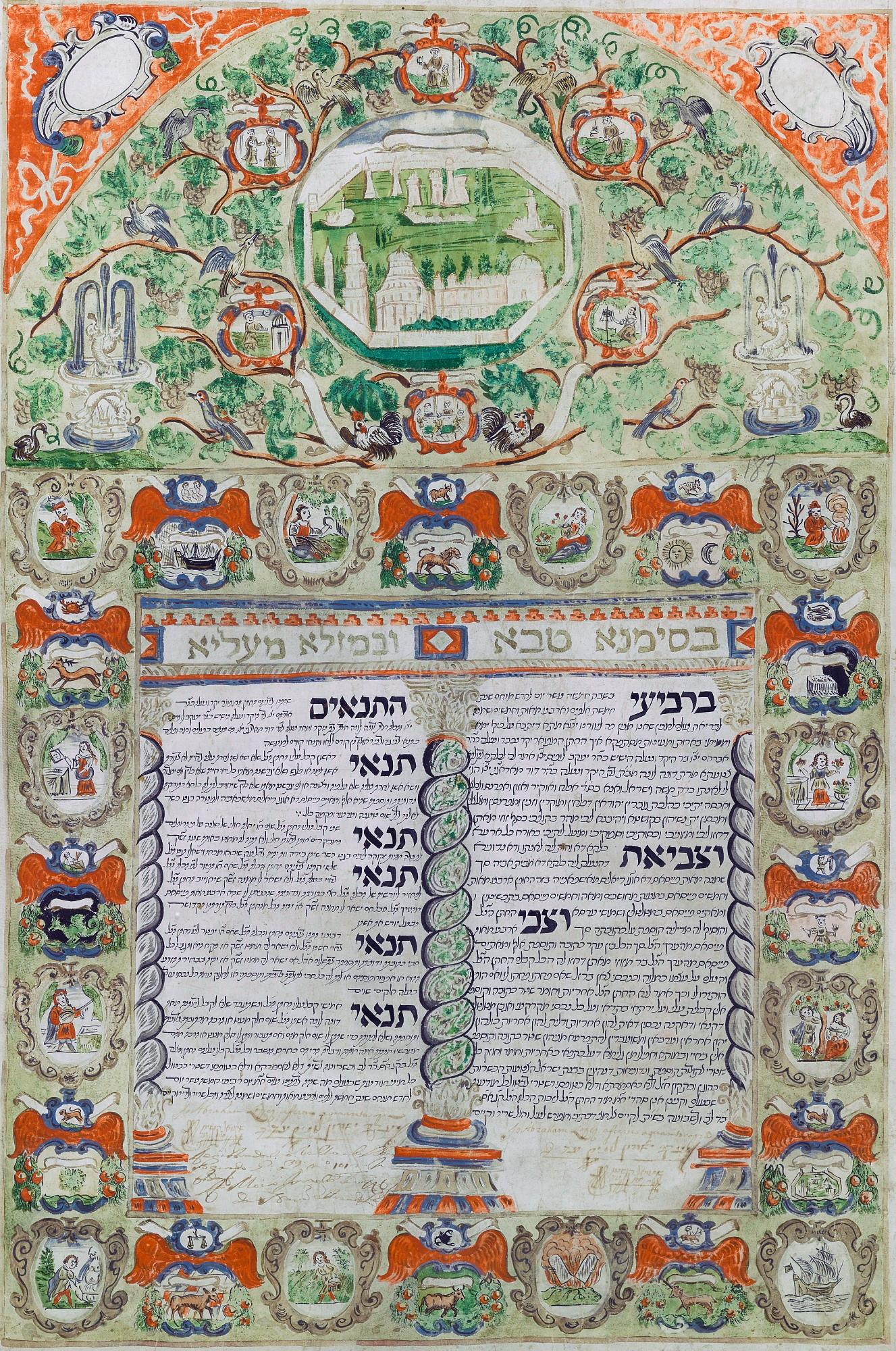 Wikimedia Commons (Public domain)
The ketubah is the Jewish marriage contract, written in Aramaic or Hebrew and signed before the ceremony. It's been called the world's oldest prenuptial agreement, but that framing misses the point entirely. The ketubah isn't about protection from divorce; it's about stating clearly what marriage means.
Historically, the ketubah formalized the groom's financial obligations to his bride, protecting her economically. It outlined what he promised to provide and what she brought into the marriage. In a time when women had few legal rights, this document was radical: it gave a wife recourse and recognition.
Modern couples often rewrite the ketubah's language or choose egalitarian versions where both partners make explicit promises to each other. Some add personal vows or translate the whole thing into English or a community language. Others stick with the traditional Aramaic text. The ketubah remains a legal document, but it's become something more important: a written statement of what this marriage means.
Ketubahs are frequently beautiful, illustrated with Hebrew letters, family symbols, or community motifs. Couples commission artists to create custom designs, turning the contract into artwork worthy of framing. The ketubah hangs in many Jewish homes as both a legal record and a visual reminder of the day two people promised to build a life together.
The Chuppah: Building Home
The wedding canopy, or chuppah, is perhaps the most recognizable symbol of a Jewish wedding. It's open on all four sides, representing the couple's openness to their community and their willingness to welcome others into their home. The chuppah can be simple (a prayer shawl, or tallit, held up by four friends) or elaborate (a floral structure, a wooden frame, even an arch of flowers), but its meaning stays the same: this is a sacred space where two people become partners.
The chuppah as a concept is ancient, rooted in Talmudic law. It symbolizes the home the couple will build together, a private space that is part of the larger community. Standing under the chuppah, the couple moves from being individuals to being a unit in the eyes of Jewish law and tradition.
In many Ashkenazi communities, the chuppah is positioned outdoors or in a place where stars can be seen, connecting the moment to Abraham's blessing in Genesis: "And I will make your offspring as numerous as the stars of the sky." In Sephardic traditions, the timing and location vary more widely, reflecting different community customs.
Ashkenazi Traditions and Their Meaning
Ashkenazi Jewish weddings (primarily from Central and Eastern Europe) developed practices that feel central to many people's image of a Jewish wedding, though they represent one of many traditions.
Bedeken (Veiling): Before the ceremony, the groom uses a veil to cover the bride's face. This practice dates back to biblical Jacob, who mistakenly married Leah thinking she was Rachel because she was veiled. By veiling the bride, the groom confirms he knows who he's marrying. The bride remains veiled throughout the ceremony until the kiddushin (betrothal) when the groom gives the ring. In some families, the veil is then lifted as a symbol of moving from private to public recognition of the marriage.
Circling: In many Ashkenazi ceremonies, the bride circles the groom seven times under the chuppah, or sometimes they circle each other. Seven is a sacred number in Jewish tradition (God created the world in six days and rested on the seventh). The circles represent the spiritual walls that come down between two people, creating an unbreakable bond. It's worth noting this is a specific Ashkenazi custom, not universal across Jewish communities.
Fasting: In Ashkenazi tradition, both the bride and groom often fast on their wedding day. The logic mirrors the fast on Yom Kippur: a day of spiritual intensity and atonement before entering a new life. The fast is broken at the wedding feast, making the meal a true celebration and transition.
Wine and Blessings: Ashkenazi ceremonies typically use two cups of wine during the Sheva Brachot (seven blessings), one for the initial blessings and another for the concluding blessing. This distinction is part of the detailed legal structure of how the ceremony must unfold.
Sephardic Traditions and Variations
Sephardic Jewish traditions (from Spain, North Africa, the Mediterranean, and the Middle East) have their own richly developed wedding customs that reflect different legal interpretations and cultural evolution.
No Circling: Unlike Ashkenazi practice, Sephardic brides do not traditionally circle the groom. This reflects different legal reasoning about how the couple enters into marriage and what creates their bond.
Bedeken and Timing: In Sephardic ceremonies, the bride may enter to the chuppah already veiled, but the veil is removed during or at the beginning of the ceremony, not at the end. This reflects different interpretations of how the groom demonstrates his knowledge of who he's marrying.
No Fasting: According to Sephardic law, particularly as codified by Rabbi Obadia Yosef, the groom should not fast because his wedding day is considered a joyous holiday, like a festival. This reflects a different approach to spiritual preparation.
Wine Cups: In Sephardic tradition, the same cup of wine is refilled during the Sheva Brachot rather than using two separate cups. This, too, reflects different legal structures and interpretations of how the ceremony should unfold.
Timing and Setting: Sephardic weddings often take place during the day, indoors or outdoors, without the specific emphasis on nighttime and stars that characterizes many Ashkenazi ceremonies. The practical and legal frameworks allow more flexibility.
Mizrahi, Yemenite, and other Jewish communities have their own distinct traditions as well, some emphasizing different elements of the ceremony or adding unique rituals. The diversity is not a bug; it's a feature of a people spread across the world who maintained their core commitments while adapting to their surroundings.
The Ceremony Itself: Kiddushin and the Seven Blessings
Regardless of whether the wedding is Ashkenazi or Sephardic, the legal core of the Jewish marriage ceremony involves two key moments.
Kiddushin (Betrothal): The groom gives an object of value (traditionally a ring, though any valuable item works) to the bride while saying specific words in Hebrew. This act, witnessed by two valid witnesses, is what creates the legal marriage. It's the moment that makes the commitment binding under Jewish law.
Traditionally, the bride is silent during kiddushin, but modern weddings often include the bride giving a ring or object to the groom as well, with both partners making the commitment simultaneously. This reflects changing views about equality and the equal nature of their promises.
Sheva Brachot (The Seven Blessings): After kiddushin, seven blessings are recited over wine. These blessings celebrate creation, the couple, and invoke the rebuilding of Jerusalem. The first blessing praises God for creating the universe. The next few blessings focus on the joy and meaning of this particular wedding. The final blessing, unique to weddings, asks God to bring joy to the couple and to Jerusalem.
The seven blessings are among the most ancient parts of the wedding, referenced in Talmudic discussions and evolved over centuries. They can be recited by rabbis, family members, or friends, and many modern ceremonies invite meaningful people in the couple's life to share in reciting them.
Breaking the Glass: Remembering and Rejoicing
After the blessings, the groom (traditionally, though now often the couple together) smashes a glass, usually wrapped in cloth for safety. The sound is unmistakable and marks the moment the ceremony ends and the marriage begins.
The breaking of the glass is rich with meaning. It's often interpreted as a reminder of the destruction of the Second Temple in Jerusalem in 70 CE. Even in moments of great joy, Jewish tradition teaches, we remember communal grief and suffering. It's also a reminder of the fragility of life and relationships, the need to cherish what we have because it can break.
Some interpret it as representing the permanence of the marriage: once broken, the glass cannot be reassembled, just as the commitment made in marriage is irreversible. Others see it simply as a moment of joyous release, a sound that says, "It's done, we're married, let's celebrate."
The interpretation matters less than the moment itself. The loud crack of the glass cuts through solemnity and invites everyone to shout "Mazel tov!" (congratulations/good luck), transforming the ceremony from formal to festive in an instant.
After the Ceremony: Yichud and Celebration
Immediately after the ceremony, the couple traditionally goes into a private room (yichud, meaning "togetherness" or "private union") for a few minutes alone. This practice serves several purposes: it's the first moment they can speak privately after the ceremony, and in some communities, it has halachic significance related to consummation and the finalization of the marriage.
While the couple is in yichud, guests move into the reception area for cocktails and hors d'oeuvres. When the couple emerges, the celebration truly begins.
The hora, or circle dance, is the traditional moment where guests lift the bride and groom (usually in chairs) and dance in circles around them. Originally a Balkan and Eastern European folk tradition, it became so integral to Ashkenazi Jewish weddings that many people assume it's an ancient Jewish ritual. The dancing continues to "Hava Nagila" and other joyous songs, creating a moment of pure collective celebration.
The wedding feast includes toasts, multiple courses, and often a special moment when the Sheva Brachot blessings are recited again. Any time new guests join the celebration, the seven blessings can be repeated, allowing the joy to be extended and shared.
Sheva Brachot: A Week of Blessings
Traditionally, celebrations don't end with the wedding reception. For the seven days following the wedding, the community gathers for evening celebrations called Sheva Brachot meals. These are dinner parties, often hosted by different friends or family members, where the Sheva Brachot are recited again and the couple is celebrated repeatedly.
This week-long tradition emphasizes that marriage isn't a single moment but the beginning of a journey. The community's role in supporting the couple is formalized through these communal meals and blessings.
Modern Choices: Honoring Tradition While Choosing Your Own
Today's Jewish couples have unprecedented freedom to choose which traditions speak to them and which don't. Some couples honor every Ashkenazi tradition exactly as their grandparents did. Others blend traditions (Ashkenazi and Sephardic elements, or elements from multiple cultures), rewrite vows, or create entirely new rituals that reflect their values.
What matters, according to most contemporary Jewish perspectives, is that the choices are intentional. If a couple breaks from tradition, they do it knowingly, not by accident. If they honor tradition, they do it because it means something to them, not by rote.
Many modern couples include rituals from non-wedding contexts in their ceremonies. Lighting candles for deceased loved ones, commissioning artists to create custom ketubahs that tell their specific story, including both parents in the ceremony regardless of gender or role, or writing personal vows alongside traditional elements. These additions don't diminish the ancient traditions; they deepen them by making them personal.
The beautiful thing about Jewish wedding traditions is their flexibility within structure. The basic legal requirements (two valid witnesses, kiddushin with an object of value, acceptance by the bride) are firm. But how you dress that core, which secondary customs you include, how you express joy and reverence: those are yours to decide.
Choosing Meaningful Gifts
If you're invited to a Jewish wedding, know that your presence is the greatest gift. But if you want to bring a gift, consider something that honors both the couple and their heritage. For couples who appreciate Jewish pride and culture, pieces from collections like Kosher Couture's Hebrew Script or Chai Fashion can make thoughtful engagement or wedding-guest gifts. These are subtle ways to celebrate their identity and their willingness to wear their pride.
FAQ
What makes a Jewish marriage legally binding? The legal requirement is simple: the groom must give an object of value to the bride (with her consent) while saying specific words in Hebrew, all witnessed by two valid witnesses. Everything else, while rich with meaning and tradition, is ceremony and custom.
Do all Jewish weddings include circling? No. Circling is an Ashkenazi custom, particularly strong in Central and Eastern European Jewish traditions. Sephardic, Mizrahi, Yemenite, and other communities may have different customs or no circling at all. Modern couples also choose whether to include it based on their own heritage and preferences.
What's the significance of breaking the glass? The most common interpretations are that it reminds us of the destruction of the Temple in Jerusalem and of life's fragility, or that it symbolizes the permanence of the commitment. Different people and communities emphasize different meanings, but all agree it marks a joyous moment to celebrate.
Can couples write their own vows or rewrite traditions? Yes. Many contemporary Jewish couples write personal vows, create custom ketubahs with meaningful language, or blend traditions from different communities. The key is that these choices are intentional and meaningful to the couple.
How long do Jewish wedding celebrations typically last? The ceremony itself usually takes 15 to 30 minutes. The reception can last several hours, often including dinner, dancing, and toasts. In traditional contexts, celebrations extend for a full week with Sheva Brachot meals, though this is less common in modern, secular settings.
Are non-Jewish friends and family welcome at Jewish weddings? Yes. Jewish weddings are community celebrations, and all are invited to participate and celebrate the couple's joy.