
Jewish Fashion Designers Shaping Style

Jewish designers have fundamentally transformed the fashion industry, from the garment district factories of New York to the high-fashion runways of Paris and Milan. Their contributions span a century of innovation, from inventing the wrap dress to pioneering ready-to-wear clothing to redefining what luxury means. This is the story of how Jewish designers turned entrepreneurship, craftsmanship, and cultural pride into brands that dressed the world.
From the Garment District to the Runway
The history of Jews in fashion is inseparable from the history of fashion itself. When Jewish immigrants arrived in America between 1820 and 1924, many began as "rag pickers," collecting and selling used clothing. It was an unglamorous start, but it was entrepreneurial: they built from the ground up, moved from dealing in used goods to manufacturing ready-to-wear, and eventually created couture lines that would define American fashion.
By the early 1900s, more than 90 percent of factories in New York City's garment district were owned by German Jews. By the turn of the century, an astonishing 60 percent of all Jews employed in New York made their living in the garment industry. These weren't just factory workers. They were manufacturers, designers, retailers, advertisers. Jews were involved in every link of the supply chain, from the fabric mills to the department store windows. This wasn't an accident of history. It was a blueprint: immigrants with limited capital but unlimited resourcefulness built an industry from nothing.
The impact spread across the Atlantic. In the 1920s and 1930s, Berlin was the undisputed fashion capital of the world. And that position was almost exclusively due to Jewish innovators in business, design, photography, and journalism. The thread that connects this era to today runs through every major fashion house: it's made of ambition, ingenuity, and mishpucha (family).
The Icons Who Redefined Fashion
Donna Karan: The Architect of Wearability
Donna Karan grew up in the Five Towns, a Jewish enclave on Long Island. She attended Parsons School of Design and went to work under fellow Jewish designer Anne Klein. When Klein passed away in 1974, Karan stepped into the role of chief designer. She didn't just fill the role. She transformed it.
In 1984, Karan founded her own company, Donna Karan Co., with her husband Stephan Weiss. Her most famous contribution to fashion was the concept of "Seven Easy Pieces": a capsule wardrobe of interchangeable essentials including a white shirt, little black dress, tailored jacket, pencil skirt, leather jacket, and cashmere sweater. This wasn't revolutionary for any single item. It was revolutionary for how she thought about clothing: as a system. As versatile. As something that could work across contexts, that didn't demand a closet full of single-use pieces.
This philosophy would become DKNY and eventually become the basis for her global brand. The idea that good design solves problems, that fashion should serve the wearer instead of demanding the wearer serve it, came directly from her vision. It's a lesson that still defines modern fashion today.
Calvin Klein: The Minimalist Visionary
Calvin Klein was born in the Bronx to Hungarian Jewish immigrant parents. His career is a masterclass in understanding what consumers actually want underneath the hype. While fashion was chasing ornamentation, Klein was chasing simplicity. Clean lines. Quality fabrics. Minimalism not as an aesthetic luxury but as a philosophy.
His breakthrough came with jeans. While most designers treated denim as workwear or treated it as a canvas for embellishment, Klein cut them with impeccable proportions and minimal branding. The jeans became iconic, and they proved something: that heritage and elegance didn't require flash. This philosophy extended across his entire brand, from fragrance to underwear. Klein made plainness feel like luxury.
It's a particularly Jewish sensibility, this understanding of restraint as strength. Klein built one of the largest fashion houses in the world on the principle that less is more.
Ralph Lauren: The American Dream in Menswear
Ralph Lauren was born Ralph Lifshitz in 1939, the son of Ashkenazi Jewish immigrants from Belarus. Like Calvin Klein, he grew up in the Bronx. Unlike Klein, he chose a different name to navigate his career. He changed his surname from Lifshitz to Lauren (he later explained to Oprah that the original name contained a word that would make it harder to succeed in fashion).
But he never forgot who he was. He attended Marsha Stern Talmudical Academy, went to yeshiva, and remains conscious of his Judaism throughout his life. He goes to synagogue. His Jewish identity runs underneath everything he built.
His contribution to fashion was different from Klein's or Karan's. Ralph Lauren created an entire lifestyle. He took the preppy aesthetic, refined it, and sold it as an idea: the Ralph Lauren brand wasn't just clothes, it was a way of living. It was the Oxford shirt and the polo and the tartan. He essentially invented modern American luxury branding.
The irony is delicious: a Jewish kid from the Bronx with immigrant parents became the designer most associated with old-money WASP aesthetics. He didn't just succeed in fashion. He redefined what American elegance meant, and in doing so, he paved the way for other Jewish designers to be taken seriously in an industry that had historically excluded them.
Diane von Fürstenberg: The Wrap Dress Revolutionary
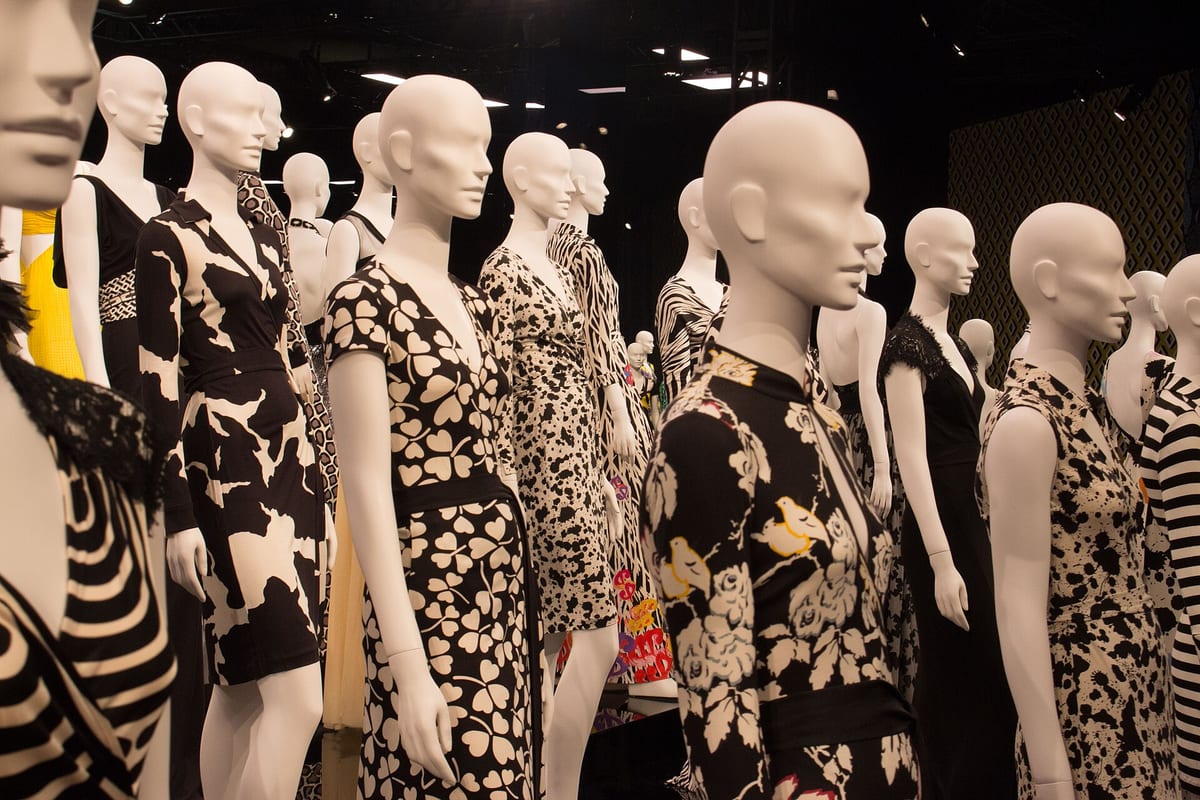 Photo: Bruce Monroe, Wikimedia Commons (CC BY-SA 2.0)
Diane von Fürstenberg's story begins with survival. She was born Diane Halfin, the child of Lily Nahmias, a Greek Jew who helped deliver counterfeit papers to other Jews during the Holocaust. Her mother was caught in 1944 and sent to Auschwitz, where she was liberated weighing just 49 pounds. Diane was born 18 months later.
She grew up in Brussels and was educated in Switzerland and England. She studied economics at the University of Geneva and apprenticed under textile manufacturer Angelo Feretti in Paris. In 1970, at age 23, she launched her fashion company. Four years later, in 1974, she invented the wrap dress.
The wrap dress was a phenomenon. It was elegant, flattering, and versatile. You could wear it to the office or to dinner. You could dress it up or dress it down. It fit different body types beautifully. And it was accessible. By 1976, Newsweek put her on the cover and called her "the most marketable woman since Coco Chanel." She was 29 years old.
Von Fürstenberg's achievement wasn't just the dress itself. It was understanding something fundamental about what women wanted: clothes that worked, that moved with them, that made them feel confident. She also became a champion for other women. She became president of the Council of Fashion Designers of America in 2006 and founded the DVF Awards to honor women in leadership around the world.
Marc Jacobs: The Democratizer of High Fashion
Marc Jacobs released his first collection in 1986 under his own name. By 1992, at age 28, he was awarded the Women's Designer of the Year Award by the Council of Fashion Designers of America. In 1997, he became the artistic director of Louis Vuitton, one of the most prestigious positions in fashion.
Jacobs is known for making high fashion feel approachable. He brought irreverence to luxury, humor to couture. His designs have never felt precious or untouchable. He's always believed that great design isn't only for people who can afford the runway shows. This democratizing impulse is part of his inheritance: the story of Jewish designers making quality accessible, making beauty available, making pride affordable.
Zac Posen: Heritage as Inspiration
Zac Posen was born and raised in a Jewish family in New York City, in the SoHo neighborhood of lower Manhattan. His family has roots in Shklow, Belarus, and Żychlin, Poland. As a child, his fascination with clothing was so consuming that he would steal yarmulkes from his grandparents' synagogue to fashion into ball dresses for dolls. It's a perfect image: using sacred objects, repurposing them into something beautiful, something wearable, something joyful.
Posen built a brand known for elegant and glamorous evening gowns. He's been worn by everyone from Sarah Jessica Parker to Michelle Obama. His designs show technical mastery in construction and draping. In 2021, he appeared on the show "Finding Your Roots" and explored his Jewish heritage, discovering his family's deep ties to craftsmanship and the apparel industry. It was a full-circle moment: a designer famous for precision and glamour learning that this precision, this attention to the making of clothing, was woven into his family DNA.
The Threads That Connect
What's striking about Jewish designers isn't any single aesthetic. Karan's minimalism looks nothing like Posen's glamour. Klein's restraint contrasts with Lauren's maximalism. But there are threads connecting them.
The first is entrepreneurship. Almost every Jewish designer mentioned here didn't wait for permission from the fashion establishment. They created their own houses, built their own brands, took the risk. Many of them came from manufacturing backgrounds, which meant they understood production, quality, cost, and how to scale. They weren't trained to expect that fashion houses would simply exist for them. They made them exist.
The second is accessibility. Whether it's Karan's capsule wardrobe concept, Klein's understanding that great jeans should be available to everyone, or Jacobs's philosophy of democratic luxury, there's a consistent thread of making excellent design available to more people, not fewer. This is partly pragmatic, partly principled. The garment district workers who built the American fashion industry knew that their market was ordinary people. That lesson never entirely left.
The third is balancing heritage with innovation. These designers didn't pretend their backgrounds didn't matter. Zac Posen discovered his family's history in textiles. Ralph Lauren went to yeshiva. Diane von Fürstenberg's work is inseparable from her mother's survival story. They honored where they came from while pushing fashion forward. That's not contradiction. That's integrity.
The Legacy Today
The influence of Jewish designers on contemporary fashion is everywhere. The wrap dress that Diane von Fürstenberg invented is still made, still worn, still considered a modern classic. The capsule wardrobe philosophy Donna Karan pioneered is now the foundation of the entire "minimalist fashion" movement and countless sustainability-focused brands. Calvin Klein's minimalism shaped how we think about luxury. Ralph Lauren's branding created the template that almost every lifestyle brand still follows. Marc Jacobs's playful irreverence gave permission for high fashion to be fun.
And the tradition continues. Jewish designers keep innovating, keep taking risks, keep building brands that matter.
Pride Worn Daily
For Kosher Couture, the legacy of Jewish fashion designers tells us something important: pride in heritage doesn't happen once a year on a holiday. It happens every day. It happens when you wear something that celebrates who you are, that connects you to a history of innovation and excellence, that says to the world: I'm here, I'm proud, and I'm not asking for permission.
The designers in this story didn't wait for the fashion industry to make space for Jewish identity. They created that space themselves, one collection at a time. They wore their heritage forward. And they proved that the most powerful fashion isn't about looking like someone else. It's about looking like yourself, but better. Bolder. Prouder.
That's the spirit that runs through every piece we make at Kosher Couture. Heritage worn daily. Pride that doesn't take a day off. And the conviction that good design serves everyone.
FAQ
Who are some of the most famous Jewish fashion designers?
Donna Karan, Calvin Klein, Ralph Lauren, Diane von Fürstenberg, Marc Jacobs, and Zac Posen are among the most influential Jewish designers of the modern era. Each has shaped fashion in different ways, from inventing the wrap dress to pioneering minimalism to creating lifestyle brands that redefined American luxury.
What did Jewish designers contribute to the fashion industry?
Jewish designers fundamentally transformed fashion by pioneering ready-to-wear manufacturing in America, democratizing luxury, creating innovative design philosophies like the capsule wardrobe, and building some of the world's most iconic fashion houses. Their contributions span manufacturing, design, retail, and branding.
Why did so many Jewish designers come from New York?
New York's garment district, built by Jewish immigrants in the early 1900s, created an ecosystem of expertise in manufacturing, design, and fashion entrepreneurship. By the turn of the century, 60 percent of all Jews employed in New York worked in the garment industry, making it a natural launching pad for designers and entrepreneurs.
What is the wrap dress, and why was it revolutionary?
Designed by Diane von Fürstenberg in 1974, the wrap dress is a simple dress style that ties at the side. It was revolutionary because it was elegant, versatile, flattering to different body types, and accessible. It solved practical problems about how women wanted to dress, moving beyond rigid formal categories.
How do Jewish designers balance their heritage with modern fashion?
Many Jewish designers actively honor their heritage while pushing fashion forward. They do this through understanding their family histories in textiles and design, bringing cultural values like craftsmanship and accessibility into their work, and not apologizing for their identity even while creating universal appeal.


