
Jewish Art History: Manuscripts, Synagogues, and Artists
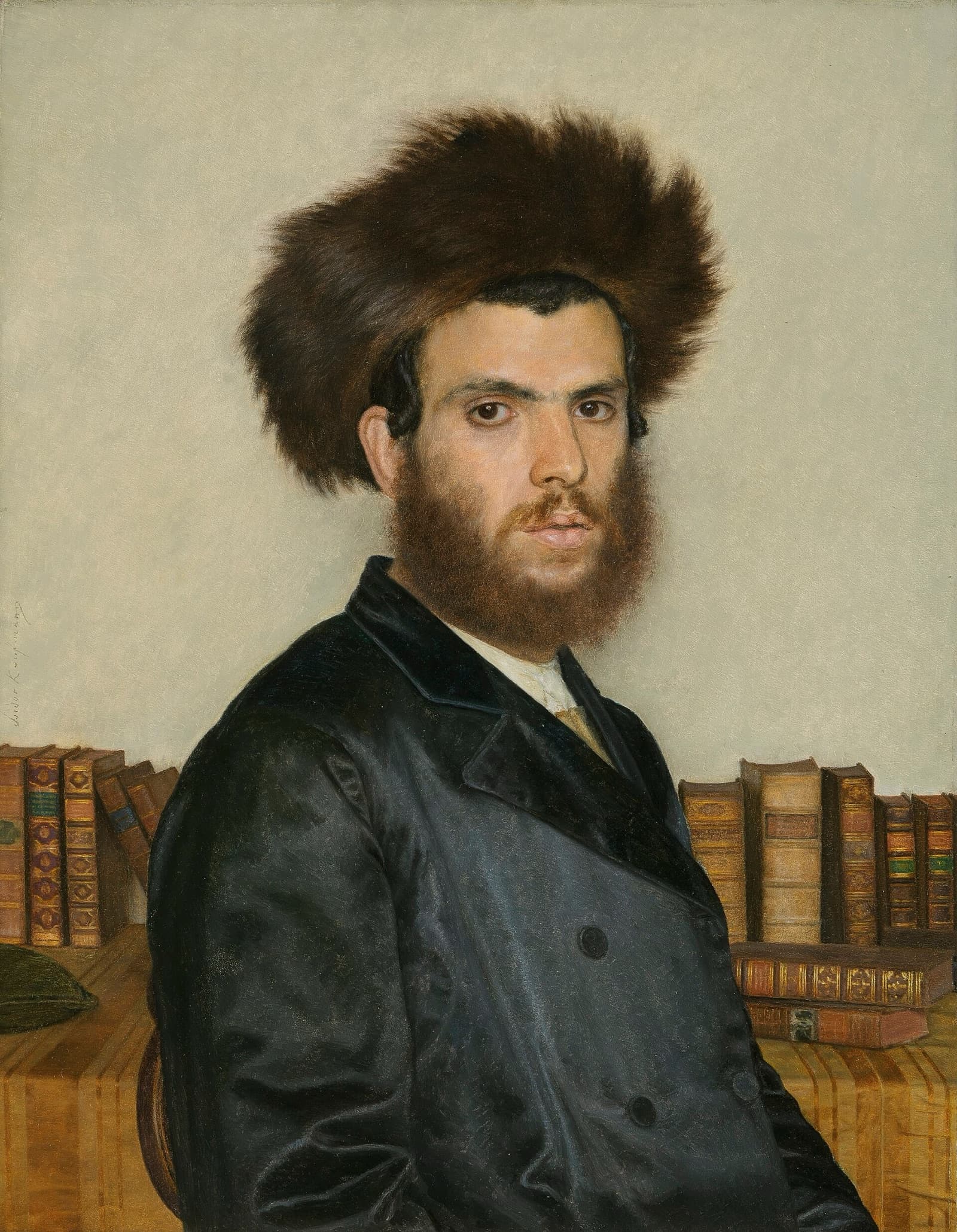
Jewish art tells the story of a people who have used creativity to preserve identity, process grief, celebrate survival, and imagine the future. From illuminated Hebrew manuscripts to abstract expressionism, from synagogue interiors shimmering with gold to paintings of shtetl life and installations confronting modern trauma, Jewish artists have built a visual language that speaks to the depths of Jewish experience and to universal human truths at once. This tradition deserves a close look for a simple reason: it shows how art works as a repository of culture, resistance, and hope.
The Myth That Jews Didn't Make Art
For much of history, people assumed that Jewish tradition discouraged visual art altogether. That's a myth. Jewish law cautions against certain kinds of idol worship, but it never prohibited artistic expression in service of faith and community. Jews have been making striking visual work since ancient times: synagogue mosaics, decorated burial sites, illuminated religious texts, and sacred spaces designed with care and skill.
The evidence is everywhere if you know where to look. Late antique synagogues were decorated with figural mosaics depicting biblical scenes. Medieval Hebrew manuscripts glowed with gold leaf. Jewish communities built some of Europe's most breathtaking buildings. None of this was a side project or a compromise with secular culture. It was central to how Jewish communities expressed their values and passed down their story.
The Deep Roots: Medieval and Early Modern Jewish Art
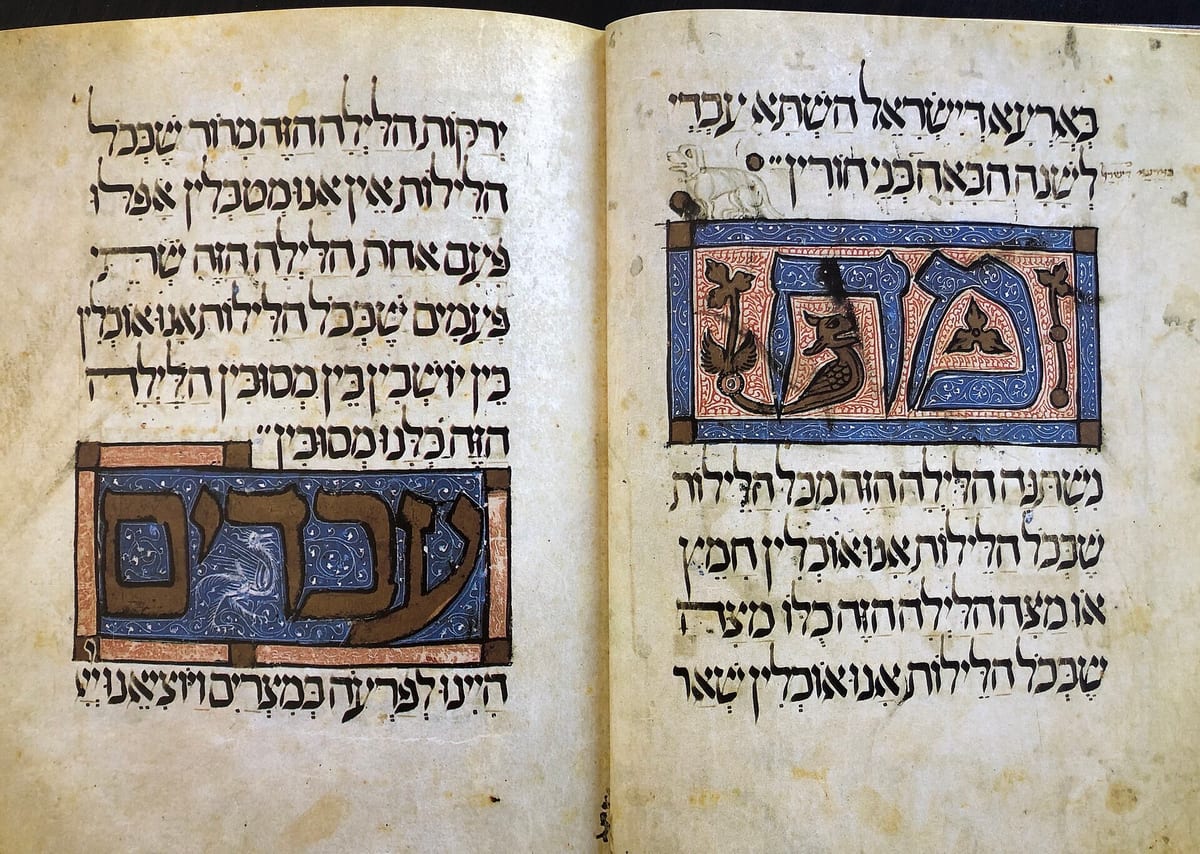 Photo: Unknown, Wikimedia Commons (Public domain)
Before there was a concept of "Jewish art" as a recognized category, Jews were creating visual work within the constraints and possibilities of their time and place. In medieval Europe, Jewish manuscripts became some of the most astonishing artistic achievements in the Jewish tradition.
The Sarajevo Haggadah
If one artwork embodies the beauty and defiance of Jewish art history, it's the Sarajevo Haggadah. Created in Barcelona around 1350, it was likely commissioned as a wedding gift for two prominent Jewish families in medieval Spain. It was written on parchment in the Sephardic Hebrew script of the time, illuminated with gold leaf and intricate borders, and it carries 34 full-page miniatures that tell the Jewish story from the Creation through the Exodus, the heart of Passover.
Each page is a world unto itself. The miniatures match the sophistication of Christian manuscripts of the era while staying distinctly Jewish in subject and sensibility. Figures wear the clothing and live in the architecture of medieval Iberia. The deep blues, reds, and greens still glow after 675 years.
Then came the journey. The manuscript survived the Inquisition, the Ottoman Empire, Nazi occupation, and the Bosnian War, and it has been housed since the 19th century in the National Museum of Bosnia and Herzegovina in Sarajevo. In 2017, UNESCO registered it in the Memory of the World program. Its survival is itself a metaphor for Jewish cultural resilience, and its making captures a moment when Jews in medieval Spain could create openly, lavishly, and brilliantly. It says: we are here, our story matters, and we will remember.
The Language of Illumination
From the 10th through the 16th centuries, Jewish scribes and artists created manuscripts that served both spiritual and social functions. A beautifully illuminated manuscript was an object of pride, often commissioned for a wedding or to mark a family's or community's wealth and learning. These were not rare oddities. They were read aloud at Passover seders and weddings and became part of the fabric of Jewish life.
These were functional religious works, and they were also expressions of beauty, skill, and an impulse to make the everyday sacred. A Jewish scribe illuminating a Haggadah was doing something deeply Jewish and deeply creative at the same time. Convention leaned toward intricate patterns and toward Hebrew letters themselves as decorative elements, with a caution about human forms in religious contexts that was never uniformly enforced. The Kennicott Bible (15th century) depicted biblical kings and prophets with the same skill found in Christian royal manuscripts. The Birds' Head Haggadah (early 14th century, Germany) rendered human figures with the heads of birds, a convention that may have helped artists navigate questions about figural representation while still making dynamic, expressive art. Within those constraints, artists found infinite variation.
In Islamic lands, Jewish artists worked in different traditions entirely. The Cairo Geniza, a repository of medieval Jewish documents discovered in the 19th century, reveals that Jewish communities in Egypt created manuscripts, amulets, and everyday objects with Hebrew inscriptions and geometric patterns. The look was different from European Jewish art, but the impulse was the same: to embed Jewish identity and belief into material form.
The 19th Century: Jewish Artists Enter the Mainstream
By the 19th century, as legal restrictions on Jews began to ease across Europe and the Americas, Jewish artists began participating in the broader art world. They studied in academies, exhibited in salons, and competed for commissions. They were no longer making art exclusively for Jewish contexts; they were entering a secular, cosmopolitan artistic sphere.
This was both liberation and a kind of loss. Jewish artists faced a question that would echo through the 20th century: should they make explicitly Jewish art, or move beyond ethnic or religious subject matter? Some chose one path, some the other, and many moved between them.
Synagogues as Statements
Meanwhile, Jewish communities across Europe finally had the wealth, freedom, and confidence to commission truly monumental synagogues. These weren't modest prayer halls. They were declarations of belonging and pride.
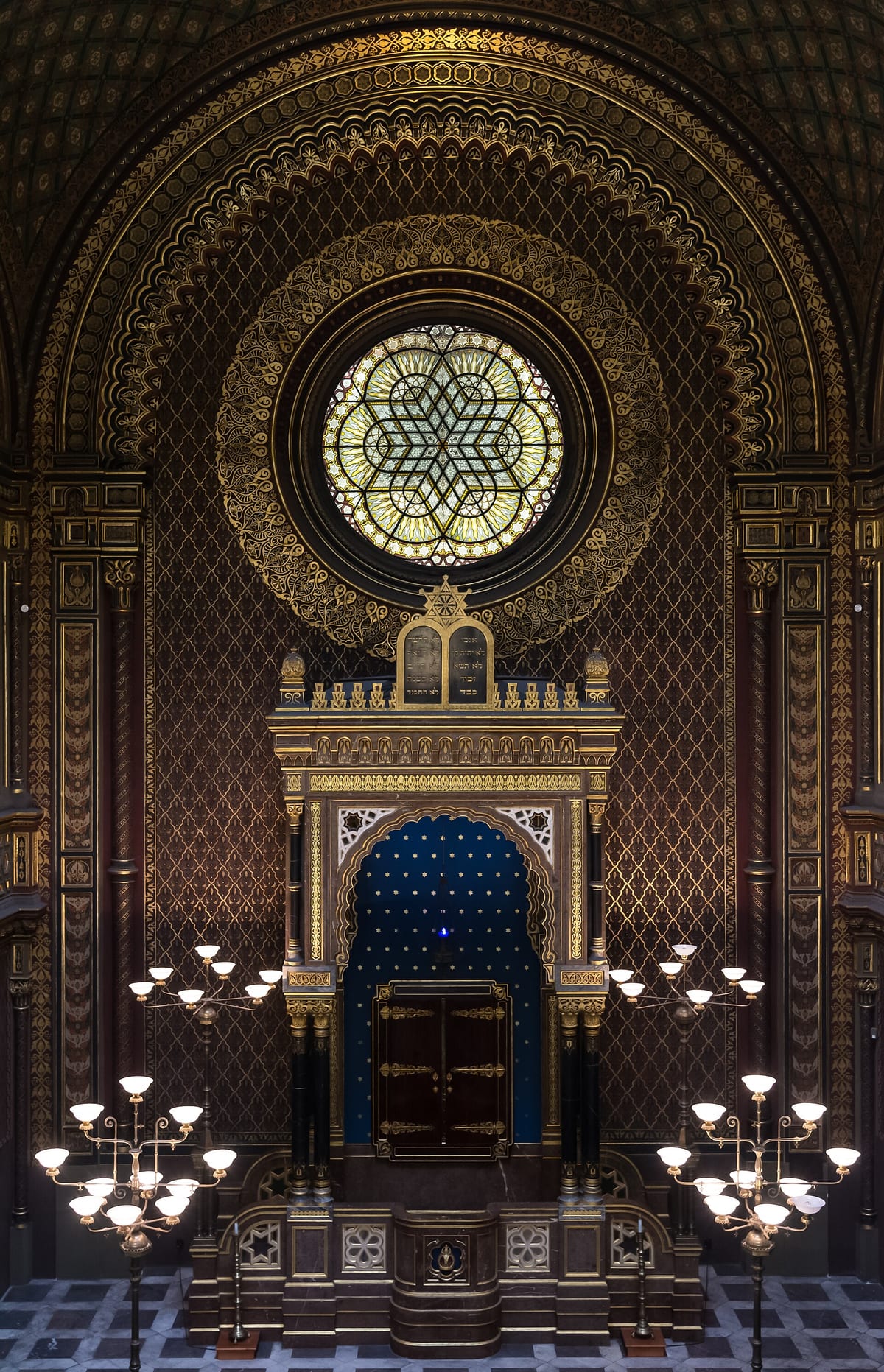 Photo: Uoaei1, Wikimedia Commons (CC BY-SA 4.0)
The Spanish Synagogue in Prague, built in 1868, sits on the site of the Old Shul (Altschul), the oldest house of worship in Prague's Jewish Quarter. Its architects, Vojtěch Ignác Ullmann and Josef Niklas, chose Moorish Revival, a style inspired by the Alhambra that looked backward to medieval Spain and forward to their own era. Stucco arabesques in stylized geometric and plant forms cover the walls in low relief, rendered in gold and polychrome colors drawn from Islamic art, while stained glass filters light across the room. Every surface creates a sense of the sacred without depicting religious figures, a space where geometric precision and visual richness work together to lift the spirit of prayer.
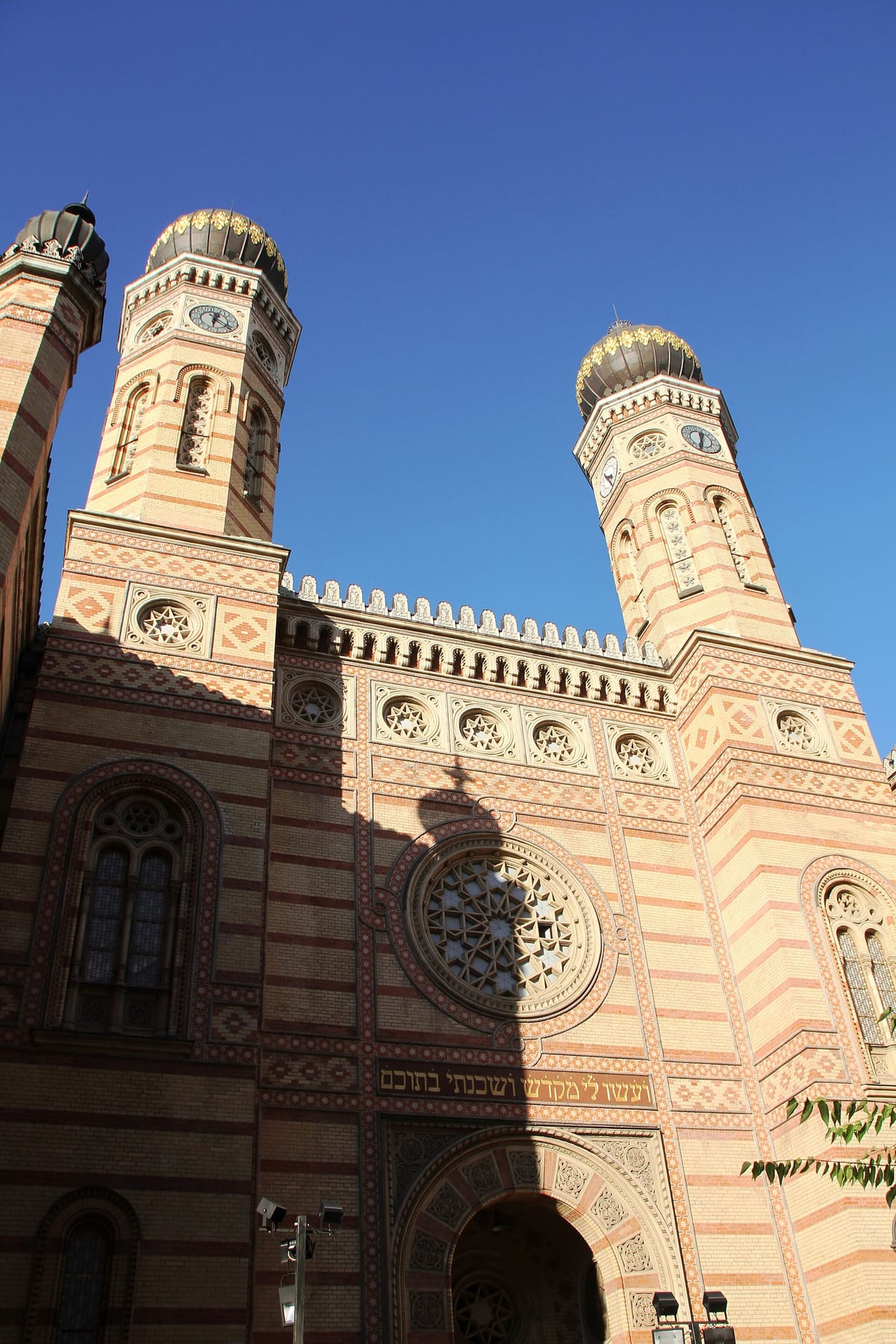 Photo: Bjoertvedt, Wikimedia Commons (CC BY-SA 4.0)
If Prague whispers, Budapest announces. The Dohány Street Synagogue, built between 1854 and 1859, is the second-largest synagogue in the world. Its twin octagonal towers rise 43 meters, topped with onion-shaped domes that became one of the city's most recognizable silhouettes. Architect Christian Friedrich Ludwig Foerster designed it in Moorish Revival and Romantic Historicist styles, and Frigyes Feszl created the Torah ark and the frescoes of golden and colored geometric shapes. The sanctuary glows with gold-and-blue Moorish mosaics, and the Heroes' Temple within the complex carries Byzantine-inspired tilework. The scale tells you everything about Budapest's 19th-century Jewish community: they had arrived, they were thriving, and they meant to build something that would endure.
Both buildings share a vocabulary rooted in Islamic and medieval Spanish art, and that was no accident. These communities were deliberately referencing the periods when Jewish culture had flourished, before persecution drove Jews north and west. They were acts of historical memory built in stone and glass and gold.
Bezalel and a Jewish Visual Language
Another significant development was the Bezalel Academy of Art and Design, founded in Jerusalem in 1906 by Boris Schatz. Schatz, a Belarusian-Jewish sculptor, wanted a school where Jewish artists could reclaim and reinterpret Jewish artistic tradition in a modern context. The academy became a hub for a movement sometimes called "Orientalism with a Jewish twist," blending Art Nouveau, Middle Eastern motifs, and Jewish symbolic content. Artists like Abel Pann and Ephraim Moses Lilien created images that asserted Jewish culture and Jewish connection to the land of Israel in visual form, at a moment when such assertions mattered intensely.
The 20th Century: Trauma, Meaning-Making, and Revolutionary Form
The 20th century forced a reckoning. The Holocaust, the establishment of the State of Israel, and the profound transformations of Jewish life globally all demanded artistic response. Some of the most significant Jewish artists of this era did not make explicitly "Jewish" art in a symbolic sense. Instead, they processed Jewish experience through form, color, and abstraction.
Marc Chagall is perhaps the most globally recognized Jewish artist. His work blends Russian folk imagery, Jewish symbolism (fiddlers, candelabras, goats, villages in snow), surrealist dream logic, and brilliant color. Chagall fled Nazi-occupied France during World War II and eventually settled in France again after the war. His paintings often return to his childhood in Vitebsk, Belarus, rendered in a magical, impossible space where perspective ignores the rules and bodies float or transform. His content was unmistakably Jewish; his form was pure modernism.
Mark Rothko, born in Latvia and raised in Portland, Oregon, created monumental abstract paintings with little explicit Jewish content. Yet Rothko was deeply engaged with questions of meaning and spirituality. He refused to allow his paintings to be displayed in churches or synagogues because he wanted viewers to approach them without institutional framing. Some scholars read his work as a response to the post-Holocaust struggle for meaning: how do you create spiritual content when God and meaning seem absent or broken? Rothko's paintings demand an encounter with feeling and presence rather than with representation or narrative.
The Israeli artist Menachem Shemi created paintings and drawings documenting the kibbutz movement and Palestinian life. His work is politically engaged and artistically rigorous, refusing easy answers or simple narratives about Israeli society.
None of these artists set out to represent Jewish identity didactically. They were processing experience, innovating formally, and grappling with meaning through materials and abstraction. Their Jewishness shaped the questions they asked and the experiences they drew from.
The Holocaust and Remembrance
Some artists made the Holocaust itself the explicit subject. This required a different kind of courage, both moral and artistic. How do you create art about something so catastrophic that it threatens the very possibility of meaning and beauty?
Jewish artists answered in radically different ways. Some created realistic or semi-realistic imagery: paintings of concentration camps, drawings of families in hiding. Others turned to abstraction, color field, or gesture to express the emotional and spiritual devastation. Some made work that is almost unbearable to look at. Others found beauty and strength standing right beside the darkness.
Yitzhak Danziger, an Israeli sculptor, created works that grapple with Jewish history and trauma while asserting a fierce presence and physicality. The photographer Roman Vishniac documented Jewish life in Eastern Europe before the Holocaust, then spent decades photographing in the aftermath. His images are never sentimental, and always deeply human.
Artists like Archie Rand, a Brooklyn-based painter, have created massive, color-saturated works that address Jewish identity, Talmudic texts, and personal and collective memory. Rand's paintings are huge and packed with imagery and text. They demand engagement, not passive viewing.
Contemporary Jewish Artists: Diaspora, Identity, and Experimentation
Contemporary Jewish artists work across every medium and style imaginable. What binds them is a set of shared questions about identity, belonging, history, and diaspora rather than a unified aesthetic.
Siona Benjamin, a Baghdadi-Jewish artist based in New York, creates paintings that blend Indian miniature painting traditions, Islamic art, and Jewish iconography. Her work refuses the idea that Jewish art must come from a European or Western context. It shows that Jewish identity has long lived in conversation with other cultures, that Jews have been part of Islamic and Asian civilizations for centuries, and that a contemporary Jewish artist can draw from multiple traditions at once.
Israeli and Palestinian artists are creating work together, separately, and in response to each other. This work is often politically engaged, asking questions about coexistence, violence, land, and possibility. Artists like Khaled Jarrar (Palestinian) and Yael Bartana (Israeli) create provocative installations and videos that challenge nationalist narratives and imagine alternative futures.
Photographer Diane Arbus, who identified as Jewish later in her life, made portraits of people on the margins of society: circus performers, nudists, people with dwarfism, gender-variant individuals. Her work is often read as deeply humanistic, insisting on the dignity and complexity of people society dismisses, and that commitment to seeing the overlooked has been connected to Jewish ethical imperatives.
Younger Jewish artists are working in digital media, video, installation, sculpture, and mixed media. Some make explicitly Jewish-themed work; others address identity, race, gender, and power without direct reference to Jewish content. All of it is part of the continuum.
Themes, Symbols, and Meaning-Making
Throughout Jewish art history, certain themes and symbols recur. The menorah appears again and again, representing Jewish continuity and the presence of light even in darkness. The Magen David (Star of David) is ubiquitous in modern Jewish art, particularly after it became the symbol on the Israeli flag. Pomegranates, symbolizing fertility and abundance, appear in ancient Jewish art and still resonate. The map of Israel/Palestine, in various forms, is a recurring subject in contemporary art.
Shtetl scenes are a genre unto themselves. Marc Chagall painted them; Isaac Bashevis Singer wrote about them; more recently, artists have revisited the visual world of Eastern European Jewish villages with a mix of nostalgia, irony, and political consciousness. These scenes carry the weight of a world largely destroyed. They also insist that this world existed, mattered, and merits remembrance and reimagining.
Yiddish and Hebrew text appears in Jewish art as both content and formal element. Some artists treat text as pure image, focusing on the shapes of letters and the visual music of language. Others layer text and image into works that demand literacy in Hebrew or Yiddish to fully access. Still others play with the fact that most viewers won't read the text, making that gap part of the work's meaning.
Why Jewish Art Matters
Jewish art reveals how a people have thought about themselves, survived catastrophe, built culture in diaspora, and imagined futures. Artists are often the first to process collective experiences that society hasn't yet found words for, and visual culture shapes how we understand ourselves and the world.
It is also deeply communal. A synagogue is built for a congregation, not an individual. An illuminated manuscript might be a family possession, but it was made to be used and shared, linking the family reading it to the larger Jewish people. Jewish art has always been in conversation with law, theology, community, and history, which is how it manages to express pride without arrogance and remember without being imprisoned by the past.
And it's plural. There is no single "Jewish aesthetic." There is a Jewish experience of diaspora, of connection to land and tradition and text, of survival and loss. But the ways artists respond are endlessly varied. An artist in Tel Aviv has different preoccupations than an artist in Berlin, who has different concerns than an artist in Brooklyn. All are part of a tradition of meaning-making that stretches back centuries.
For people proud of their Jewish identity, engaging with Jewish art is one way to understand the depths of that identity. It's an inheritance, a conversation, a source of pride. That's why you'll find Jewish art references woven into contemporary Jewish pride fashion, and why collections like our Hebrew Script and Shushan Chic collections draw on historical and contemporary visual traditions. The impulse runs straight from the Barcelona scribe to the tee you wear to Shabbat dinner: make something beautiful that says, "I am Jewish, and I'm not hiding it."
FAQ
What is considered Jewish art? Jewish art is work created by Jewish artists or work that explicitly engages with Jewish themes, history, and identity. It includes religious art made for synagogues and homes, fine art in museums, and contemporary work in every medium, in every style from realism to pure abstraction.
Did Jewish law forbid making art? No. Jewish tradition cautions against certain kinds of idol worship, but it does not prohibit artistic expression in service of faith and community. Jews have created mosaics, manuscripts, and monumental architecture for centuries while honoring religious principles.
What is the Sarajevo Haggadah? A 14th-century illuminated Haggadah created in Barcelona and now housed in the National Museum of Bosnia and Herzegovina. Its 34 full-page miniatures depict biblical stories from Creation through the Exodus, and UNESCO added it to the Memory of the World register in 2017.
Why do synagogues like Dohány Street and Prague's Spanish Synagogue use Moorish design? These 19th-century synagogues deliberately referenced medieval Spain and Islamic art to honor periods when Jewish culture had flourished. The design choices were acts of historical memory and cultural pride.
Who are some of the most famous Jewish artists? Marc Chagall and Mark Rothko are among the most globally recognized. Other significant Jewish artists include Menachem Shemi, Siona Benjamin, Archie Rand, Yitzhak Danziger, Yael Bartana, and countless others working in galleries and museums worldwide. Jewish artists have shaped every major art movement of the past two centuries.
What role did the Holocaust play in Jewish art? The Holocaust became a subject for many Jewish artists seeking to process trauma, honor the dead, and assert the survival of Jewish culture. Some addressed it directly through representation; others through abstraction or experimental form. Creating meaning and beauty in the aftermath of catastrophe became a central preoccupation of post-war Jewish art.
Is there a specifically Israeli art tradition? Yes. Israeli art developed its own identity after 1948, drawing on European traditions, modernism, and the preoccupations of a new nation-state. Israeli artists have created powerful work about landscape, identity, conflict, and possibility, across many styles and political perspectives.
How can I learn more about Jewish art? Visit museums with significant Jewish art collections like the Jewish Museum in New York or the Israel Museum in Jerusalem. Read monographs on individual artists or surveys of Jewish art history. Follow contemporary Jewish artists on social media and in galleries.


